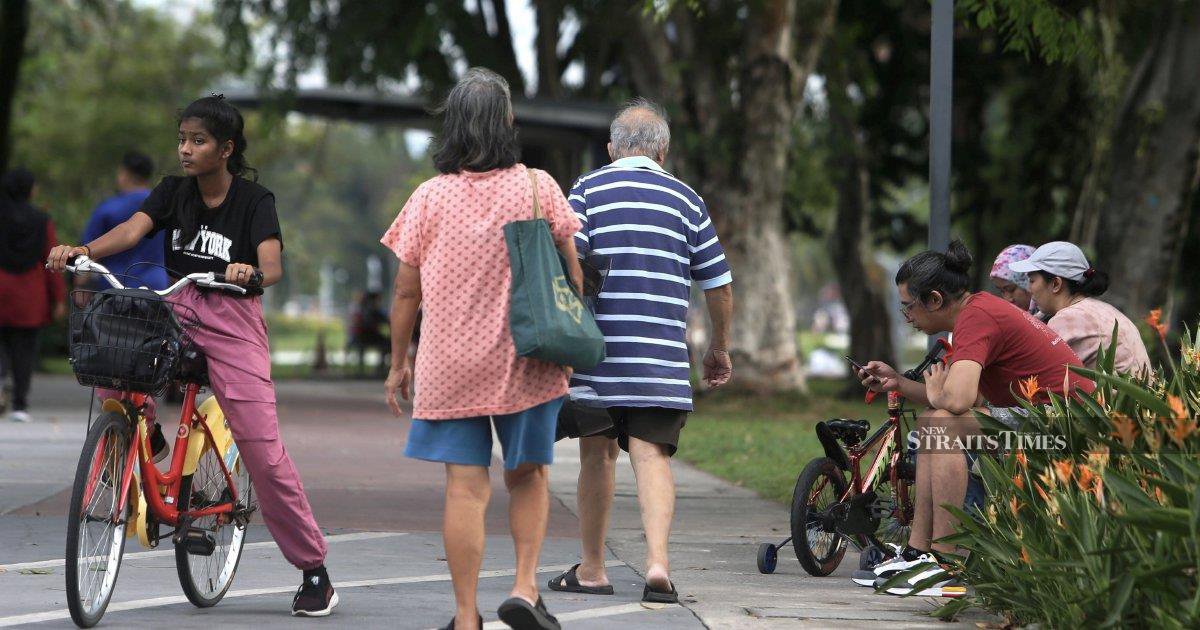

LETTER:By 2030, Malaysia will have entered the ranks of ageing societies, with nearly five million people aged 60 and above.
This is a demographic milestone and a profound transformation of how we live, work, care and organise our economies.
Our response remains largely defensive. Ageing is discussed principally in terms of pension liabilities, healthcare expenditure, dependency ratios and the financial burden on families.
But framing ageing exclusively as a welfare problem obscures an opportunity of extraordinary economic and social significance.
The emerging silver economy – the goods, services, technologies and infrastructure serving older people – is becoming one of the world’s most consequential economic frontiers.
China offers a striking illustration. It sees its silver economy as a new growth driver estimated at around seven trillion yuan (approximately US$1 trillion) in 2024.
Projections suggest it could reach RMB30 trillion by 2035, equivalent to around 10 per cent of China’s GDP.
What is emerging is not simply a market for nursing homes and medical services, but an ecosystem encompassing assistive technologies, robotics, smart homes, accessible transport, financial services, lifelong learning and new forms of employment.
We need to rethink ageing itself. Malaysia has considerable advantages.
It possesses an established healthcare sector, a multilingual population, relatively competitive operating costs and growing digital infrastructure.
Its location within Asean offers access to a regional market whose demographic transition is already underway.
Yet Malaysia has barely begun to articulate what a national silver economy might look like.
We lack a comprehensive assessment of its market potential, an integrated strategy for developing ageing-related industries, and a framework connecting innovation, investment, care provision and employment.
Retirement security remains precarious for many. Families struggle to reconcile employment with caregiving. Informal care facilities operate in regulatory grey zones.
Older people encounter neighbourhoods, transport systems and public spaces that are often inaccessible or hostile to their needs.
These are not simply social-sector problems. They represent unmet demand, lost economic opportunities and failures of public policy.
Artificial intelligence could fundamentally change the economics of ageing.
China’s pursuit of AI and robotics is driven by multiple strategic considerations, including technological competition and industrial productivity.
But its demographic transition adds another important dimension.
As the population ages and the workforce contracts, automation becomes increasingly important not merely for economic competitiveness, but for sustaining productivity and care.
AI-enabled technologies can support fall detection, medication management, remote monitoring, predictive healthcare and assistive robotics.
They can help older people remain independent for longer, while enabling caregivers and healthcare professionals to work more effectively.
Crucially, technology should extend human care, not replace it. Ageing is also about loneliness, dignity, belonging and human relationships.
Malaysia’s investments in AI infrastructure present an opportunity we should not squander.
Beyond hosting data centres, we could develop regional capabilities in multilingual eldercare technologies, intelligent home systems, digital health services and AI-assisted care management.
Our universities, technology companies and healthcare institutions could collaborate to develop solutions relevant not only to Malaysia, but to the wider Global South.
Consider the popular proposition of ageing in place – allowing older people to remain in their homes and communities rather than institutional care. It is an attractive principle.
But what does it mean in a neighbourhood with broken pavements, inaccessible public transport, unsafe public spaces, poorly maintained lifts and weak community support?
The silver economy cannot flourish in a society where the public systems necessary for its development remain dysfunctional. Malaysia still has time to act.
But the window is narrowing. We need a national silver economy strategy that connects industrial policy with social policy; mobilises private investment while professionalising care; harnesses AI while protecting dignity; and develops age-friendly communities as productive, inclusive places rather than merely spaces for managing dependency.
The silver wave is coming. Ageing will test the quality of our institutions and also reveal the limits of our imagination. The question is whether Malaysia will merely grow old or grow wiser.
DR SHAHRIDAN FAIEZ
Think City, Kuala Lumpur