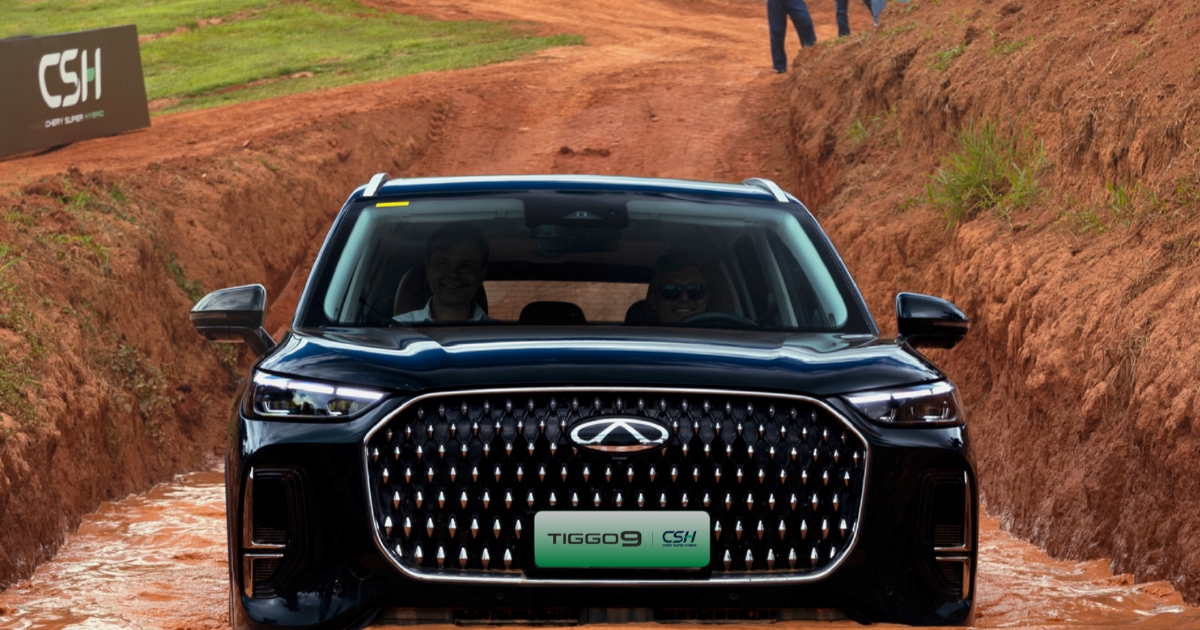

KUALA LUMPUR: Chery has put its flagship seven-seater sport utility vehicle (SUV), the Tiggo 9 plug-in hybrid electric vehicle (PHEV), through more than 50 water-crossing tests within 24 hours in Brazil.
This is part of the Chinese carmaker’s global vehicle safety assessment programme.
The tests were designed to assess the vehicle’s ability to withstand heavy rainfall and flooded roads, conditions commonly experienced in monsoon-prone markets such as Malaysia, Indonesia and Thailand.
During the Chery Global Safety Challenge in Brazil, the Tiggo 9 PHEV completed three consecutive water crossings at speeds of 10kph, 20kph and 30kph, before undergoing more than 50 crossings within a 24-hour period.
Following the tests, inspections found no water ingress into the battery pack or vehicle systems, while battery temperatures remained within normal operating levels.
The vehicle’s insulation resistance exceeded 500 megaohms, with no warning lights triggered. It also started and operated normally throughout the evaluation.
The SUV, equipped with all-wheel drive and multiple driving modes including Sand, Snow, Mud and Off-Road, was put through the exercises to demonstrate its performance under challenging driving conditions.
The Tiggo 7 and Tiggo 8 models also took part in the programme, undergoing track and off-road challenges to demonstrate their handling stability and ability to navigate difficult terrain.
Chery Brazil marketing director Jan Telecki said the safety challenge was intended to demonstrate how the company’s vehicles could handle unexpected driving conditions through real-world testing.
“Choosing an SUV for your family is about more than performance or space. It is about the confidence and peace of mind that your vehicle can handle unexpected situations when they arise.
“The Global Chery Safety Challenge here in Brazil allows us to demonstrate that confidence through real-world testing and measurable results,” he said.
The Brazil exercise is part of Chery’s wider global initiative to assess vehicle safety across different operating environments.
Previous exercises included a 53-hour saltwater immersion test involving a Tiggo 8 PHEV battery in Indonesia and an extreme battery burn test in Malaysia, where the battery was exposed to temperatures exceeding 1,000 degrees Celsius.
Last month, the company also conducted a truck-collision test involving the Tiggo 7 in China.
Separately, the Tiggo 7 has secured five-star safety ratings from C-NCAP, Euro NCAP, ANCAP and Asean NCAP.
It also received four accolades at the Asean NCAP Grand Prix Awards 2026, including the Excellence Award for Best SUV.