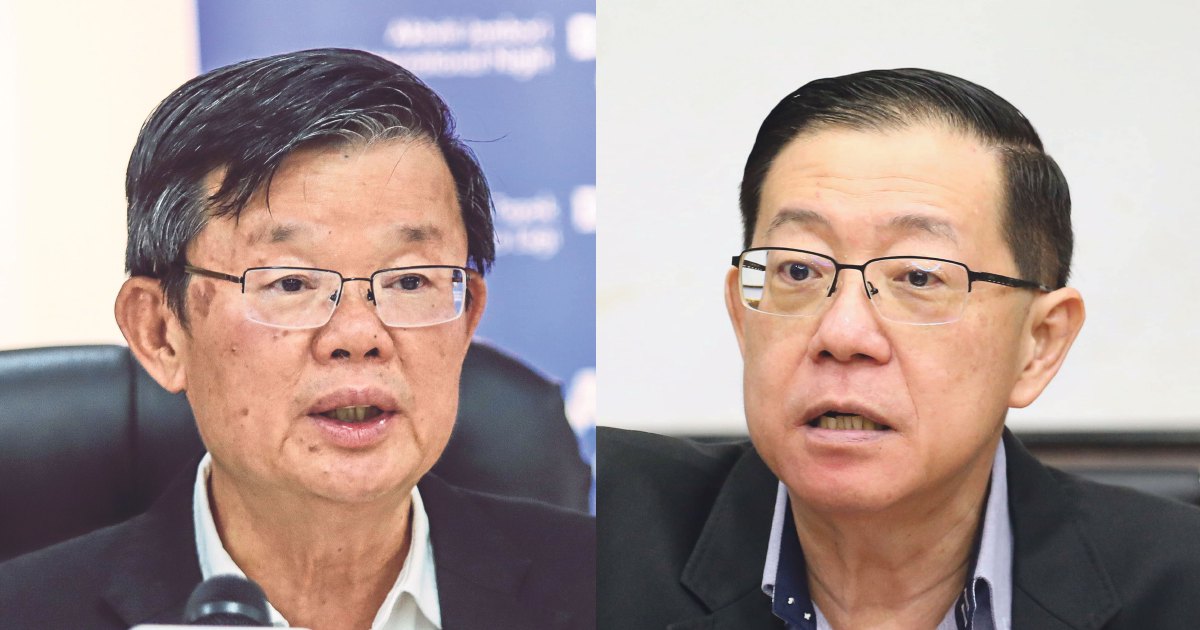

GEORGE TOWN: Chief Minister Chow Kon Yeow has rebuked Bagan member of parliament Lim Guan Eng for misleading the public over the Perak-Penang Bulk Water Supply Agreement (BWSA).
Chow, who is also PBA Holdings Bhd (PBAHB) and Penang Water Supply Corporation (PBAPP) chairman, said Lim’s repeated attacks ignored explanations already given to state assemblymen and shareholders.
“It is completely irresponsible for Bagan MP Lim Guan Eng to disregard explanations that have been repeatedly given and continue to mislead the public regarding the BWSA between Perak and Penang,” he said today.
Yesterday, the former Penang chief minister criticised Chow and state executive councillor Zairil Khir Johari over Penang’s obligation to pay RM210 million annually to Perak, regardless of the amount of water supplied.
Lim demanded an explanation for why PBAPP must pay RM210 million annually for 40 years, amounting to RM8.4 billion, even if Perak fails to supply any treated water.
Chow noted that the agreement was thoroughly debated during two previous state legislative assembly sittings, besides being detailed to assemblymen in special PBAPP briefings.
Shareholders were also briefed via a circular ahead of PBAHB’s extraordinary general meeting on Nov 12, where the BWSA received 98 per cent approval.
Chow said Lim had failed to offer any viable alternative despite Penang’s surface water resources reaching full utilisation by 2030, with demand projected to exceed 1,100 million litres per day (MLD) by 2032.
Internal PBAPP estimates showed that desalination, the next best option, would cost over RM25 billion for a 300 MLD plant with a 20-year lifespan, he said.
In contrast, the 40-year BWSA between PBAPP and Prasarana Air dan Irigasi Perak (PAIP) to supply between 300 and 500 MLD of treated water carries a total capacity charge of RM8.4 billion, or RM210 million annually.
“If the agreement between Perak and Penang is deemed unprofitable, wouldn’t the people of Penang suffer a much greater loss if large-scale water desalination were implemented?” he asked.
Addressing concerns raised by five dissenting PBAHB directors regarding payment terms and Perak’s State Interest Clause, Chow clarified that Penang’s interests are heavily safeguarded.
He explained that PAIP bears all upfront construction costs of RM3 billion and financing risks for the dedicated 500 MLD treatment plant, with PBAPP paying no upfront capital.
Penang will also pay the RM16.2 billion supply charge — part of the total RM24.6 billion deal — only for delivered water that meets quality standards, while PAIP must pay liquidated damages for shortfalls.
“Should supply be suspended for over three months due to non-PBAPP faults, such as severe drought or Perak prioritising its own domestic needs, renegotiations will be triggered.
“If talks fail after another three months, the deal can be terminated with PBAPP paying only a discounted lump-sum balance of the capacity charge at four per cent per annum, rather than paying until 2072,” he said.
Chow said PBAPP can also terminate the contract without further capacity payments if PAIP breaches terms and fails to rectify them within 90 days, becomes insolvent, or loses its licence.