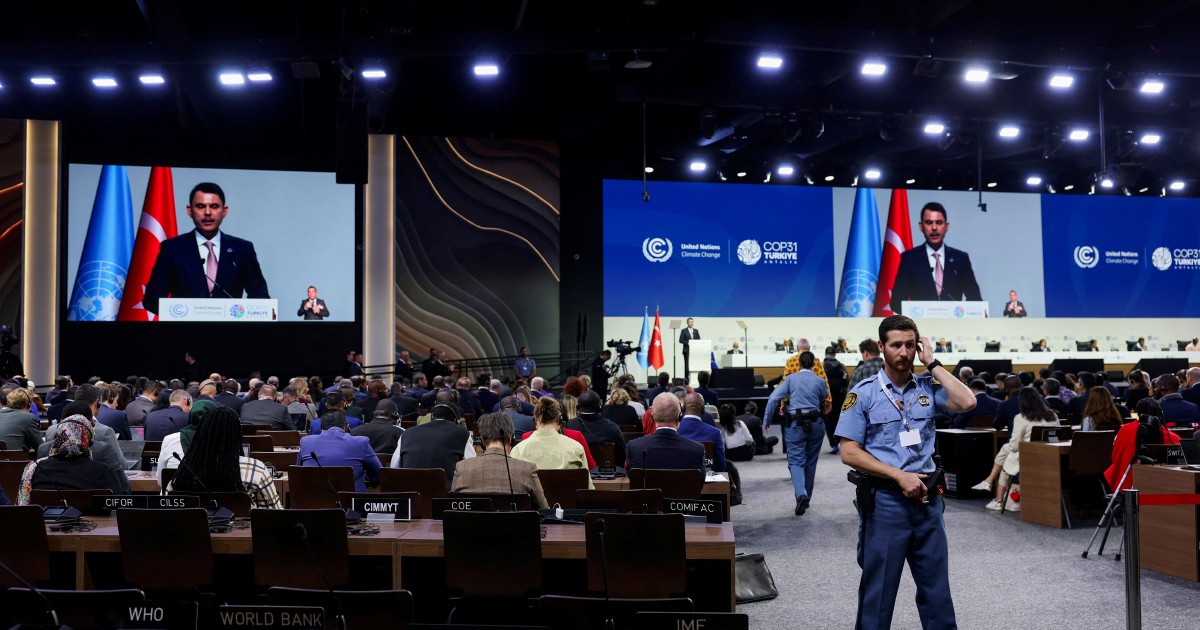

AS delegates attend the 31st cycle of the United Nations’ climate pageantry, officially known as the Conference of Parties (COP), in Antalya, a familiar fatigue hangs over governments worldwide.
Critics question the effectiveness of the COP talks, while detractors ask if it is even necessary at this point.
While their sentiment is understandable, a more pragmatic position acknowledges the inherent limitations of the process while moving the needle forward – however slightly or slowly.
Nonetheless, because of multilayered interests, climate multilateralism has lost its focus as the talks have been co-opted by non-climate interests.
The “co-opting” by broader geopolitical and economic interests can be seen across the three different negotiation areas.
The examples showcase the obvious Global North and Global South divide, and the not so obvious struggle of who gets to dictate the industrial reboot of the 21st century.
First, the corporate hijacking of the just transition agenda threatens climate multilateralism by protecting high-emitting fossil fuel producers from phase-out mandates.
More than 5,300 fossil fuel lobbyists from 859 organisations attended COPs between 2021 and 2024, outnumbering most countries’ delegations.
As a coalition of petro-state lawyers and corporate strategists have surmised, industry survival can be extended with semantics.
In this case, they have successfully shifted the focus of the just transition away from production phase-outs to emission mitigation.
This success bought the industry time and loopholes, validating risky energy sources like hydrogen and dubious emission-reduction technologies that allow the fossil fuel industry to delay net zero to another day.
Ultimately, the climate goals are preserved on paper, while the fossil fuels continue to be extracted from the ground.
Second, the replacement of public climate finance with private finance endangers climate multilateralism by allowing developed countries to outsource their legal responsibilities to the private sector.
The cost of climate change on the Global South runs in the trillions of dollars a year, while the current climate finance target is discounted at US$300 billion a year.
To address the financial discrepancy, Global North countries often note the insufficiencies of their public finance before delegating to private finance that are conveniently headquartered in their countries.
These private actors operate by their own commercial rules, utilising conventional credit frameworks that view Global South countries as high-risk investments and assigning them lower credit ratings that justify high borrowing costs.
Neither Global North countries nor private financiers are willing to admit the structural limits of private finance in climate action.
[[nid:1575037]]
Operating on a piecemeal basis, private finance inherently lacks the coordination and mandate required for multi-decade structural transformation.
In short, instead of treating climate finance to right a historical wrong, proponents of private finance ensure that those who had the least to do with creating the crisis pay the price.
Third, allowing trade protectionism to inform climate negotiations risk fracturing multilateralism by prioritising industrial competitiveness over planetary survival.
Following an unprecedented mandate from the 2025 COP, the climate regime under the UN’s Framework Convention on Climate Change (UNFCCC) began exploring the intersection with global trade, which is an arena typically governed by the World Trade Organisation (WTO).
While seemingly aimed at addressing the climate change impacts on global trade, this new intersectional front could risk introducing competing institutional motivations.
Dialogues are held before official negotiations even begin to align divergent regimes – which exposed a fault line.
With the Global North favouring the WTO’s technical and rules-based forums and the Global South insisting on adhering to UNFCCC’s equity principles, this split gives ground for forum shopping.
Global North countries could bypass climate justice frameworks, opting instead for rules that prioritise trade.
If trade logic supersedes climate diplomacy in these formative talks, subsequent negotiations risk becoming a proxy battleground for trade protectionism under the guise of green stewardship.
To prevent this, the dialogue must anchor itself in UNFCCC principles.
Though the messiness looks typical of diplomatic friction, global climate multilateralism has turned into a high-stakes platform where Global North countries and their allies are increasingly shaping the substance and manner of these negotiations.
The irony, however, is that these powerful forces cannot control the messaging and narrative outside of the negotiation rooms because they cannot compel an increasingly sceptical and worried public.
For Malaysia at COP31 in Antalya, the path forward is to anchor negotiation strategies in domestic realities – such as capacity and financial gaps – and leverage the second Global Stocktake (GST-2) to systematically evaluate and expose policy loopholes utilised by Global North delegations.
As a comprehensive climate action progress report, GST-2 will dictate the trajectory of climate action over the next five years.
Until climate multilateralism is course-corrected, a hall in Antalya at COP31 will draft another elaborate mandate to chronicle what could have been and what should have been done.
- The writer is senior researcher at Institute of Strategic & International Studies (ISIS) Malaysia