
OUTSIDE China, the country’s rapid technological rise is sometimes seen as something to be feared.
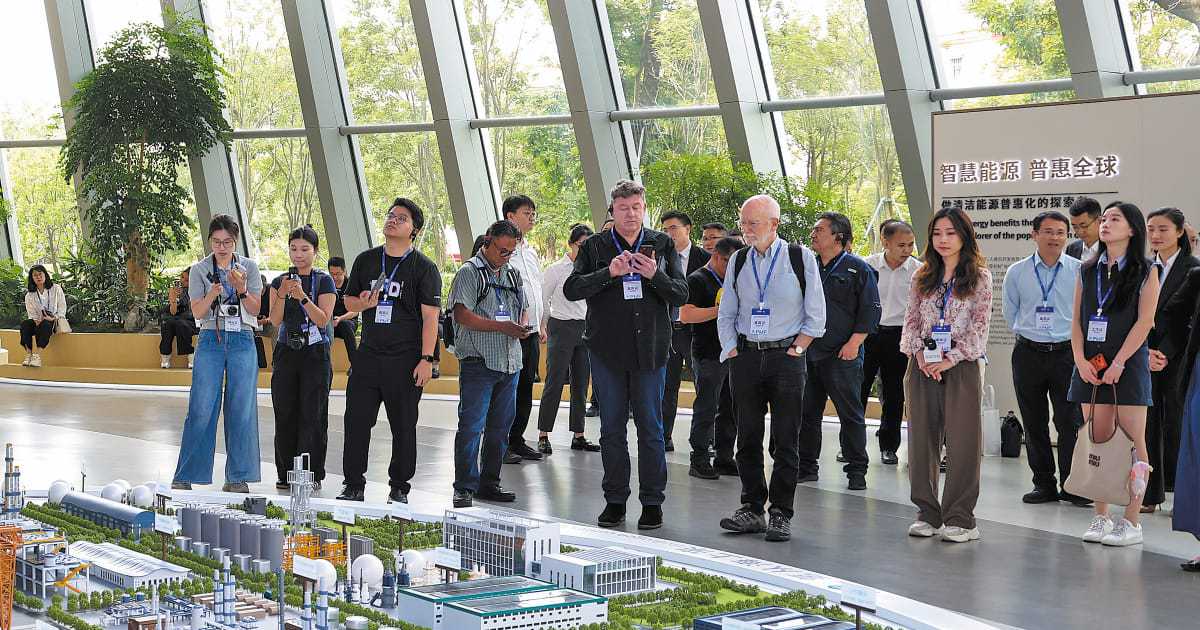
On the ground in the Guangdong-Hong Kong-Macao Greater Bay Area in South China, visiting journalists, scholars and officials from across the Asia-Pacific were recently greeted by a much more benign reality: automated ports, AI-powered grids and replicable sustainable urban development that promise to make the world a better place.
Hosting forums and field tours alongside this year’s APEC Economic Leaders’ Meeting, the city of Shenzhen has become a testing ground for how firsthand exposure stacks up against longstanding narratives and stubborn prejudices.
Yasiru Ranaraja, founding director of the Belt and Road Initiative Sri Lanka, recently visited Guangdong’s capital, Guangzhou, a hub in the Greater Bay Area.
Ranaraja, touring the Nansha Port Phase IV Fully Automated Terminal and the Guangzhou Nansha International Logistics Centre, looked at how integrating technology and logistics into international trade creates broader opportunities across the Asia-Pacific and beyond.
“It is a very modern arrangement they have done here, because in this supply-chain cargo business, what is most important is time,” he said.
“That’s because the ship cannot wait for a long time, so whoever can do it very efficiently can win market capacity.”
Other countries should study these management models developed in China to see if they can be implemented locally, because “the benefits will go to the people of that country and the world”, Ranaraja said. “That is what is important. You can get the lower prices in products, and then eventual benefit will come to your people.”
After touring Shenzhen, Ranaraja said he was also impressed by the city’s public spaces, including its well-furnished parks, museums and riverbank walking lanes.
“That is something good that your policymakers and government officials are doing — making public spaces much more efficient.”
The economic backdrop to all this is Shenzhen’s flourishing trade with APEC economies, the value of which has risen more than tenfold over 30 years, from 267.5 billion yuan (US$40.1billion) in 1996 to 3.13 trillion yuan last year, according to the Shenzhen Special Zone Daily. For international observers touring the region, street-level reality is now reflecting those figures.
On a tour of the Greater Bay Area, Aman ul Haq, controller of international relations for Pakistan Television Corporation in Islamabad,pushed back against the negative portrayal of China’s technological advances as his Chinese hosts asked him whether Chinese manufacturing represented a shock or an opportunity.
“You can say it is shocking when we see this modernisation, but it is an opportunity for the world. It is very important to replicate these things.”
Mark Beeson, an adjunct professor at the Australia-China Relations Institute at the University of Technology Sydney, is a frequent visitor to China who goes by the
Chinese name “Bi Sheng”, meaning “surely will win”.
Having first visited China in 1990, Beeson called the scale and speed of its development astounding.
[[nid:1587198]]
When he toured Shenzhen in September, he described the city as “amazing”, noting it “has come from nowhere” in roughly 40 years to become “this huge city with modern architecture”.
Calling China’s broader trajectory “impressive”, he pointed to its success in lifting tens of millions out of poverty, tackling climate change and transitioning to green energy.
Rebecca Fannin, founder of Silicon Dragon Ventures of the United States, a news, events and research group covering innovation and investment hubs, has watched firsthand how today’s Chinese technology behemoths were built from scratch.
Attending the Asia-Pacific Media Forum in Shenzhen in September, she toured local high-tech exhibitions on the sidelines, where Chinese reporters asked for her take on the sector.
She pointed to global household names such as the smartphone maker Oppo and the new energy vehicle maker BYD, both based in Shenzhen.
“I remember when Oppo was a baby, and now is an adult,” Fannin said. “Same thing with BYD … Now BYD is getting much more of a global presence.
“I’m happy to say that I was there from when all this was starting.
China is very effective in the business models.
We are definitely seeing this becoming a much bigger story internationally.”
The spectacular rise of the artificial intelligence company DeepSeek of Hangzhou, Zhejiang province, “was a surprise to people in the West”, she said.
“They didn’t expect that China could do that and make a large language model that was very efficient and cost-effective.
“There was a lot of scepticism about China’s innovation.
There is a new respect for China’s innovation that we didn’t see even 10 years ago.”
In Zhuhai, Guangdong province, Anish Chand, managing digital editor of The Fiji Times, was drawn to an AI-powered inspection robotic dog during a visit to the Qinyun smart substation, a power hub linking Guangdong and the Macao Special Administrative Region.
He stopped to snap photos on his phone before squatting beside the robot for a picture with a thumbs-up.
“I have seen robots on YouTube videos, but this is the first time I have seen one live,” he said.
Such technology could significantly boost industrial development in his country, he added.
Muhammad Zahir Shah, director of news at Pakistan’s Bol TV, made his first visit to China this year and called its AI-hybrid engagement “revolutionary”.
“Especially the green ecology, I think the same green ecology and low-carbon industry experiment can be duplicated in Pakistan. Pakistan can benefit a lot,” he said.
John Wallace, an adviser at the Asia Pacific Journalism Centre in Melbourne, Australia, an organisation whose mission is to promote quality journalism, said during a recent visit to Guangdong that the notion that China poses a threat to the world gets a lot of space in Australian media.
“The thing about coming to China is you can see the genuineness and the enthusiasm of people here, to do the right thing as a global citizen — and that is a terribly important message to convey to other countries.”
Wallace stressed the value of “bringing people together, providing opportunities for people from other countries to see what China is doing and how genuine it is.”
[[nid:1587197]]