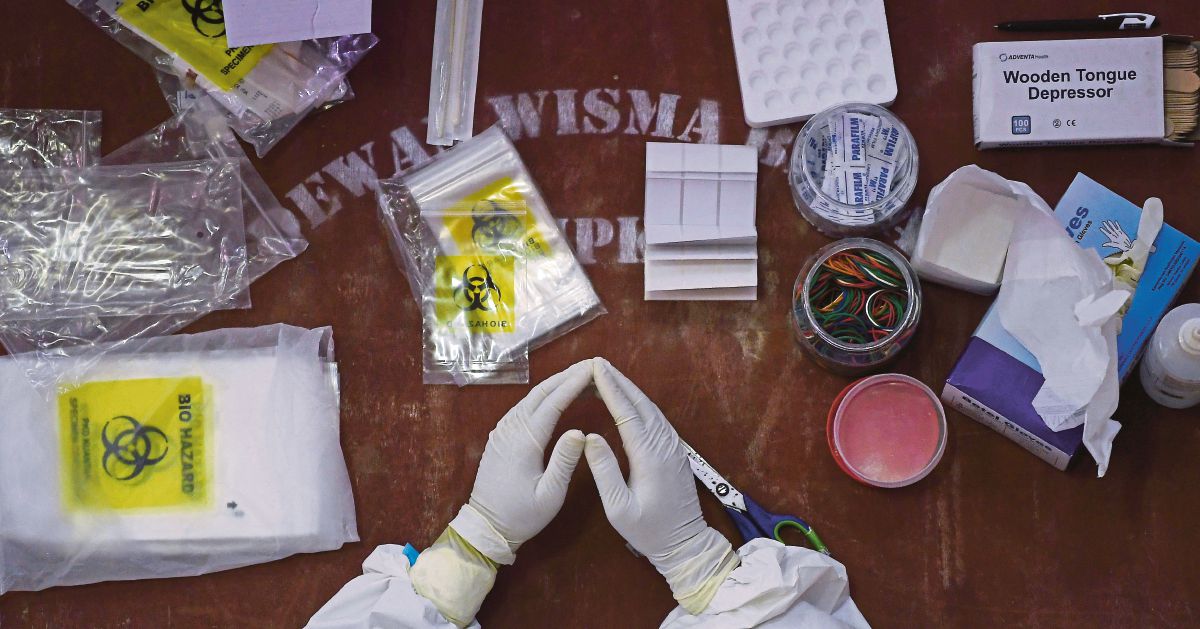

GEORGE TOWN: Covid-19 has never disappeared, and the recent uptick in cases reflects expected viral mutation cycles rather than a fresh health crisis.
Universiti Sains Malaysia’s (USM) Institute for Research in Molecular Medicine virologist Dr Kumitaa Theva Das said the virus continued to circulate and there was no reason for alarm.
Citing the World Health Organisation (WHO) Covid-19 dashboard, she said the proportion of positive test samples had remained between one and four per cent throughout the year.
“The percentage of samples testing positive for Covid was close to four per cent at the beginning of this year, dropped to one per cent mid-year, and is now inching back up to four per cent.
“As a comparison, at its peak, close to 45 per cent of samples tested positive. So, while there are reports of an increase in cases, it is still relatively low,” she said in an interview.
With the emerging PJ.2.1 Covid-19 strain presenting symptoms similar to those of a common cold or influenza, the World Health Organisation (WHO) said testing remained essential for proper diagnosis, Sputnik/RIA Novosti reported.
Addressing regional concerns over the PJ.2.1 subvariant, Kumitaa said it remained part of the Omicron family, with minor mutations in its spike protein that could make it easier to enter cells.
“However, a recent study of circulating variants worldwide found that it was broadly similar to NB.1.8.1 and XFG, variants that have been circulating globally since 2024 and 2025.
“In other words, it does not seem to be more dangerous than earlier variants,” she said, adding that the latest Pfizer vaccine (Comirnaty LP.8.1) appeared to offer good protection against PJ.2.1.
While neighbouring countries have detected the subvariant, Malaysia has not officially recorded any PJ.2.1 cases.
However, this could reflect reduced community surveillance rather than the variant’s complete absence, Kumitaa said.
“That does not mean it is not already here in Malaysia. It could just mean that we are not getting tested like we used to.
“These days, when anyone has flu-like symptoms, they often assume it is flu and not Covid. There are no indicators that this would lead to a huge spike in cases or a wave of infections,” she said.
With the year-end holidays approaching, Kumitaa advised vulnerable groups to remain cautious.
She said PJ.2.1 has been shown to mainly affect those aged 70 and above.
“People in this age group may consider wearing masks as a precaution.
“Likewise, those who might meet individuals in the high-risk group should postpone get-togethers or meet-ups if displaying any flu-like symptoms.
“We should always be mindful, but there is definitely no reason to panic,” she added.