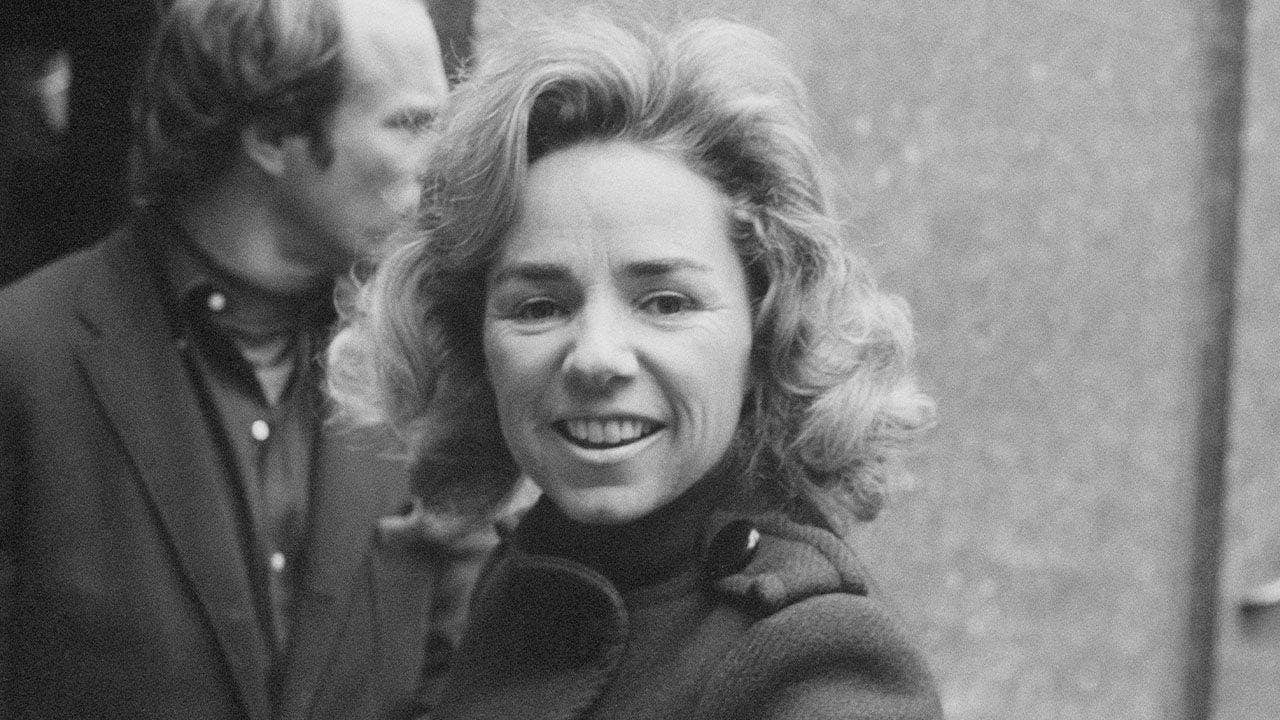

Ethel Kennedy was a high-society wild child in the ’60s, according to her daughter.
Ethel was the matriarch of one of America’s most prominent political dynasties and the devoted wife of the late Sen. Robert F. Kennedy, with whom she raised 11 children.
Known for her boundless energy, irreverent humor, and deep Catholic faith, she turned the couple’s Hickory Hill estate into the lively social epicenter of 1960s Washington. Following her husband’s 1968 assassination, she channeled her personal resilience into decades of dedicated human rights advocacy, carrying forward his legacy until her death in 2024 at 96.
Ethel and RFK’s daughter, Kerry Kennedy, detailed her late mother’s life in the biography, “Ethel Kennedy: The Extraordinary Life and Bold Legacy.”
TATIANA SCHLOSSBERG, JFK’S GRANDDAUGHTER, DIES AT 35 AFTER YEAR-AND-A-HALF LEUKEMIA BATTLE
may be compensated for or earn a commission if you buy through our referral links.
Below are some of the biggest revelations from the late Kennedy’s life.
Kerry wrote extensively about her mother’s philosophy on fun and Ethel’s ties to Hollywood.
Kerry described her mother as “the original merry prankster, the life of the party,” noting she was raised very differently from the formality of the Kennedys. Kerry wrote that her mother “never lost her wild streak.”
Kerry also detailed a moment after John F. Kennedy and Jacqueline Bouvier’s engagement. The couple hosted a scavenger hunt and one of the guests took a policeman’s hat off his head.
LIKE WHAT YOU’RE READING? ENTERTAINMENT NEWS
“Needless to say, the police were not amused,” Kerry wrote. “Before long there were three squad cars with lights flashing parked in the drive, with a furious Grandpa Joe trying to sort out the trouble. (As Mum would later say: ‘It isn’t a party unless the police are called.’)”
Hickory Hill became notorious for hosting some lively parties, often ending with guests in the pool.
Kerry wrote that Sen. Barry Goldwater recalled that one of his invitations read, “Black tie and snorkel.”
“Daddy would observe these antics with quiet amusement, until Uncle Jack sent a message to end the dunkings, which were getting press coverage,” Kerry wrote.
Kerry recalled Ethel’s decision to seat historian Arthur Schlesinger Jr. next to Judy Garland, using her birth name, Frances Gumm, on the place card.
“It wasn’t until dessert that he finally asked what Frances did. She said, ‘I am an entertainer.’ He asked, ‘What sort of entertainment?’ She said, ‘I sing and dance a bit.’ Arthur asked, ‘What do you sing? Maybe I have heard of it.’ She said, ‘‘Over the Rainbow,’” Kerry wrote.
Kerry also wrote about her late father’s 40th birthday party. Gene Kelly, a prominent actor at the time, hid in a rug and popped out to surprise the guests.
“At a party for Daddy’s fortieth birthday, in 1965, he disappeared during dinner and reappeared with two friends, carrying a rolled-up rug with a ribbon around it,” Kerry wrote. “Mum unwrapped the ribbon and discovered Gene Kelly inside, who then danced across the living room with her.”
In the ’50s, Ethel and RFK had a three-month honeymoon in Hollywood. Kerry wrote that stars kicked off their stay with a dance.
“My parents kicked off their three-month honeymoon in Los Angeles, where the couture designer Oleg Cassini and the actress Gene Tierney threw a dinner dance for them that was awash in glitter,” she wrote. “Everywhere you turned, there was a Hollywood star,’ Mum wrote.”
Rose Fitzgerald Kennedy was Ethel Kennedy’s mother-in-law, the wife of family patriarch Joseph P. Kennedy Sr. and the mother of President John F. Kennedy, Senator Robert F. Kennedy, Senator Ted Kennedy, and six other children.
Rose often gave Ethel brutal mother-in-law critiques that were preserved in unvarnished letters.
Kerry wrote a lot about her grandmother, specifically about how she influenced Ethel. She recalled that Rose used to leave letters for Ethel and comment on her miniskirts in the ’60s.
PUT YOUR ENTERTAINMENT KNOWLEDGE TO THE TEST AND SEE HOW YOU SCORE
“Ethel Dearest . . . Dresses are still short, as you know, but I am told [they should be] longer in the back to cover the unattractive part of the knee . . .,” Kerry wrote. Rose would also gift Ethel perfume, writing, “Ethel dearest, Think you should try some more highly sophisticated perfume now, so we are sending this with all our love, Grandma and Grandpa. You are just wonderful.”
In 1967, Rose sent a mass correction to her adult children, including sitting U.S. senators: “I noticed that, when saying the word ‘didn’t’ you were not enunciating the letter ‘t’ and instead were saying ‘didn.’ I suggest that… you eliminate the habit.”
Rose also clipped a magazine ad about sun damage and mailed it to Ethel with a scrawled critique: “You will be looking old and weather-beaten like a sailor, Ethel.”
Kerry recalled Ethel’s summary of her mother-in-law as, “Mother Superior, Eleanor Roosevelt, Amy Vanderbilt, Heloise, Elsa Maxwell, Ann Landers and Dr. Spock all rolled into one.”
Following RFK’s 1968 assassination, strangers constantly approached Ethel in public to recount where they were when he was shot, involuntarily pulling her right back to the Ambassador Hotel kitchen pantry, according to Kerry.
Her silent coping mechanism was to look into the distance, smile, and change the topic.
At the funeral train, Kerry recalled that Ethel offered a comforting hand to the guests even though she was grieving herself.
“She walked up and down the aisle, car after car, greeting old friends, comforting them in their grief, even as her own grief must have been overwhelming. ‘I haven’t seen you in so long,’ she told one passenger. ‘Thanks for coming.’ She patted the back of another who was bent over in sorrow. ‘We’ll cry later,’ she said,” Kerry wrote.
Kerry wrote that Ethel’s Catholic faith kept her grounded after RFK’s assassination, and the “six months of just blackness” after JFK’s assassination.
“Mum described going to Mass as ‘the anchor of my life, a daily nurturing. With all the vicissitudes of life I think we’d go wacky without something solid at the center. It is the time of my day that is not a whirlwind. A time to be quiet,’” Kerry wrote.
Kerry also emphasized that throughout Ethel’s life, she had a philosophy on moving forward and not dwelling on the past.
“‘I think life has different chapters. I don’t really look back; I am living this one chapter today and looking forward to the next,’” Kerry wrote of her mother’s philosophy in her own words.