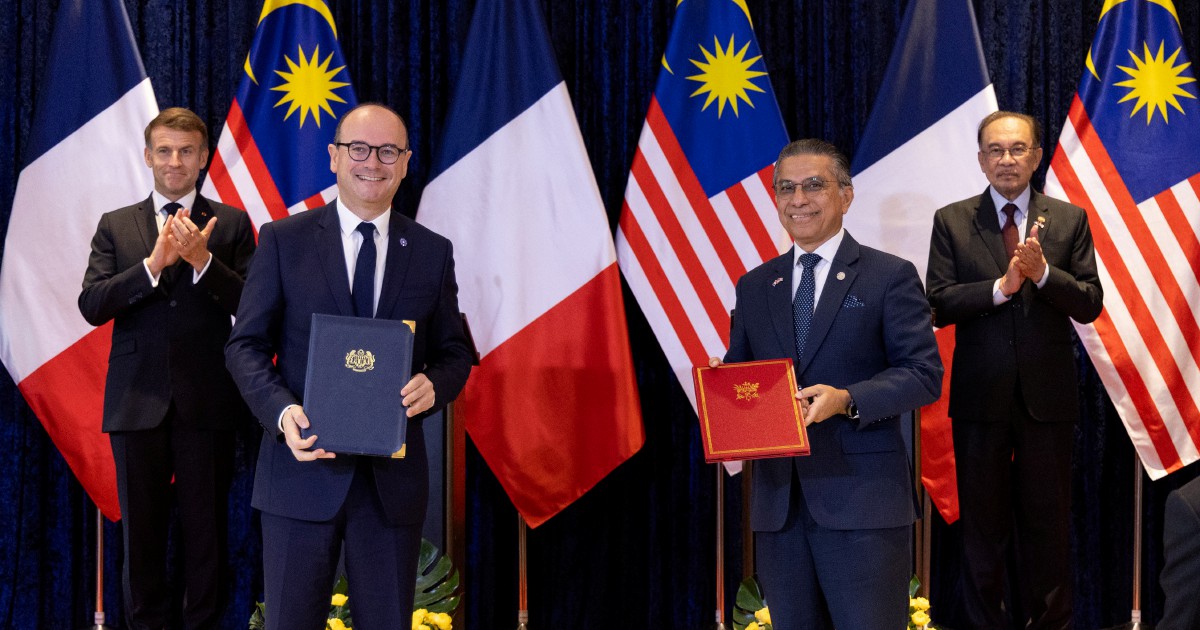

LETTER: When French President Emmanuel Macron visited Malaysia and shook hands on a rare earths partnership, many Malaysians cheered.
Finally, someone from Europe wants to help us move beyond digging up rocks and shipping them overseas.
But, let’s ask a simple question: does France actually have what it takes to help us?
France used to run a rare earths processing plant in La Rochelle. It stopped operating years ago.
The reasons were simple — prices fell, and the recycling business that fed it dried up when old fluorescent lamps gave way to LED lights.
So when people hear “France has a rare earths facility,” they should know it’s not humming along at full speed today.
To be fair, France is now trying hard to restart that engine. The French government has announced big plans to rebuild its rare earths industry, with money set aside for refining and even making magnets.
The company working with Malaysia, Carester, is part of that push. But France is not offering to build a full factory in Malaysia that turns rocks into finished magnets for electric cars and wind turbines.
That matters because we don’t want to be a quarry forever. We want the factories, the skills, the high-value jobs. So any partnership should be judged by one question: does it help us climb that ladder?
The good news is there’s a sensible middle ground. France’s real strength is in separating and purifying rare earths—the messy middle step that most countries can’t do.
Pairing French know-how with Malaysian resources and speed is a fair deal, as long as the technology transfer is real and not just a line in a press release. The Perak plant, which involves Carester, includes promises of skills transfer and local training.
There’s also a less glamorous but smarter opportunity: recycling. Old electronics, old magnets, old motors — they’re full of rare earths. A joint recycling project could give both countries valuable materials without digging new mines.
However, France’s own magnet-making industry is still tiny. When Macron talks about refining “at home,” he means France keeps some of the good stuff for itself.
Meanwhile, Malaysia’s real magnet factory is already being built in Kuantan — by Lynas and a Korean company. So France is a useful partner, but it’s not the only suitor, and it’s certainly not the whole answer.
Nevertheless, the France-Malaysia rare earths deal is a reasonable, middle-of-the-road partnership between two countries that want to depend less on China.
France brings genuine refining skills and a European market. Malaysia brings resources and determination.
But Malaysians should measure this deal by whether French companies actually train our engineers, build real facilities here, and help us make magnets — not just ship our rocks to Europe.
A good partner doesn’t just take your resources — it helps you build something lasting.
PROFESSOR DATUK DR AHMAD IBRAHIM
Tan Sri Omar Centre for STI Policy
UCSI University