
MHIA Farhana was in the shower, music blaring from her phone, when it started ringing. Her mother was video-calling her. The phone rang repeatedly, while messages began flooding the family group chat.
“I was like, ‘What’s going on?’ I was actually kind of scared because… did I do something wrong?” she recalls, her brows knitting together.
When she finally answered, her mother’s face was beaming with pride. The reason for all the excitement soon became clear: The 20-year-old had earned a nomination for her role in Sayang Sayang at the 63rd Golden Horse Awards, scheduled to take place in Taiwan on Nov 22.
A Malaysian-Taiwanese drama directed by Taiwanese filmmaker Tang Hsiang-Chu, Sayang Sayang explores love, identity, family expectations and acceptance through the lives of three deaf young people from different cultural backgrounds growing up on Malaysia’s East Coast.
“Even now, it still feels surreal,” exclaims Mhia.
It’s an extraordinary moment for a young actress whose introduction to the performing arts came much earlier, not through an audition or a film set, but by watching her mother bring characters to life.
[[nid:1577991]]
There is, however, one childhood question that continues to follow her.
“How do people cry when they act?”
It was a question she repeatedly asked her mother, Malaysian actress Farah Ahmad, who offered an answer that was perhaps more profound than any acting lesson.
“You have to find it.”
At the time, Mhia was simply a curious little girl trying to understand how someone could summon tears on demand. Today, those four words carry a different significance as she navigates a profession that requires her to look beyond the script and find something truthful in the characters she portrays.
BEFORE THE CURTAIN RISES
[[nid:1577990]]
Growing up, Mhia was often brought along to her mother’s rehearsals and performances. She and her sisters sometimes joined Farah on stage during curtain calls, standing among the performers as the audience applauded.
The stage was hardly an unfamiliar place, and like any inquisitive child, she had questions about what went on behind the performances.
For little Mhia, making an actor cry was, perhaps, the most impressive feat of all. But her mother’s response was not a demonstration or a set of instructions. Instead, she told her that the emotion had to come from within.
Mhia tried to make sense of this in the simplest way she knew, practising different expressions in front of a mirror and attempting to understand how an actor could bring an emotion to life.
Her early understanding of the craft was also shaped by the performances she watched.
One that stayed with her was Nyanyian Angsa, in which her mother portrayed a prostitute searching for her way in life. The production was directed by her grandmother, Datuk Fauziah Nawi.
[[nid:1577989]]
Although young, Mhia remembers sensing that there was more to the character than what unfolded on stage. She began to recognise that people didn’t always have the freedom to choose the circumstances they found themselves in.
It was an early glimpse into the complexities of human experience, and the realisation that a character’s life could be vastly different from that of the person portraying it.
For Mhia, this is part of what makes performing meaningful. Sometimes, a movement, an expression or even a silence can communicate what words cannot.
But watching someone perform and becoming a performer herself are two very different experiences. The latter, she discovers, demands a willingness to be vulnerable, experiment and, occasionally, confront her own insecurities.
FINDING HER OWN NAME
[[nid:1577988]]
One might assume that growing up in a family immersed in the performing arts makes the decision to pursue acting an easy one. For Mhia, however, the reality was more complicated.
Conversations around the family dinner table often revolved around the realities of the industry, including its uncertainties and challenges. After completing her Sijil Pelajaran Malaysia (SPM), she began questioning whether acting was a practical career choice.
She enjoyed performing, but turning that passion into a livelihood was another matter.
At times, she even found herself feeling guilty for wanting to pursue something she knew could be difficult to sustain. Yet whenever she performed, she experienced a sense of comfort and peace that was difficult to find elsewhere.
Her first acting role came at 16, when she portrayed Tun Fatimah in a production at the International Islamic University Malaysia (IIUM).
Having a mother and grandmother who were established figures in the performing arts offered her a certain familiarity with the industry, as well as access to networks and opportunities. But it also came with expectations.
[[nid:1577987]]
Mhia is candid about the label of being a “nepo-baby”, acknowledging that her background has opened doors while recognising that she still has to establish herself on her own merit.
“I won’t say being a nepo-baby is harder,” she says, adding: “But the hard part is trying to prove yourself that you’re there because of your own efforts, and also trying to stand on your own name.”
Even when attending acting classes conducted by her mother and grandmother, she received no special treatment.
[[nid:1577986]]
Instead, her mother challenged her creative choices, reminding her that what she considered an original approach might actually be the easiest way of interpreting an idea.
It’s an important distinction for someone growing up in the shadow of two generations of performers.
Mhia wants to respect the legacy she inherits, but she’s equally conscious of the need to develop a voice of her own.
She believes younger performers have a responsibility to bring fresh perspectives into the industry, particularly through the stories they choose to tell. Art, says Mhia, should do more than entertain. It should invite audiences to reconsider what they think they know and perhaps see familiar issues through a different lens.
“It has to come from the heart because… it has to be meaningful,” she muses softly.
BECOMING SOMEONE ELSE
[[nid:1577985]]
Her role in Sayang-Sayang offered a significant test of that belief.
Mhia plays Mina, a deaf and non-verbal young woman living on the East Coast. Preparing for the character took her beyond the experiences she knows, requiring her to learn unfamiliar skills and immerse herself in a different way of life.
Her preparation included Muay Thai, diving and learning sign language. Muay Thai proved challenging, but the physical demands were only one part of the process.
There was also the responsibility of portraying someone whose lived experiences are different from her own.
Mhia is conscious that learning a few skills and preparing for a role cannot fully replicate another person’s reality. She describes the understanding she gained as probably just “one per cent” of what it means to live with Mina’s experiences.
It’s a measure of humility that she hopes will guide her portrayal, particularly when representing a character from a community whose experiences deserve to be treated with care and respect.
For her, the challenge wasn’t simply learning how Mina moves or communicates, but recognising that there was a person behind those actions, with a life and experiences that extended beyond what the script revealed.
[[nid:1577984]]
The demands of the production extended beyond the set, too.
Filming in Terengganu and Kelantan meant juggling her acting commitments with university studies. During breaks in the production schedule, she travelled back to Kuala Lumpur for classes before returning to the set.
It was a physically and mentally exhausting routine, especially while navigating the expectations that came with a demanding role.
“I was really tired during that semester,” admits Mhia.
Yet the experience also offered her an opportunity to discover what she was capable of, both as a performer and as a young woman learning to manage competing responsibilities.
KEEPING TRADITION ALIVE
[[nid:1577983]]
Mhia’s journey as a performer isn’t only confined to the screen. Her encounters with traditional Malay performing arts have also challenged her understanding of what it means to inhabit a character.
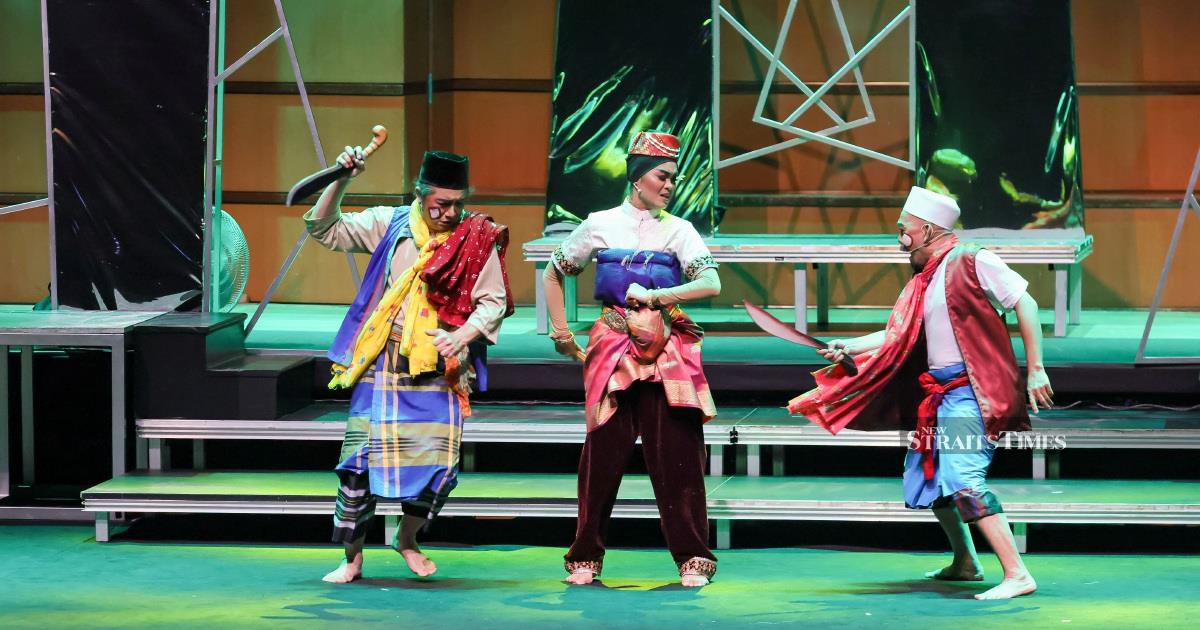
During her first semester at university, she performed in Mek Mulung, a traditional Malay dance-drama originating from Kedah.
Her lecturer noticed that she was approaching the performance as though she were acting for television. On screen, a slight shift in expression could communicate what a character was feeling. On stage, however, gestures had to be more expansive, carrying the emotion across the auditorium to reach audiences seated further away.
The learning curve became even steeper when she took on the role of Pak Yong. Struggling with the Kelantanese dialect and the demands of the character, Mhia often questioned whether she was doing enough.
“Dewan Filharmonik Petronas is a prestigious, big hall. So, you have to have that aura and make sure your gestures are big,” recalls Mhia.
The pressure sometimes followed her beyond rehearsals, with some sessions ending in tears as she walked back to campus, wondering how she could improve and do justice to the character.
Looking back, Mhia recognises how different she has become from the little girl who once practised expressions in front of a mirror, seemingly unbothered by the awkwardness of trying something new. “I feel like if my younger self were to do it during rehearsal, she wouldn’t be embarrassed to try anything,” she says.
[[nid:1577982]]
In 2025, Mhia performed Mek Mulung again at the Andong Maskdance Festival, this time before an international audience. Representing Malaysia gave her a renewed appreciation of the cultural heritage she had grown up around.
“We should appreciate more of our arts and culture, and we should really preserve it,” she says.
For Mhia, preserving traditional art forms isn’t simply about keeping old performances alive. It’s also about finding ways for younger generations to connect with them.
In another performance, as Mak Inang, her lecturers encouraged her to incorporate jokes and references that audiences of her generation could recognise. It was a way of creating familiarity without losing sight of the form’s cultural identity.
The experience reinforced her belief that tradition and contemporary expression need not exist in opposition. There’s room for younger performers to bring their own sensibilities into the arts while respecting the foundations on which these forms are built.
Asked what she hopes people will remember about her 20 years from now, Mhia doesn’t speak about awards, accolades or how far her career might take her. “I hope they remember me as someone that’s humble and very respectful,” she replies softly.
It’s a modest aspiration from someone whose name is already beginning to reach a wider audience. But perhaps it also says something about the values she hopes to carry with her as her career unfolds.
Years ago, a little girl wanted to know how actors could make themselves cry. Her mother didn’t offer a formula or a technique. She simply told her to find it. Now, as Mhia continues to discover the many lives and emotions that acting asks her to inhabit, those words remain relevant.
Because becoming a character isn’t just about knowing how to perform. It’s about finding the humanity within the person she portrays and, in the process, discovering a little more of herself.