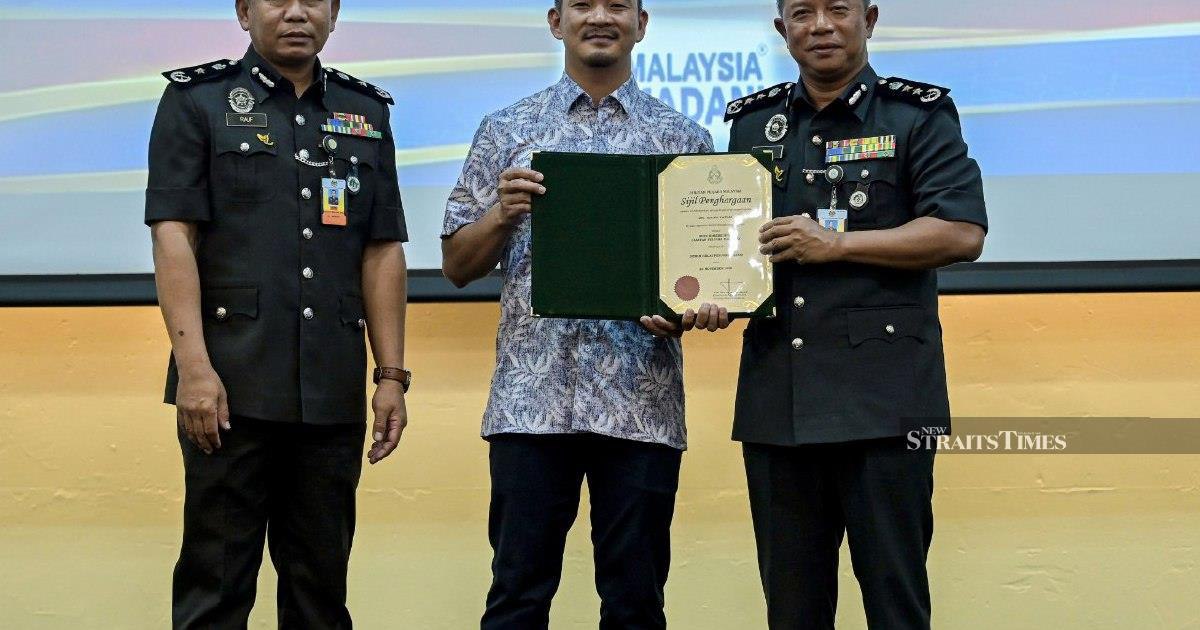

KAJANG: From sitting for the Sijil Pelajaran Malaysia examination behind bars to earning a doctorate, former inmate Dr Malik Yatam’s journey is now inspiring others to believe that prison need not mark the end of their ambitions.
His story was shared with about 200 inmates at Kajang Prison, where he delivered an inspirational talk under the Prisons Department’s Inspira Programme, encouraging them to use their time in prison to pursue education and rebuild their lives.
The programme also highlights the department’s efforts to expand educational opportunities among inmates, with 362 currently pursuing studies ranging from SPM to doctorate level.
Prisons Department Deputy Commissioner-General (Management) Zaidi Hamid said of the number, two inmates were also pursuing doctorate studies and were expected to complete soon.
He said the department worked with education ministry and nstitutions of higher learning, including Open University Malaysia (OUM) and Universiti Pendidikan Sultan Idris (UPSI), to facilitate access to education.
“The education system is almost the same as that offered outside prison. The only difference is that they are deprived of their freedom and materials..
“Lecturers come to the prison according to a scheduled timetable to conduct lectures, provide coaching and supervise the students,” he said.
Also present at the event were Prisons Department Parole and Community Services Division director Mohd Andri Md Ridzwan, Selangor Prisons director Aminon Adnan and Corrective Division deputy director Abd Rauf Lang Pasih.
Malik said he spent almost 24 years in prison after being convicted for murder. He received a royal pardon from the Sultan of Selangor in December 2024.
Recalling his early years behind bars, he said he had endured emotional pressure and isolation, with no family members or lawyers visiting him.
He admitted that he had contemplated ending his life before a change in his outlook following his conversion to Islam.
“I told myself, let me be imprisoned in this world, but I do not want to be imprisoned in the hereafter,” he said.
That realisation prompted him to pursue education, believing that knowledge could give his life a renewed purpose and allow him to contribute to others.
His determination saw him progress from SPM to a degree and subsequently a master’s qualification, before pursuing his doctorate.
Malik recalled attending his degree convocation in 2014 alone, as his family could not be present because of financial restrictions.
Despite being discouraged by people who questioned the value of pursuing higher education while serving a prison sentence, he persevered and completed his master’s degree in 2015 before continuing with his doctorate studies.
Following his release, Malik documented his experiences in a 391-page book titled “PhD Dari Penjara”.
He is now an e-tutor with OUM, a consultant at National Integrated College, a business trainer with UUM Prospect and a motivational speaker. He also runs a chilli farming business.
Zaidi said Malik’s journey and book had inspired not only inmates but also prison officers, the public and schoolchildren.
He said the Inspira Programme was introduced to recognise inmates who had persevered with their education and encourage others to follow their example.
Zaidi, who said he read Malik’s book within two days, described it as a moving account of the challenges faced by someone determined to rebuild his life.
However, he acknowledged that access to books and financial assistance remained among the challenges faced by inmates pursuing higher education.
He said the department would explore cooperation with government agencies and other organisations to provide greater support for their studies.
Zaidi said prisons should not be viewed merely as places of punishment but as institutions that offered opportunities for rehabilitation, education and personal transformation.