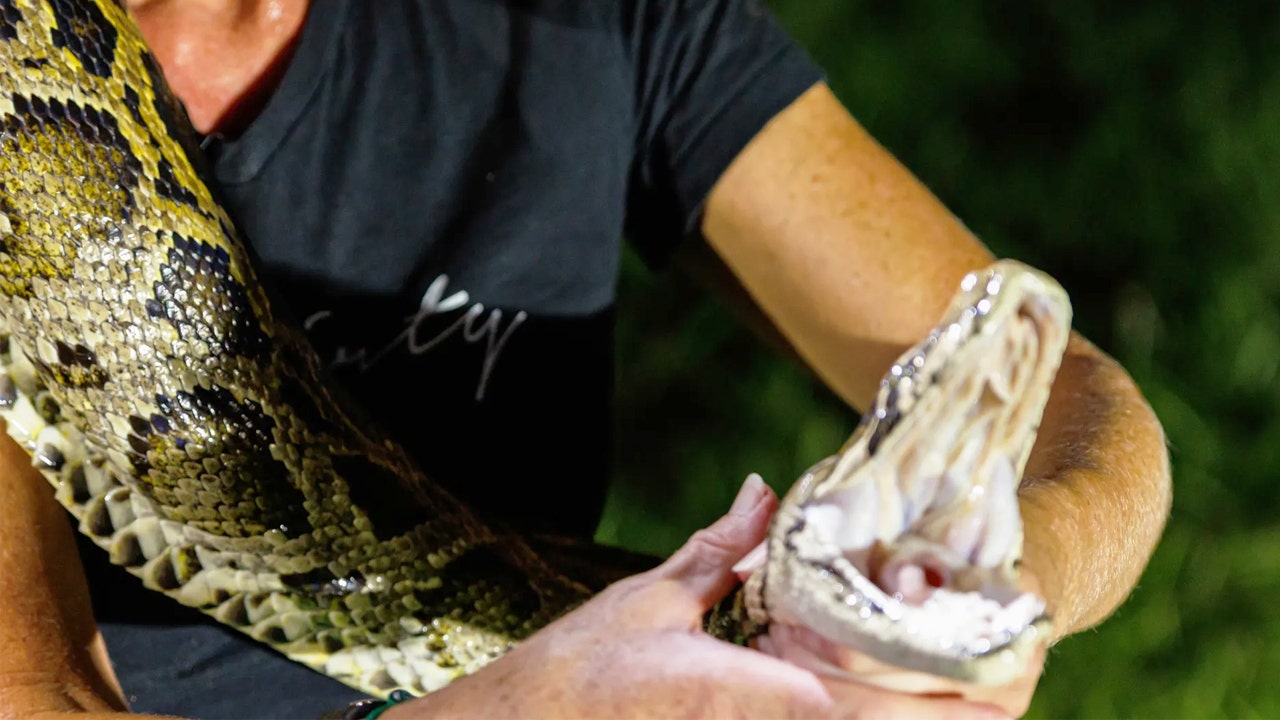

Burmese pythons have been wreaking havoc on the Florida Everglades ecosystem for more than 25 years. Now, experts warn they are making their way farther north.
Hard freezes were once thought to limit Burmese pythons to South Florida, but researchers have documented the invasive snakes sheltering and sometimes breeding in burrows, which can protect them from cold temperatures.
“First of all, they’re following the food,” said Amy Siewe, professional python hunter and guide. “But they are also stealing gopher tortoise burrows and armadillo burrows. And that’s how they’re staying warm during those colder nights in Florida that they typically wouldn’t be able to survive.”
For Siewe, python hunting is a full-time job. Known as the “Python Huntress,” she left behind a 13-year real estate career in 2019 after discovering Florida’s Burmese python problem, turning her lifelong passion for snakes and reptiles into a new purpose.
BEAR SWIPES HUNTER’S DEER BEFORE HE GETS A CHANCE TO CLIMB OUT OF HIS TREE STAND TO RETRIEVE IT
“They eat 98% of the mammals in parts of the Everglades,” said Siewe. “So they’re really devastating our ecosystem. So we need to do everything we can to get them out of our ecosystem to save the native wildlife. But also, you know, we don’t even know what type of damage this is going to do to our ecosystem in the years to come.”
Siewe’s husband, Dave, and her puppy, Dixie, like to get in on the action, too. Multimedia Reporter Amy Galo joined them on a hunt through the Everglades in Collier County, getting a firsthand look at what it takes to find the invasive snakes.
“She’s (Dixie’s) really just telling us where they are. And when she finds one, she says her indication,” said Siewe as Dixie searched through the brush. “So then I go in. Well, once she sits, Dave calls her off, and I go verify that there’s a python.”
Siewe searches for pythons in the Everglades several times a week, even leading guided hunts.
“We’ve got our snake deck here,” said Siewe. “It’s a platform on the truck that just gives us a little bit of height so we can see the pythons easier in the grass and in the water and things like that.”
Conservative estimates place the population of Burmese pythons in the Greater Everglades region in the tens of thousands. An exact count is difficult because these snakes are masters of camouflage.
According to Siewe, they spend roughly 85% of their time lying still in often inaccessible areas.
“We are always happy catching one, like I always want to catch one more,” said Siewe. “There are a lot of times we go out and you don’t catch any. That’s just the nature of the python.”
AGGRESSIVE TURKEYS ARE HARASSING PEOPLE ACROSS THE BOSTON AREA JUST DAYS BEFORE THANKSGIVING
More than 23,000 Burmese pythons have been removed from Florida, according to the Florida Fish and Wildlife Conservation Commission. But recently, the snakes have also been spotted farther north.
“There are two different populations. One in Brevard and also up in Charlotte County,” said Siewe. “But based on what we know, the scientists think that those are separate events. So that is not an extension of the colony down here (in the Everglades) that has been established for years.”
Once a breeding population becomes established, eradication is extremely difficult.
“The problem with the pythons is that you don’t even know that they’re there until it’s way beyond your control,” explained Siewe. “These guys spend 85% of their time not moving. And so, when we find one python, there could be up to a thousand more that we’re not seeing.”
Siewe added, “They lay eggs, you know, 20 to 40 eggs a year. Sometimes the big ones can lay over 100. So it’s just, it’s a never ending cycle.”
That is why researchers emphasize early detection and public education to try to prevent additional releases of captive invasive snakes.