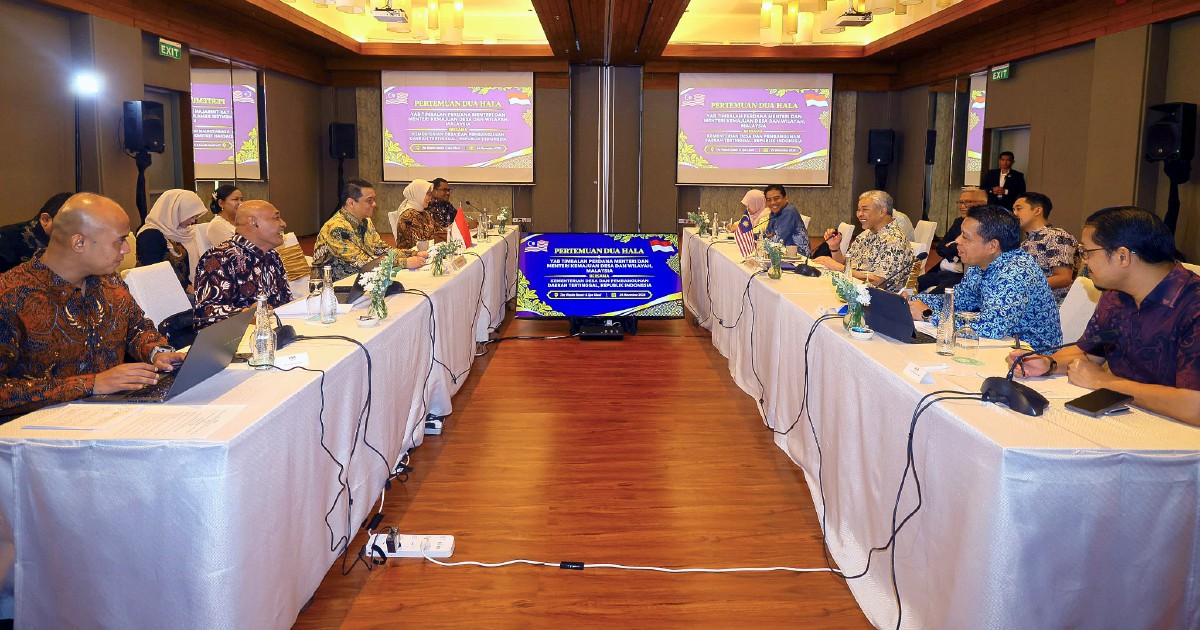

BALI: Malaysia and Indonesia have agreed to establish a joint working group (JWG) to strengthen cooperation in rural development, including through the exchange of best practices in village management in both countries.
Deputy Prime Minister Datuk Seri Dr Ahmad Zahid Hamidi, who is currently on a working visit to Indonesia, said Malaysia could benefit from Indonesia’s experience specifically its more structured village rating system to improve data collection and the effectiveness of rural development programme implementation.
He said Indonesia classifies its approximately 75,000 villages into four categories as developed, developing, lagging and severely lagging.
He added that this rating system could serve as a reference for developing an index or set of standards to measure the level of village development in Malaysia, which has about 15,000 villages.
This, he said, would assist the government in planning development programmes more effectively.
“We also aim to have an index or standard for ranking these villages something we have already implemented though their system is more structured.
“We can leverage this to further improve data collection and determine how such data can be utilised for the implementation of government programmes,” he told Bernama during a visit to Tegallalang Village here today.
Zahid, who is rural and regional development minister, arrived in Bali yesterday for a five-day working visit to Indonesia, which includes a series of engagements on the resort island and in Jakarta.
He began today’s agenda with a bilateral meeting with Indonesia’s Deputy Villages and Development of Disadvantaged Regions Minister Ahmad Riza Patria in which both sides agreed to establish a JWG.
This was followed by the visit to Tegallalang Village and one to Mas Village.
Zahid said another approach worth studying was the Indonesian government’s development of ecotourism, for instance, by transforming terraced padi fields as tourist attractions.
Doing so, he said, would see benefits shared not only by the farmers but by the entire village community.
He added that Indonesia also utilises village-owned enterprises known as “Badan Usaha Milik Desa” (BUMDes), which engage in economic activities such as the production of handicrafts for the export market.
He also cited rural development programmes such as “Desa Kirana” and “Desa Lestari” in Malaysia, as well as Indonesia’s “Desa Mandiri” (Independent Village) programmes which are similar in nature but differ in implementation.
“By fostering this integration, they can learn from us, and we can learn from them, allowing us to further improve upon what has already been established,” he said.
Zahid was scheduled to depart for Jakarta later today to attend the 14th Asean Ministerial Meeting on Disaster Management (AMMDM) and the 15th Meeting of the Conference of the Parties to the Asean Agreement on Disaster Management and Emergency Response (AADMER) in Tangerang, Banten.
Meanwhile, Riza said he plans to conduct a reciprocal visit to Malaysia in the near future to study the country’s approach to village management and development.
“There is much we can learn specifically regarding the management of villages in Malaysia which will serve as a valuable experience for us,” he said.
He also highlighted the need for both nations to collaborate on village development in the Malaysia-Indonesia border regions, not only to strengthen communication ties but also in terms of rural development policy.