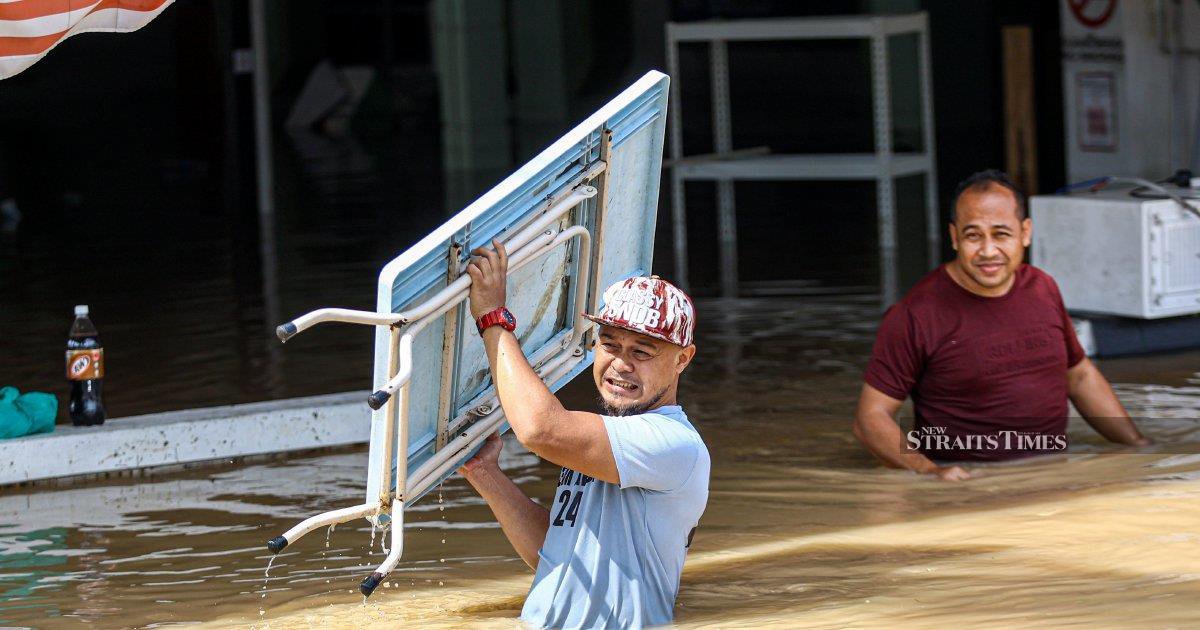

KUALA LUMPUR: Malaysia suffered close to RM1 billion in flood-related losses in 2024, but a significant proportion of the damage was uninsured, highlighting the country’s widening protection gap against natural disasters.
General Insurance Association of Malaysia (PIAM) chief executive officer Chua Kim Soon said many households and vehicle owners remained inadequately insured despite the increasing frequency and impact of extreme weather events.
He said East Malaysia had the lowest flood insurance coverage, with only 21 per cent of fire and motor insurance policies carrying flood extensions.
“This compares with 29 per cent on the east coast and 28 per cent each in the central and northern regions, while the southern region recorded the highest proportion of policies with flood coverage,” he said at PIAM’s Monsoon Readiness Media Roundtable here today.
Chua said the insurance gap was also evident across Asia, where floods accounted for more than 50 per cent of economic losses caused by natural disasters, estimated at US$31 billion (RM125.816 billion), but only about five per cent of those losses were insured.
He said Malaysia had also recorded RM5 billion in losses from landslides between 1961 and 2023, while about 26,000 storm-related incidents had been reported since 2021, resulting in property damage.
Chua called on homeowners to review their insurance coverage, particularly the distinction between houseowner policies, which protect buildings, and householder policies, which cover household belongings and contents.
He said many homeowners only insured their buildings to meet bank requirements when taking out housing loans, leaving furniture, electrical appliances and other personal belongings exposed to financial losses.
“Most of the insurance policies they have do not cover the contents. They only insure the building,” he said, citing the Putra Heights fire as an example of the importance of having adequate protection.
On motor insurance, Chua said only 13 per cent of internal combustion engine (ICE) vehicles in Malaysia had additional flood coverage, compared with 50 per cent of electric vehicle (EV) owners.
He said EVs recorded an average flood-related loss of RM8,404, significantly lower than the RM34,000 recorded for ICE vehicles.
He attributed the difference partly to EVs’ protected electrical systems and high-voltage isolation technology, as well as lower exposure and higher flood insurance uptake among predominantly urban EV owners.
“EVs are less prone to flood damage. Their protected electrical systems and high-voltage isolation technology help reduce flood-related risks,” he said.
Meanwhile, Chua said at least 12 insurance policies linked to Malaysians who went missing in the Nepal glacial flash floods had been fully settled, with payments made to their next-of-kin.
He said preliminary records had identified more than 50 insurance policies associated with the incident, although these did not necessarily represent an equivalent number of individuals, as one person could hold multiple policies.
“The policies included travel insurance, annual personal accident insurance and group personal accident coverage.
“We expect more of these matters to be resolved in the coming weeks. We will also continue providing support to the next-of-kin of those missing,” he said.
Chua said the insurance industry was working with Bank Negara Malaysia (BNM) to reach out to affected families and expedite claims processing.
Some 54 Malaysians went missing following glacial flash floods in Nepal on Aug 26, particularly around the Rasuwagadhi-Kerung border area.