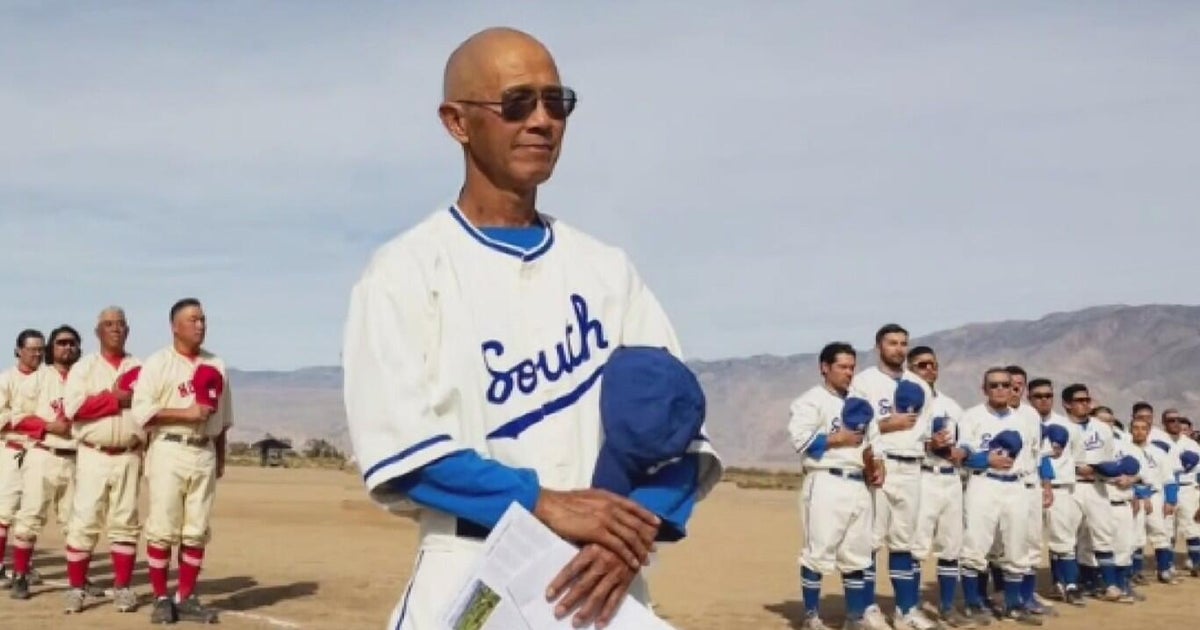

Tyler Higa of Torrance made the five-hour drive to play a baseball game in the middle of nowhere, and everyone who showed up said they wouldn’t miss it for the world.
It’s the 26-year-old’s first time in Manzanar, and the dusty field in the Owens Valley was once home to his ancestors. “It kind of just got real when I got here, when I set foot,” Higa said.
The baseball game had been 81 years in the making as descendants of WWII Japanese American internees recently played a commemorative game at the Manzanar War Relocation Center.
Higa said he comes from a long line of Japanese American amateur athletes.
His maternal great-grandfather, Fred Shinso Nakagawa, was a gardener in West LA, but his first love was baseball. At the turn of the century, Japanese players who faced discrimination formed their own leagues.
Nakagawa was a part of the legendary 1933 championship team, the West LA Japanese Baseball Club.
After the Pearl Harbor attacks, Nakagawa was one of 120,000 people of Japanese ancestry shamefully forced into internment camps.
When he wasn’t busy cooking in the mess hall, Nakagawa was on the makeshift diamond. “In Manzanar, he was a player and manager,” Higa said.
Dozens of baseball teams formed in the camps. It became one of the most popular activities. “I think the game really gave a sense of unity and a sense of hope and entertainment for them,” Higa said.
After the war, internment remained a shameful memory for many families. But Japanese American, or JA, sports leagues that thrived in camp continued. A few are still active today.
Higa joined the Japanese “Sansei” league when he was six. He’s now part of the JA adult league.
About three years ago, Higa heard about the National Park Service’s plans to restore Manzanar’s historic baseball diamond. LA-based performance artist Dan Kwong spearheaded the effort.
“The universe dropped this project on my lap,” Kwong said. The 71-year-old, who has played JA baseball for five decades, is the son of Manzanar internee, Momo Nagano.
“I had this vision of a double header with players from the Japanese American baseball league,” Kwong said. In October, that vision became a reality. Higa was invited to the Northern vs. Southern California all-star game.
His grandfather, Koso Nakagawa, was there to watch proudly as his grandson ran the bases, just as his father had 82 years earlier. “I would think he’s pretty honored. He’s pretty happy,” Nakagawa said.
The legacy continues thanks to the pioneers, who despite impossible circumstances, refused to give up on America’s favorite pastime.
“Manzanar is a place of sadness, trauma, and injustice. And we are doing something joyful,” Kwong said.