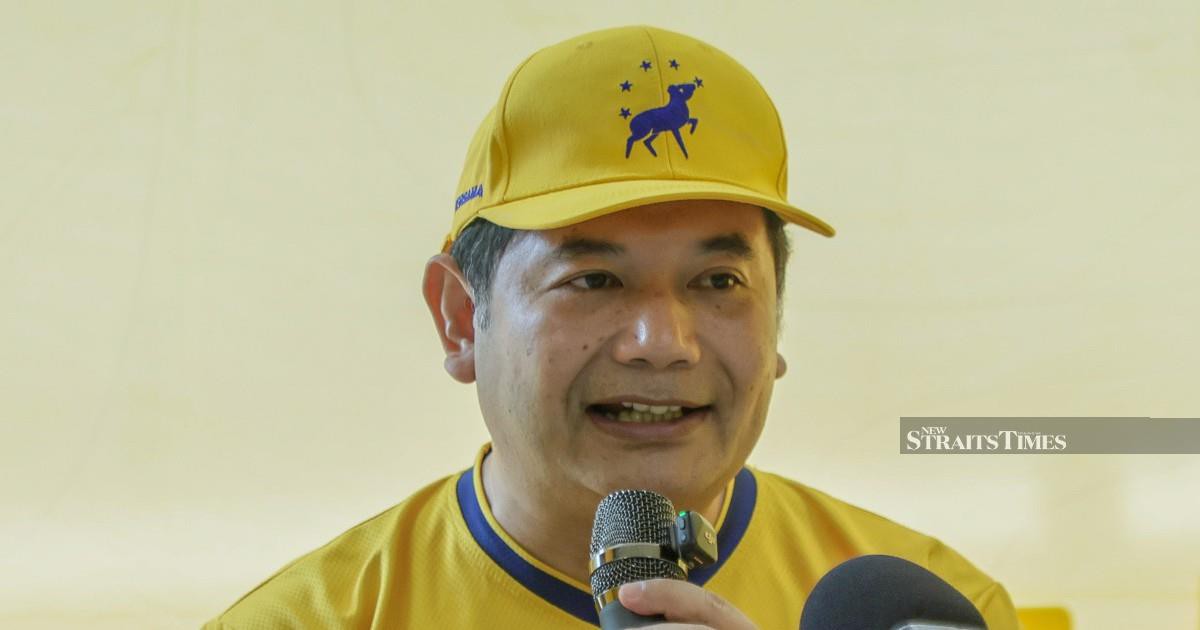

MELAKA: Former PKR deputy president Datuk Seri Rafizi Ramli has claimed that PKR candidates only declared their assets during the 15th General Election because he personally insisted on it, despite strong resistance from within the party.
He alleged that some of those who opposed the requirement were individuals close to Prime Minister Datuk Seri Anwar Ibrahim, who is also PKR president.
Rafizi said resistance to asset declarations was even stronger within Pakatan Harapan, particularly from DAP and Amanah, prompting him to abandon efforts to introduce a similar requirement across the coalition.
“PKR candidates only declared their assets during the last general election because I forced them to do so.
“At the time, I was the deputy president and election director, so I made it compulsory for everyone.
“After I left, until today, even something as simple as asset declarations cannot be implemented,” the Bersama leader said at a press conference here.
He said opposition to asset declarations within PKR had been particularly strong among certain party figures.
“Even within PKR, there were individuals who strongly opposed asset declarations, and these individuals were close to Anwar.
“The resistance was strong within PKR, but it was even stronger at the PH level,” he said.
Rafizi claimed that DAP and Amanah were firmly opposed to the proposal, leaving him with little choice but to abandon efforts to make asset declarations compulsory for all PH candidates in 2022.
“In 2022, I gave up. I did not even try to force PH to declare their assets because DAP and Amanah were completely against it.
“PH has never implemented asset declarations across the coalition,” he said.
He alleged that politicians’ reluctance to disclose their assets stemmed largely from concerns over their ability to account for their accumulated wealth.
He claimed that some also feared that revealing their financial standing would discourage supporters from contributing to their political campaigns.
“The main reason politicians do not want to declare their assets, I can tell you from experience, is that they cannot explain their wealth.
“How are they going to explain having RM150 million in their accounts?
“There are also those who have substantial wealth but still collect money from people during elections.”
Rafizi said politicians frequently cited concerns over their families’ safety and privacy as reasons for opposing public asset declarations.
However, he dismissed these concerns, pointing to Bersama candidates in the Johor and Melaka elections who had publicly disclosed their assets without encountering any security-related problems.
He said all 31 Bersama candidates contesting in the two elections, comprising 15 in Johor and 16 in Melaka, had submitted statutory declarations detailing their assets, which were made publicly available on the party’s website.
“Until today, not a single Bersama candidate has faced any problems as a result of declaring their assets,” he said.
Rafizi also challenged Anwar and PH to introduce regulations making asset declarations compulsory for all election candidates, saying this would demonstrate a genuine commitment to combating money politics.
He said the Melaka election provided an opportunity for PH to regain the confidence of disillusioned supporters by taking concrete steps towards greater political transparency.
“If the government takes this bold step, it will strengthen public perception that BN, now supported by PN, is not serious about combating money politics.
“Bersama believes that if PH takes this step, PH voters who may have become disillusioned will reconsider their position and support the coalition,” he said.