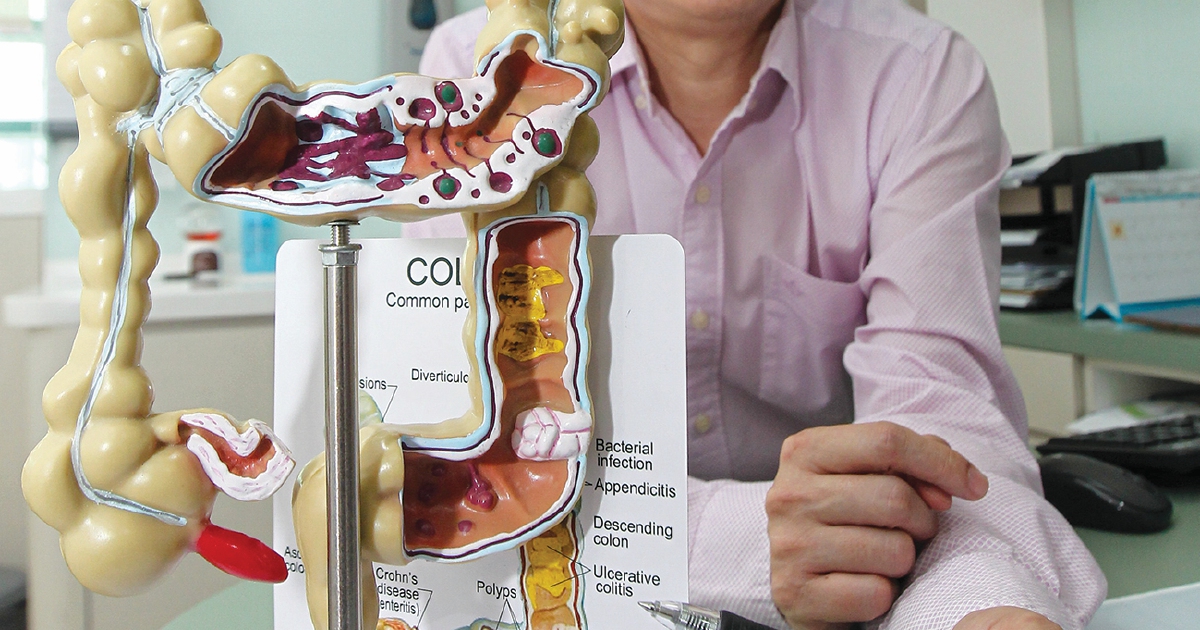

OUR toilet habits are often a reflection of our overall health. Unfortunately, due to the nature of the topic, it is rarely brought up.
Haemorrhoids and constipation, for example, are signs that the body’s internal system is not working as it should.
Haemorrhoids are a common condition. Patients often experience pain, anal swelling and bleeding during bowel movements.
Many people tend to ignore it as a mild problem when in fact, haemorrhoids can be easily treated.
But what happens when it becomes serious?
When symptoms persist and are accompanied by changes in your toilet habits, it is time to seek a medical assessment, says Hospital Picaso consultant general and colorectal surgeon Dr Chong Hoong Yin.
“See whether you also have other symptoms. For example, changes in toilet habits, such as chronic constipation or chronic diarrhoea or abdominal pain.
“The changes mean something different from what’s normal for you,” he says.
It’s important to pay attention to the duration and nature of symptoms because these could be indicative of something more serious like colorectal cancer.
[[nid:1585978]]
A WORRYING TREND
Colorectal cancer is rising worldwide, particularly among younger adults.
“In Malaysia, an increasing number of young people are being affected,” says Dr Chong.
Diets high in processed food and red meat, which are low in fibre, as well as smoking and a sedentary lifestyle are believed to be contributing factors of the disease.
But there’s a genetic link too, especially if first-degree relatives are involved.
According to Dr Chong, if one’s parents or siblings have been diagnosed with colorectal cancer, then the risk is high for the family.
For the general population, a colonoscopy to screen for the disease is usually recommended once every 10 years from age 45 onwards, but for those with a family history, screening should start 10 years earlier.
For example, if a person has a father who has been diagnosed with the disease at age 48, then he or she should start screening by age 38, with the screening repeated every three to five years.
A colonoscopy is the “gold standard” in screening and during the procedure, if doctors discover the presence of polyps in the colon, they can remove them immediately, essentially preventing a cancer from even starting.
This makes colorectal cancer a highly preventable disease.
However, late detection remains a challenge in Malaysia, adds Dr Chong, with most cases being detected at stages three and four.
This leads to complicated treatments and a poor prognosis because the tumour has spread.
On the other hand, with early detection, colorectal cancer remains a very treatable disease and patients can expect a good recovery and a return to normal life.
For more information on colorectal cancer, please visit Hospital Picaso at No 110, Jalan Professor Khoo Kay Kim, Seksyen 19, 46300, Petaling Jaya, Selangor Darul Ehsan.
KKLIU 4532/EXP: 31.12. 2028
meera@