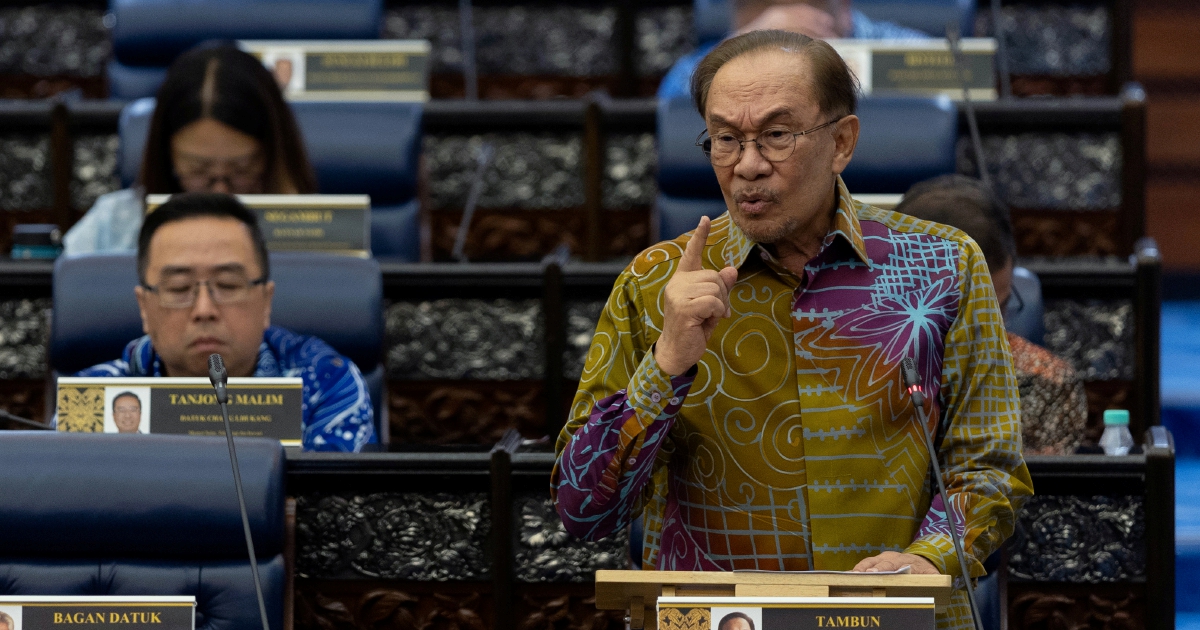

KUALA LUMPUR: Prime Minister Datuk Seri Anwar Ibrahim has rejected opposition leader Datuk Seri Hamzah Zainudin’s criticism that he had “rocked the boat” over Taiwan.
Anwar said his comments in an Al Jazeera interview were consistent with Malaysia’s One China policy, which has been in place since 1974.
He denied endorsing Chinese military action against Taiwan, as claimed by Hamzah, citing media reports.
“Did I say I agreed with China attacking Taiwan? No. I said we support the One China policy.
“We also said we believe there should be an amicable resolution through peaceful efforts,” he told the Dewan Rakyat today, responding to a supplementary question from Hamzah (PN-Larut).
Anwar said that when asked about a possible Chinese attack on Taiwan, he had described it as a domestic matter in which Malaysia did not interfere.
Earlier, Hamzah raised concerns about the economic impact, claiming that the stock market had fallen by almost 10 per cent this month.
He warned that Malaysia risked losing investments as Vietnam and Thailand courted Taiwan with incentives, and asked the government to consider a new approach to ease tensions.
[[nid:1576073]]
In response, Anwar said shares in the electrical and electronics, artificial intelligence and data centre sectors had fallen temporarily, partly due to developments involving Nvidia, but Malaysia was not as badly affected as many other countries.
He said Malaysia’s position was to uphold the One China policy while maintaining trade and investment ties with Taiwan.
“This was why it referred to a working committee to coordinate investment and economic matters, rather than negotiations between two countries,” he said.
Yesterday, it was reported that Taiwan had confirmed suspending bilateral investment negotiations with Malaysia last month following Anwar’s remarks describing Taiwan as part of China.
United Daily News quoted Taiwan’s Foreign Ministry spokesman Hsiao Kuang-wei as saying that the decision was made in consideration of the island’s national sovereignty and economic security, as well as to safeguard the interests of Taiwanese investors.