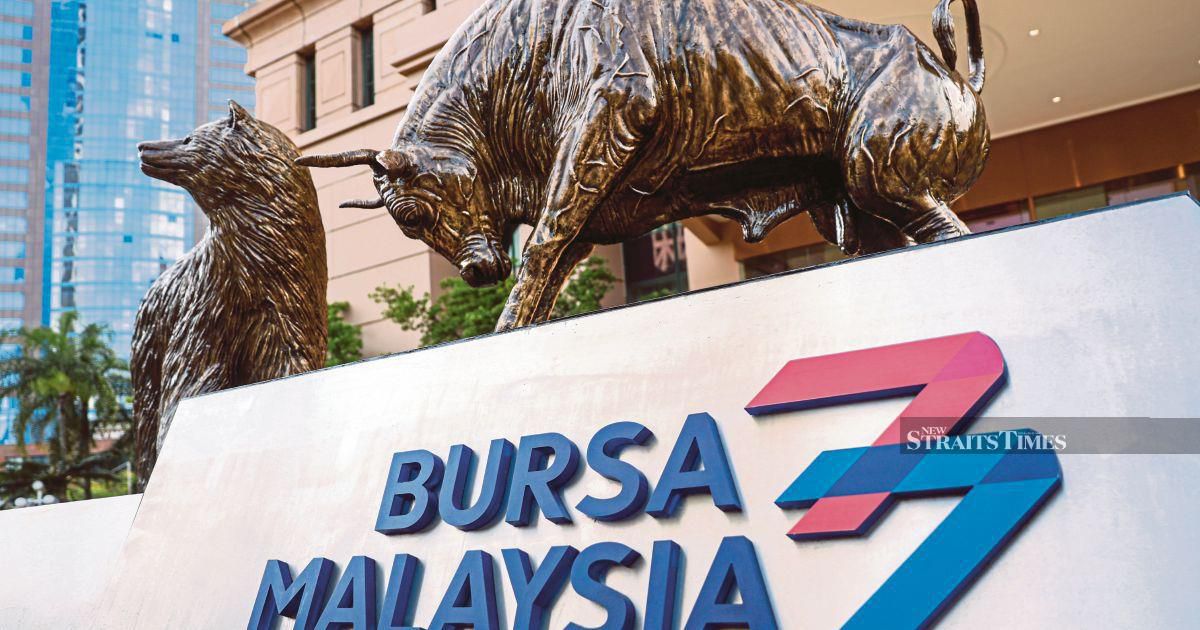

KUALA LUMPUR: Bursa Malaysia appeared unfazed by United States President Donald Trump’s latest tariff threat, with the benchmark index staying in positive territory throughout Wednesday despite the prospect of higher duties on Malaysian exports.
The FTSE Bursa Malaysia KLCI (FBM KLCI) rose 8.69 points, or 0.56 per cent, to close at 1,570.98, in line with a broader recovery in Asian equities as investors largely took the latest round of proposed US tariffs in their stride.
The benchmark index opened marginally higher at 1,563.15 before climbing as much as 1.45 per cent to an intraday high of 1,584.96, although it pared some gains towards the close.
The positive market reaction came despite Malaysia being among 14 economies targeted by Washington following its Section 301 investigations into excess manufacturing capacity.
The Investment, Trade and Industry Ministry said the proposed tariff range of 18 to 25 per cent for Malaysia was merely indicative, with the actual rate expected to be determined in the first quarter of 2027.
The ministry said it would continue engaging with Washington to ensure Malaysia’s total tariff burden under Section 301 does not exceed 19 per cent, particularly given that Malaysia was among the first economies to sign the Agreement on Reciprocal Trade.
“At this point in time, only the 10 per cent tariff under forced labour, imposed on Malaysia on July 24, 2026, is in effect,” it said in a statement.
The relatively muted reaction to the tariff announcement was not confined to Malaysia.
At press time, Hong Kong’s Hang Seng Index gained 1.7 per cent, while Japan’s Nikkei 225 and South Korea’s Kospi closed 0.9 per cent and 0.3 per cent higher, respectively. China’s Shanghai Composite ended flat.
Reuters reported that global equities rose as the latest wave of US tariffs appeared less damaging than initially feared, while AFP attributed the recovery in Asian markets partly to renewed buying interest in beaten-down technology stocks.
While tariff concerns have yet to trigger another sell-off, the bigger threats to Malaysian equities may lie in mounting global debt, rising interest rates and stretched equity valuations.
Rakuten Trade Sdn Bhd has lowered its 2026 year-end FBM KLCI target for a second consecutive quarter, cutting it to 1,670 from 1,770 amid mounting external risks.
The revised target, which implies a potential upside of 6.18 per cent from today’s close, is based on a lower price-to-earnings multiple of 15.5 times, compared with 16.5 times previously.
Rakuten Trade research head Kenny Yee said high energy costs and interest rates were fuelling the build-up of risks across global financial markets.
“Malaysia is not at the epicentre, but external forces will dominate fund flows,” he said in a note.
Among the firm’s key concerns are mounting US government debt, rising Japanese bond yields and the sustainability of Wall Street’s artificial intelligence-driven rally.
Further monetary tightening by the Bank of Japan could also trigger an unwinding of the yen carry trade, with repercussions for global financial markets.
Foreign investors have remained net sellers of Malaysian equities since the second quarter, with local institutions emerging as the main buyers, according to Rakuten Trade’s fund-flow data.
Still, Yee said Malaysia’s relatively manageable market volatility and more attractive valuations following the recent sell-down could appeal to investors seeking to reduce their exposure to more expensive markets.
“Malaysia’s fundamentals are intact, but we should remain vigilant while the bubbles are still expanding,” he said.
Rakuten Trade has set a 2027 year-end FBM KLCI target of 1,760, supported by projected corporate earnings growth of 5.5 per cent.
O-Y2-H6V1K4