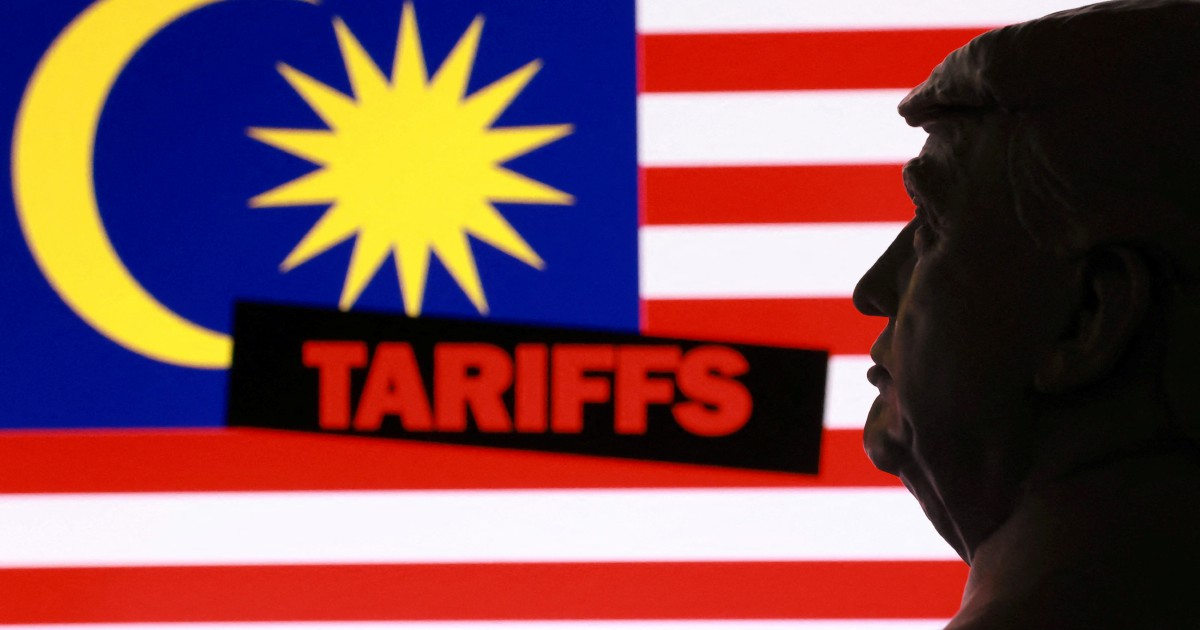

KUALA LUMPUR: Malaysia will continue negotiating with the US to cap tariffs at 19 per cent, pushing back against a proposed range of 18-25 per cent as Washington prepares to decide on the final rate by March 2027.
Investment, Trade and Industry Minister Datuk Seri Johari Abdul Ghani said the US had indicated a tariff range of between 18 per cent and 25 per cent for Malaysia.
He maintained that Malaysia’s overall tariff rate should not exceed the 19 per cent previously agreed upon under the Agreement on Reciprocal Trade (ART).
“From now on, we need to continue engaging with them and putting forward our arguments until the first quarter of next year, when they will make their final decision.
“Whatever it is, our overall tariff as a country must not exceed 19 per cent,” he told reporters after an event commemorating BYD’s local assembly initiative in Malaysia today.
Johari was responding to the tariffs proposed by the US yesterday, which cited concerns that Malaysia’s industrial and manufacturing policies had contributed to excess production capacity and undermined US businesses.
Malaysia is among 14 economies facing proposed tariffs under Section 301 of the US Trade Act, with rates ranging from 15-35 per cent.
“We have until the first quarter of next year. Our team will continue engaging with the US, and at the ministerial level, I will continue to talk to them. I want to convince them. In fact, I am now thinking of how to show them that we do not have excess capacity.
“Even though we are one of the biggest exporters of electrical and electronics products, which account for almost 45 per cent of our exports, there is nothing to show that we have excess capacity,” he said.
Johari said the US assessment of excess capacity was not limited to domestic production but also extended to products sourced from third countries with excess capacity.
“For example, I do not want to mention any particular country. Say country A exports its products to Malaysia, and we use them to manufacture our own products.
“But if those products come from excess capacity, then we are also deemed to be collaborating with the third country. Now, they have given some indication for Malaysia,” he said.
Johari said the iron and steel sector could be among those scrutinised by the US over concerns about excess production capacity.
“They do not want certain players to use Malaysia as a platform to export their products. This is something we have to be very careful about,” he added.
The semiconductor sector remains excluded for now.
Johari said Malaysia remained subject to a 10 per cent tariff relating to forced labour until the US finalised its decision on excess capacity.
He said Malaysia should benefit from being among the earliest countries to sign the ART with the US.
“We were promised 19 per cent. Whatever additional tariffs they want to impose, including the 10 per cent on forced labour, the overall tariff must not exceed 19 per cent.
“Even though you give me a range of 18-25 per cent, we were the first to sign. We must benefit from being the first to sign. If there is no benefit, why did we sign in the first place?” he said.
Meanwhile, Johari said BYD’s decision to undertake local assembly at Sime Motors’ Inokom Corp Sdn Bhd facility in Kulim, Kedah affirms Malaysia’s position as an attractive investment destination for international automotive manufacturers.
He said the move demonstrates how major automakers can leverage Malaysia’s existing industrial capabilities to establish a local manufacturing presence.
BYD will begin local vehicle assembly in Malaysia with the BYD Shark 6 pickup truck. The first Shark 6 unit is expected to roll out from the Inokom plant by March next year.
The move marks a step forward in the Chinese automaker’s plans to establish a long-term presence in Malaysia, while supporting the development of the country’s automotive manufacturing ecosystem.
“Through completely knocked-down assembly, we are able to retain a greater share of the economic value associated with each vehicle within our domestic economy,” Johari said at the ceremony.
Johari said beyond providing Malaysian consumers with a wider range of vehicle options, BYD’s presence presents an opportunity to introduce new technologies and capabilities into the country’s automotive ecosystem.
Given BYD’s expertise in battery technologies, power electronics and electric mobility, he said the government looks forward to deeper collaboration with Malaysian component manufacturers, technology providers and engineering talent.
Sime Motors managing director for Southeast Asia Jeffrey Gan said the company is still evaluating the market to ensure the model is competitively priced.
“We are still deliberating on the price point and studying the market. Rest assured, we will ensure that the price is positioned very competitively,” he said at a press conference.
BYD Malaysia managing director Jacob Ma said the country holds significant potential for BYD, not only as a growing market for new energy vehicles but also given its established automotive capabilities, skilled workforce and opportunities for further development.
He said local assembly has always been part of BYD’s long-term plans for Malaysia.
“For us, this is about much more than assembling vehicles. It is about building closer partnerships with the local industry, sharing our technology and experience, and creating opportunities for knowledge and skills transfer,” he said.
The collaboration is also aligned with the objectives of the National Automotive Policy 2020, particularly in developing the next-generation vehicle ecosystem and strengthening local participation in the automotive value chain.
BYD has been showcasing the Shark 6 in Malaysia since 2025, with the model marking its entry into the 4×4 pickup segment.