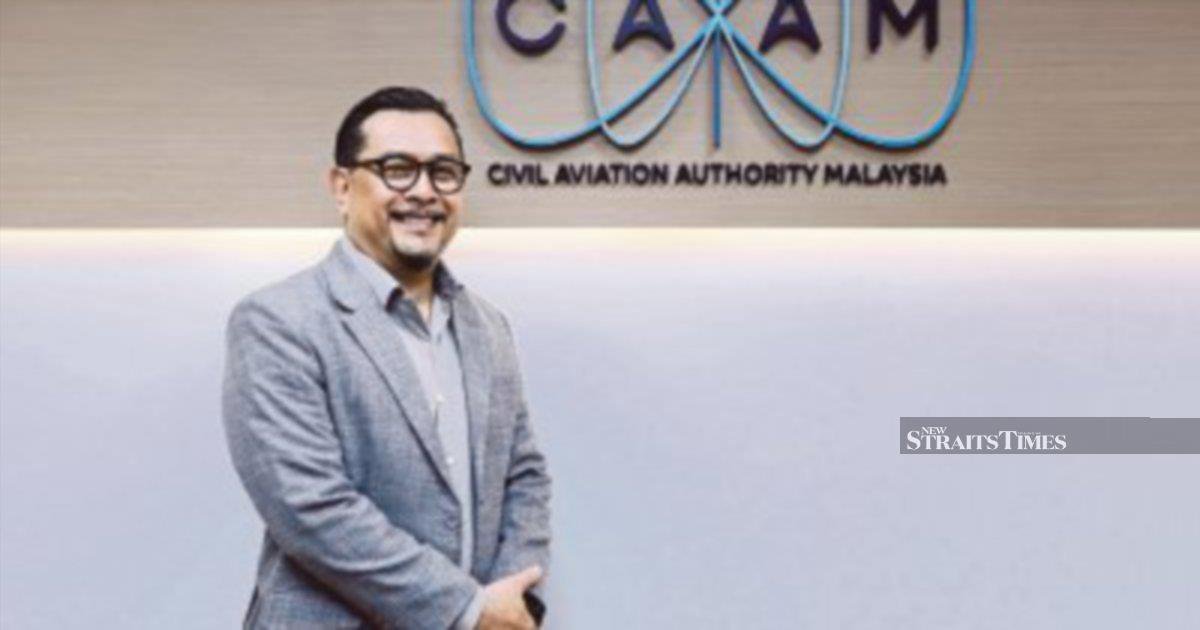

KUALA LUMPUR: Malaysia is preparing an initial framework for its low-altitude economy (LAE) by year-end as it moves towards limited commercial operations in the first quarter of 2027.
Civil Aviation Authority of Malaysia (CAAM) chief executive officer Datuk Norazman Mahmud said the framework is aims to provide a common direction for government agencies, industry players, manufacturers and operators as Malaysia scales up the use of low-altitude airspace while maintaining safety and public confidence.
“The initial framework we are targeting by end of this year…Initial framework means we need to get all the stakeholders at least to be aware,” he told Business Times in an interview recently.
LAE refers to economic and public service activities conducted within low-altitude airspace using emerging aviation technologies and services.
These include drones or unmanned aircraft systems (UAS), advanced air mobility (AAM), urban air mobility, autonomous serial logistics, future air taxi services, infrastructure inspection and emergency response operations.
Norazman said normal civil aviation traffic generally operates above 4000 feet except around airport areas, leaving lower-altitude airspace that could be used for other applications.
“Most of this area at 1000 metres and below or 3000-4000 feet are not used. A lot of applications that you can use below this altitude outside of the airport area.”
“For example, we can do surveillance; we can do cargo; lots of drones or flying machines that can be used to do this and also advanced air mobility like air taxi can use this range of altitude,” he said.
Malaysia launched its national LAE initiative on June 24 at the inaugural LAE Forum 2026, organised by CAAM and launched by Transport Minister Anthony Loke.
The Transport Ministry has entrusted CAAM with spearheading the development of the regulatory, operational and governance framework required to support the country’s LAE ecosystem.
Norazman said about 14 ministries are involved in LAE and a common framework is needed to coordinate the various stakeholders as the industry develops.
He said the ecosystem also involves government agencies, technology providers, aircraft manufacturers, operators and users, requiring the various parties to move in the same direction.
“If everybody is heading in different directions, how do you actually want to scale up this industry? So, everybody needs to move in the correct direction. How are people going to move in the correct direction?”
“You have to do a blueprint. You have to do a framework on how you actually can expand this,” he said.
Four Phase Of LAE Roadmap
CAAM’s strategic roadmap set out four phases for developing the sector.
The first began with LAE Forum 2026 as a platform to introduce the initiative and engage government agencies, industry, academia, technology providers and investors.
The next phase involves setting up a multi-stakeholder task force to coordinate policy development, regulatory planning and stakeholder collaboration.
This is followed by a national operational demonstration of low-altitude aviation technologies and a second LAE Forum before limited commercial operations are introduced under a controlled and regulated environment in the first quarter of 2027.
From small-scale low-altitude aviation operations to wider use across various industries
Norazman said Malaysia already has several low-altitude aviation activities operating on a smaller scale, including drone surveillance, agriculture, cargo and entertainment.
“We already have, but all on a smaller scale and different places. We already have surveillance approved. Petronas is doing gas pipeline surveillance. Agriculture, we already have a lot of agriculture activities, especially in the north.”
“We are venturing into cargo, sending small cargo of 50-100 kilogrammes. In terms of entertainment, there are swarm drones,” he said.
One of the applications being explored is the use of drones to transport medicines and medical samples, particularly from rural and remote areas where land transportation takes longer.
Norazman said a proof of concept involving hospitals is being carried out in Sabah to transport samples from remote communities.
“At this moment, what we are looking at, which is more critical, is delivering medicines, delivering samples,” he said.
Norazman also said drones capable of carrying between 50kg and 500kg are available, although smaller payloads could provide a starting point for such operations.
“We can do 50, 100kg within a 100-kilometre radius. That’s very, very feasible rather than if you use road, it probably takes one day (to deliver),” he said.
While these activities are already taking place on a smaller scale, Norazman said the next challenge is to expand them and integrate low-altitude operations within Malaysia’s existing civil aviation ecosystem.
“But how do you actually scale this up, make it in a safe environment? How can the activities of this low-altitude economy blend in with the existing civil aviation ecosystem?” he added.
Scaling Up LAE Ecosystem
Beyond aircraft and pilots, Norazman said scaling up LAE requires telecommunications and data infrastructure, maintenance personnel, operational planning and continuous training.
“For drone operation, telecommunications are very important, data centres are very important. But as you scale up, you need support beyond the pilot as well. Currently, there are more than 6000 rated drone pilots. But you have to think of who is going to maintain (the drones)?” he said.
He said training and skills development also have to extend beyond drone pilots.
“The training is continuous. You have to keep building the capacity not just in flying (but) in maintenance, all sorts of things. These are the kind of ecosystem, the support that needs to be built,” he said.
The wider LAE ecosystem identified by CAAM includes UAS traffic management, communications and connectivity, navigation and surveillance, take-off and landing infrastructure, data and cloud services, skills development, investment, research and development and legal and regulatory frameworks.
Norazman said CAAM’s regulatory approach has to balance the development of new technology with safety requirements without imposing controls that could unnecessarily restrict growth.
“As a safety and security regulator, that is our main aim. We are not against making the technology grow. We cannot be over-regulating as well, that distorts the growth.”
“But you need people to be aware there are some sort of controls, that it is not free-for-all,” he said.
Path For Businesses
For small and medium enterprises and start-ups seeking to conduct drone operations in sectors such as logistics and agriculture, Norazman said operators first need a clear concept of operations (CONOPS).
He said this sets out what an operator plans to do, including the type of cargo it plans to carry, its weight, operating range and the type of aircraft required.
“For any type of operation, you need a concept of operations. How are you going to operate?”
“Let’s say you are interested in the delivery business. What kind of cargo do you want to carry? What type of weight do you want to carry? What type of range do you want to cover?” he said.
He said certification requirements depend on the aircraft and the type of operation with higher risks associated with heavier and more complex aircraft.
CAAM has also expanded its drone unit as the sector develops.
Norazman said the unit had grown from one officer when he joined CAAM in 2022 to more than 10 people with personnel receiving continuous training in areas including certification and Specific Operations Risk Assessment (SORA).
CAAM said LAE has the potential to create new economic opportunities and skilled jobs, improve productivity and operational efficiency, support technology adoption and improve public services and connectivity.
Air Taxis After 2028
On passenger-carrying air taxis, Norazman said such services are likely to come later as manufacturers are still working towards certification of their aircraft.
“I would say after 2028. Why? Because in terms of certification, I don’t think anyone has one that is certified to fly people yet. Most of the advanced original equipment manufacturers are in the stages of certifying their machines,” he said.