
ANCIENT temples, grand architecture and breathtaking landscapes almost always come to mind when I think of China.
Perhaps the Hollywood films I grew up watching are to thank for that. But standing within the grounds of
Beijing’s Forbidden City, I found plenty to reinforce that impression.
One does not, in fact, need to explore the entire 72-hectare palace complex to understand why.
The moment you step through the entrance, the sheer scale of the buildings and the intricate architectural details are enough to leave you in awe.
[[nid:1584076]]
Around me, golden roofs shimmered under the sunlight, contrasting beautifully against the striking red walls that surround the sprawling complex.
Everywhere I turned, there was something to catch my eye, from the elaborate carvings and decorative details to the vast courtyards that seemed to stretch endlessly.
It was easy to see why the Forbidden City remains one of China’s most recognisable historical landmarks.
Completed in 1420 after 14 years of construction during the Ming Dynasty, the former imperial palace served as the home and political centre of Chinese emperors for nearly 500 years, spanning the Ming and Qing dynasties.
Yet, what makes the Forbidden City even more remarkable is how it has endured through centuries of change, witnessing the fall of dynasties, political upheavals and the passage of time, while preserving a significant part of China’s imperial history.
It was a fascinating introduction to China’s rich history. But as I would discover during my travels as part of this year’s Multinational Media and Think Tank Delegation, there was much more to the country than its celebrated landmarks.
[[nid:1584075]]
Far from the imperial halls of Beijing, my epiphany began with my trip to Pinghu, Zhejiang Province, where I encountered an attraction I certainly did not expect to find in China.
Making It Red
It was quite unlike anything I had encountered in Beijing — a tomato farm that had turned the humble fruit into a tourism experience.
At Pinghu Tematou Farm Homestay, also known as Temaotou Farm, agriculture and tourism come together, offering visitors a chance to follow the journey of tomatoes from cultivation to the dining table.
[[nid:1584074]]
The farm’s origins, interestingly, were not entirely rooted in tomatoes. It was conceived as a way to bridge the social divide among urban youth, bringing together founder Zhou Chengong and a group of university graduates who chose to leave behind conventional careers in technology and corporate life to venture into agriculture.
Rather than simply establishing another agricultural business, they envisioned a shared space where young people could reconnect with nature, learn about farming and build meaningful relationships beyond the competitive environment of city life.
[[nid:1584073]]
At Temaotou Farm, agriculture is therefore more than just cultivation. It is also about community, education and creating a different way of experiencing rural life.
This was particularly eye-opening for someone who has grown up surrounded by city life.
I had rarely given much thought to the food that lands on my plate, let alone considered the journey it takes to get there — from the moment it is cultivated to when it eventually makes its way to our dining tables.
But at Temaotou Farm, that process was quite literally just across the way. All I had to do was cross the road to catch a glimpse of the entire process — from the growing areas where the tomatoes are cultivated to the drone-like irrigation device that moves around the farm, distributing water to the crops.
[[nid:1584072]]
Seeing these processes up close gave me a better understanding of the work that goes into producing the tomatoes, and ultimately, a greater appreciation for the cafe’s offerings, particularly its tomato juice and sun-dried tomatoes.
Reaching New Swings
Just when I thought I had seen the many facets of China, another unexpected discovery came my way — a baseball stadium.
Given the sport’s deep-rooted association with American culture, finding one in China was certainly unexpected.
Yet, tucked away in a village in Zhejiang Province stood the Xujiadai International Baseball Stadium, a facility with a rather remarkable story behind it.
Xujiadai was once an ordinary farming village, where many residents relied on pig farming for a living.
However, following efforts to improve the rural environment and phase out livestock farming, the village found itself facing a new challenge — finding sustainable ways to generate income and attract visitors.
It was clear that a new direction was needed. The idea for baseball came about in 2017, when village secretary Liu Jianqun noticed an opportunity among the growing Japanese and Taiwanese expatriate community in nearby Pinghu.
Many shared an interest in baseball but often had to travel to Shanghai to find suitable facilities to play.
Recognising this untapped demand, Liu saw an opportunity to breathe new life into an otherwise unused land into a baseball field.
But what began as an effort to provide a sporting facility for the expatriate community soon grew into something much bigger.
The first youth baseball field opened in November 2018, attracting teams and enthusiasts from neighbouring cities and provinces.
Today, Xujiadai has developed into a venue for baseball games, training sessions and regional competitions, with the international stadium further expanding its capacity to host larger sporting events.
Beyond hosting games, the stadium has also become an important training ground for aspiring young players.
[[nid:1584071]]
American coaches, for one, have been brought in to share their expertise and nurture the next generation, introducing local children to the sport and helping them to develop their skills.
In many ways, baseball has become more than just a sport here. What began as an effort to provide a recreational space for expatriates has evolved into a community-building initiative, bringing together local residents, international players and young aspiring athletes through a shared interest.
Turning Green Gold
Transforming challenges into opportunities seems to have been a recurring theme throughout my trip.
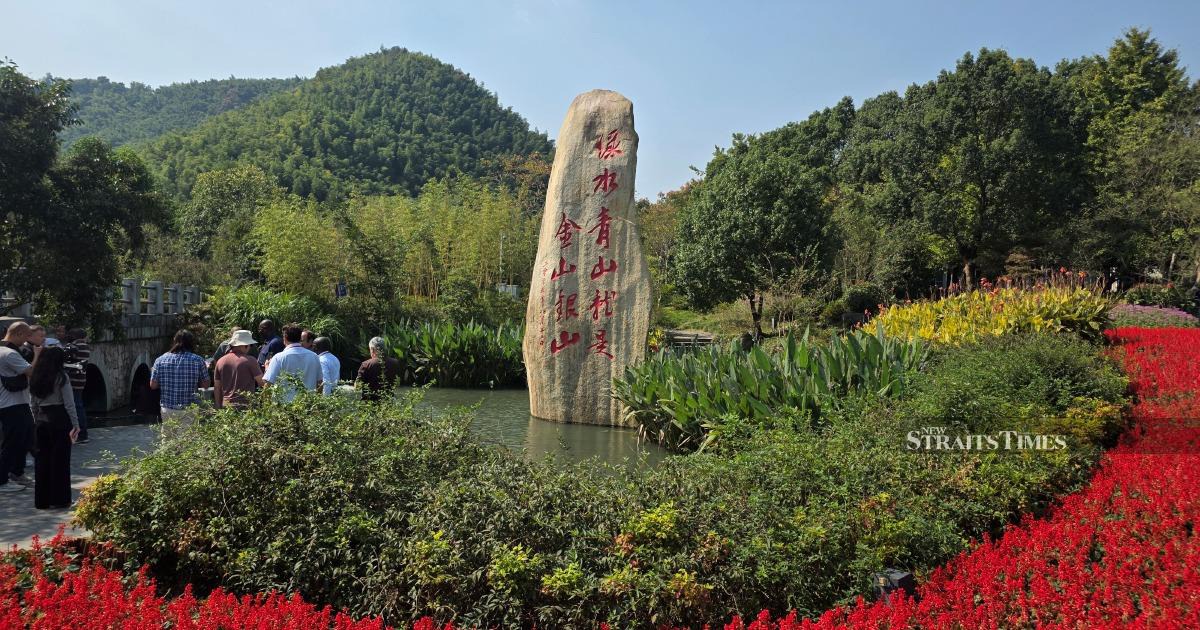
Much like Temaoutou Farm and the Xujiadai International Baseball Stadium, my next stop, Yucun Village, has a story of reinvention to tell.
One that began with a shift in how the community viewed its natural surroundings and economic future.
Not too long ago, Yucun’s economy relied heavily on mining and cement manufacturing, with industrial activities serving as a major source of income for the village.
While these industries brought prosperity to the community, they also came at an environmental cost.
Years of mining and industrial activity had taken a toll on the surrounding landscape, prompting village leaders to reconsider whether this was a sustainable way forward.
In 2003, the village made a bold decision to shut down its mines and cement factories, marking the beginning of a shift towards a more environmentally conscious approach to development — one that would later be embodied in the concept of “lucid waters and lush mountains are invaluable assets” (Two Mountains Theory).
Today, Yucun has embraced a different approach, with tourism taking centre stage in its transformation.
[[nid:1584070]]
This initiative is apparent as I made my way around the village, noticing how former industrial spaces had been given a new lease of life.
What were once factory buildings have since been repurposed into cafes, cultural spaces and even entertainment venues, including a music bar.
Some former industrial facilities have also been transformed into cultural attractions, such as a library housing around 10,000 books.
Beyond adding a tourism appeal, these businesses have also opened up alternative income opportunities for residents, many of whom now rely on tourism-related activities to support their livelihoods.
It was a striking example of how a village could turn its industrial past into an opportunity for reinvention, placing greater value on its natural surroundings while creating new ways for its people to make a living.
And perhaps that is the biggest takeaway from my trip. From the centuries-old Forbidden City to a rural village finding an unlikely identity through baseball, each destination had its own story to tell.
Some reminded me of the importance of preserving what came before, while others showed how embracing change could open doors to entirely new possibilities.
Together, they offered a reminder that progress does not always mean leaving the past behind.
Sometimes, it is about finding ways to honour it while creating something new.
And perhaps that is what makes China such a fascinating country to discover — a place where its rich history and evolving future exist side by side.
john.tan@