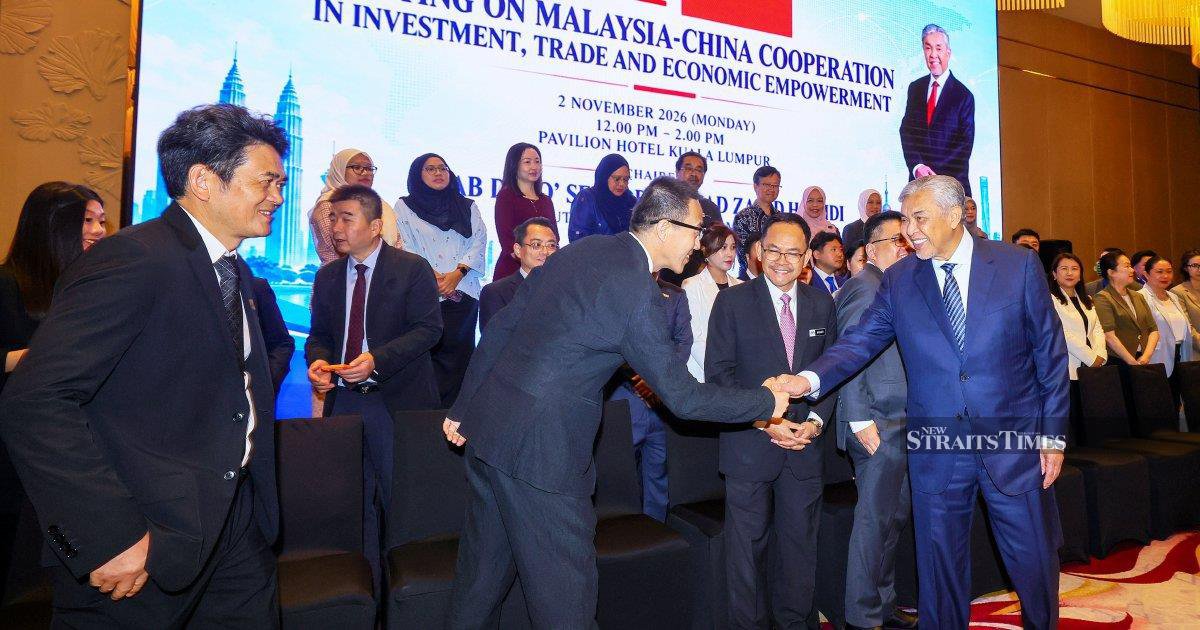

KUALA LUMPUR: A 58-member Chinese business delegation has indicated potential investments worth about US$15 billion in Malaysia, says Deputy Prime Minister Datuk Seri Dr Ahmad Zahid Hamidi.
He said he had been working for some time to bring the investors to Samalaju in Bintulu, Sarawak, to produce aluminium for the international market.
“The Malaysian market is too small,” he said at a press conference after meeting the delegation today.
Zahid, who is also rural and regional development minister, said the investors planned to build not only manufacturing plants but also green energy facilities to generate electricity for their operations.
“In my view, this can really help Sarawak,” he said, adding that he had discussed the matter with caretaker Sarawak Premier Tan Sri Abang Johari Tun Openg and several senior figures in the state.
“They chose Malaysia because they know that Malaysia has great potential in terms of investment,” he said, adding that he knew most of the investors and that they were “more confident in us now.”
He said the investors had chosen Malaysia because they recognised its investment potential.
He said the investors wanted to expand their operations in Malaysia in the same sectors in which they were involved in China
“After this, I will facilitate business matching with their prospective partners,” he said.
He added that government officials had briefed the delegation on Malaysia’s investment climate and available incentives.
The delegation was focusing on six sectors: electrical and electronics (E&E) and semiconductors; specialised industrial materials and precision engineering; digital economy and technology infrastructure; food processing and halal products; health technology; and tourism.
“They know that Malaysia’s position in electrical and electronics and semiconductors is very significant,” he said.
On data centres, Zahid said Malaysia already had many such facilities.
“However, if they are keen, it is better for them to work with existing companies, either jointly or by taking over,” he said.
On halal food processing, he said China’s largest dairy producer, which already had a presence in Malaysia, was keen to expand its operations.
“They intend to share their technology with us and also expand investment in processing, especially dairy products,” he said.
He said health technology companies were interested in obtaining halal certification in Malaysia.
“They want to manufacture those health products in our country for export,” he said.
“Their products have received approval from the FDA (Food and Drug Administration), but they do not have halal certification,” he added.
Zahid said Malaysia’s halal certification had been recognised worldwide for 52 years, making products certified here more readily accepted in Middle Eastern and American markets.
“So they want to use not only the certification but also the environment and investment climate in Malaysia, which is more conducive,” he said.
In tourism, he said the investors were looking at developing resorts and hotels, with some also seeking halal certification, including a company affiliated with a global hotel network.
Asked what Malaysia hoped to gain from China, Zahid said the government was prioritising high-value investments.
“We are now focusing on high-value investment, meaning high-end. No longer labour-intensive,” he said, adding that most of the proposed investments involved automation.
“In my view, this is something good compared with previous investments,” he said.
China is Malaysia’s largest trading partner for 17 consecutive years, with bilateral trade reaching about US$126.8 billion in 2025.
Zahid made a five-day working visit to China from Oct 12 to 16 to strengthen bilateral ties in trade, investment, technology and technical and vocational education and training (TVET).