
JAKARTA: A helicopter battling Indonesian wildfires crashed into a river on Sunday while scooping up water, an official told AFP, with two crew members rescued and one still missing.
The crash in Borneo’s South Kalimantan province was the second in days involving a firefighting helicopter, after a military chopper plunged into waters off Borneo on Wednesday, killing three people.
Two Australian nationals survived Sunday’s incident and were “safe”, said Berton Panjaitan, a spokesman for the National Disaster Mitigation Agency, while the third crew member, an Indonesian, remained unaccounted for.
Dramatic video footage showed the firefighting helicopter being slowly dragged downwards after filling its bucket from the Barito River, eventually plunging nose-first into the water.
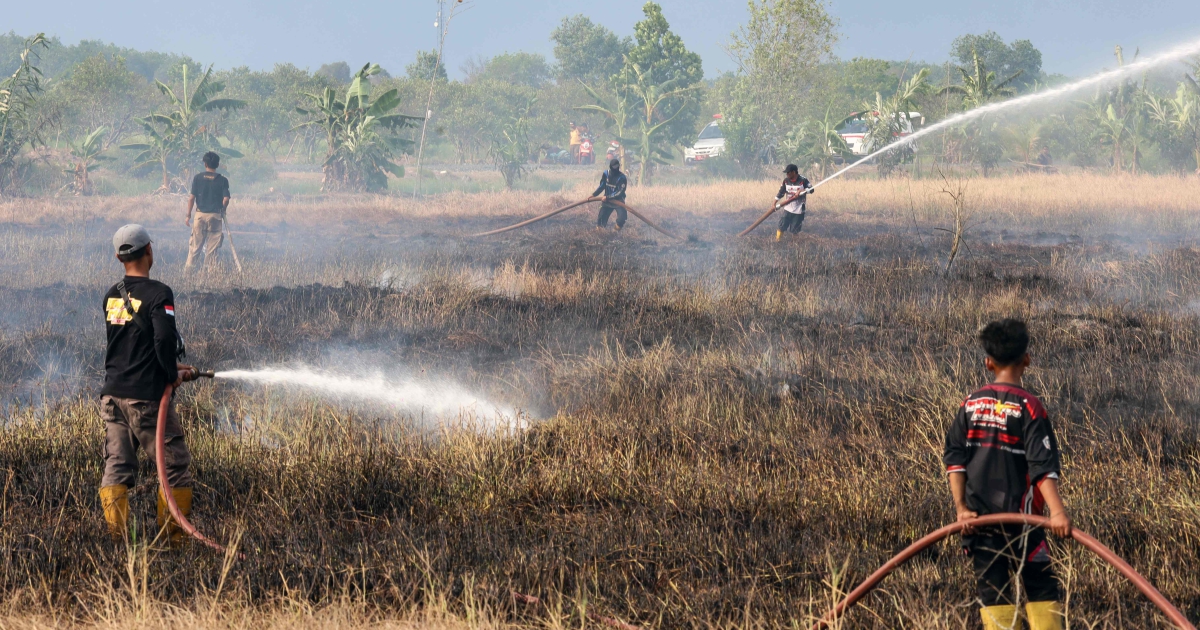
The Southeast Asian archipelago has for months been struggling to control blazes that have burned through large swathes of Sumatra, Borneo and Papua, causing choking haze that drifted to neighbouring Malaysia, Timor-Leste and Singapore.
“This incident occurred while the air fleet was conducting a water-bombing operation,” spokesman Berton said of Sunday’s crash.
“In footage captured by an amateur video, the helicopter appears to lose control while manoeuvring after scooping up water from the river with a Bambi Bucket.”
The Eurocopter EC225LP Super Puma belonged to a company the disaster mitigation agency had contracted for water-bombing operations, he added.
On Wednesday, a helicopter carrying eight people crashed during a mission to fight fires in Tanjung Puting National Park, home to animals including critically endangered Bornean orangutans.
The incident occurred while the aircraft was scooping seawater for water-bombing, according to an army statement, which added that the cause of the accident was under investigation.
Aside from ground-based firefighters, Indonesia has relied heavily on air operations to fight the fires, which have destroyed more than 1.9 million hectares, according to deforestation monitor Nusantara Atlas.
The fires are driven in part by a strong El Nino weather phenomenon, which typically causes drought in Indonesia.