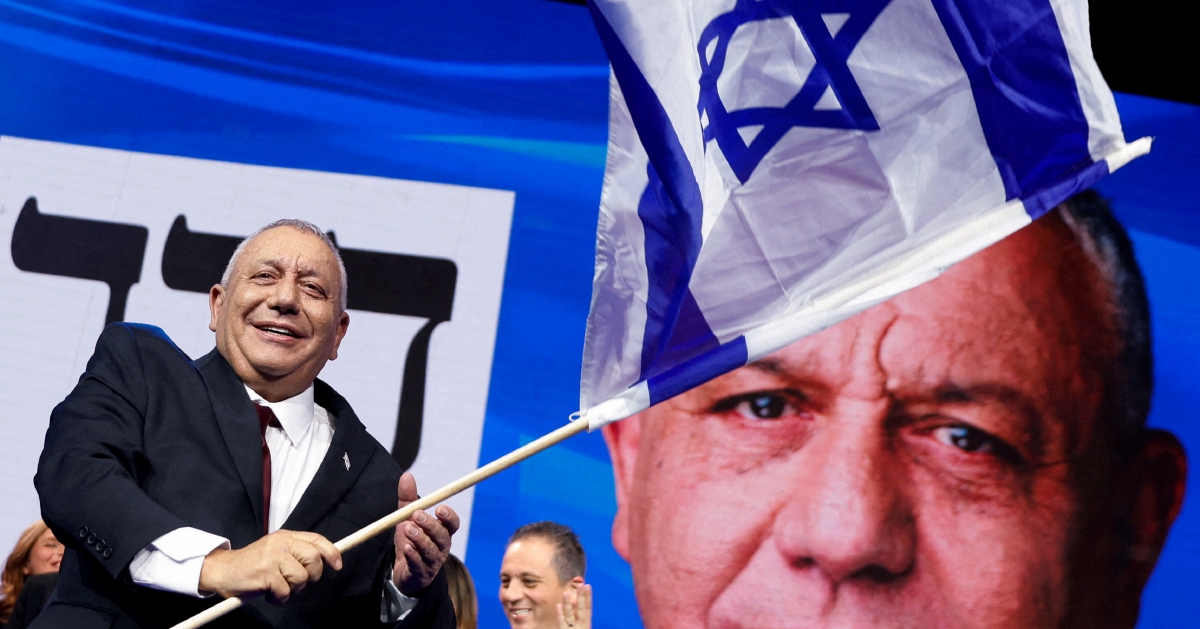

JERUSALEM: Israel’s former military chief Gadi Eisenkot was set on Sunday to be given the tough task of forming a government, with weeks to cobble together a coalition to replace Benjamin Netanyahu, the country’s longest-serving prime minister.
Eisenkot, 66, a political novice who has vowed to bridge Israel’s deep polarisation under Netanyahu, was due to meet President Isaac Herzog, who will formally give him the mandate to form a government, with an initial deadline of 28 days.
Eisenkot, born to a family of working-class Moroccan immigrants, would be the first Sephardic prime minister — a descendant of Jews from the Middle East or North Africa — in a country long dominated by an Ashkenazi elite with ties to Europe.
Netanyahu, who has been prime minister on and off for nearly two decades and has led wars in Gaza, Lebanon and Iran since the Oct 7, 2023 attacks, lost support in last month’s election, but no side claimed an outright majority.
In consultations with Herzog last week, Eisenkot received recommendations from parties accounting for 67 lawmakers, against 46 for Netanyahu.
But the vote count included Israeli Arabs, whose seat haul surged to a historic high amid anger over Netanyahu’s government, which includes far-right firebrands who have openly sought to marginalise the community.
Wooing the ultra-Orthodox
Avigdor Liberman, a former Netanyahu aide turned sharp critic who nonetheless shares his hawkish views, has been adamant against any alliance with Israeli Arabs, descendants of Palestinians who stayed after Israel’s creation in 1948.
Taking back one of his signature campaign pledges, Liberman instead voiced openness to an alliance with ultra-Orthodox Jews, whose almost singular priority is ensuring that they remain exempt from military service.
The exemption for the ultra-Orthodox — whose two main parties had been aligned with Netanyahu but could help Eisenkot secure a majority — has been a source of growing resentment among many Israelis as reservists serve multiple tours of duty.
Liberman said on Sunday he still backed conscription for all Israelis but had to make “difficult decisions” in pursuit of the higher priority of ousting Netanyahu, who faces corruption charges that could land him in jail if he loses power.
But he remained adamant that he would never ally with Israeli Arabs.
“I will not lend a hand to the establishment of such a government, which in my view will harm security and bring Netanyahu back to power,” Liberman wrote on X.
Liberman, whose party has seven seats and is the smallest within the opposition bloc, denied speculation that he was trying to engineer a deadlock that could result in him becoming prime minister.
Born in Moldova and with a party base originally made up of Russian-speaking immigrants, Liberman said commentators’ views on his motives had “sometimes a distinctly racist tone”.
Naftali Bennett, the second strongest opposition leader after Liberman, has also been outspoken against the ultra-Orthodox community’s military exemption and has remained silent since Liberman’s about-face.
‘National emergency’
Eisenkot has called for a “national emergency” government that would remove Netanyahu, calling him “a fundamental threat to the very existence of Israeli democracy”.
He has ruled out a unity government with Netanyahu, who has repeatedly called for a broad coalition with himself at the helm.
Eisenkot appears to be suggesting that he is willing to start with a minority government — relying on outside votes from Israeli-Arab parties — while continuing to seek a stable government with majority support.
Assaf Shapira, a political expert at the Israel Democracy Institute, said Eisenkot would face an especially fragile government if it had only 48 lawmakers, even if others promised to keep it in power.
“To pass laws, you need strong support from other parties,” Shapira said, explaining that an Eisenkot minority government would be forced into extensive negotiations on every piece of legislation.
Eisenkot has vowed to repair Israel’s international reputation and put an end to rampant violence against Palestinians by extremist West Bank settlers supported by Netanyahu’s government.
He has warned Netanyahu that he does not have the mandate for another attack on Iran but has also largely backed his war decisions.
Having commanded the military during the 2006 war with Hizbollah, Eisenkot devised the so-called “Dahiya doctrine”, which calls for massive force against civilian infrastructure where enemies operate — a policy critics say amounts to a war crime.
In Tel Aviv, Neri Bar-On, who works in educational technology, said he expected Eisenkot to succeed in forming a government.
“But the problems run deeper,” he said.
“The country is facing a massive internal conflict; even if he manages to form a government, it won’t solve the underlying issues.”