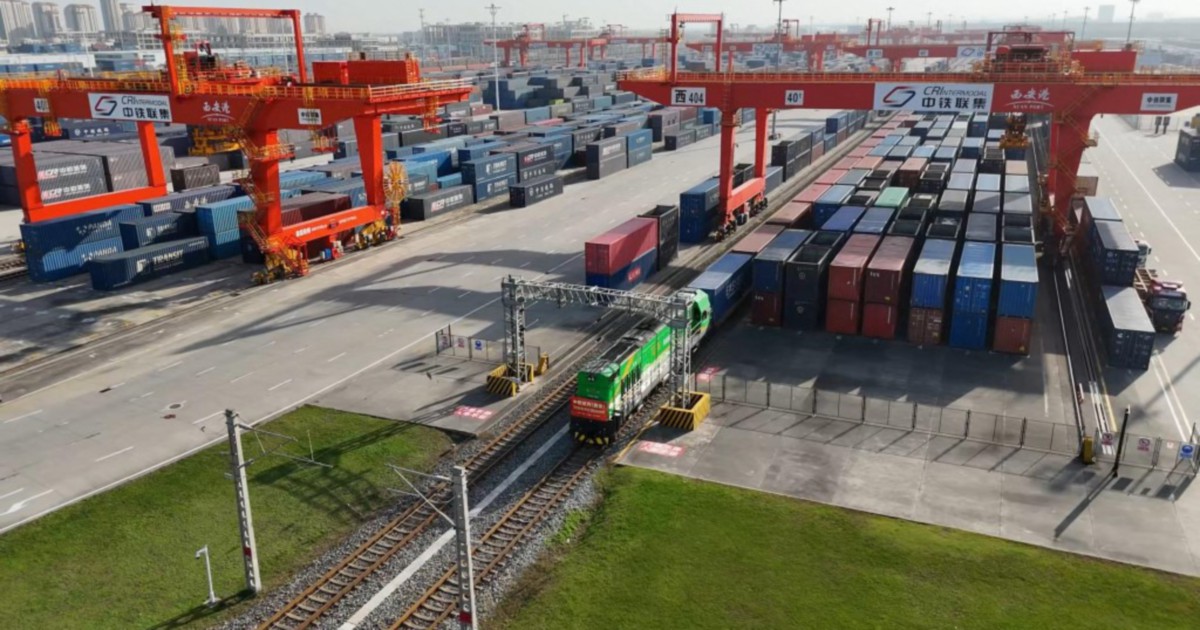

CHINA doesn’t need to clear Europe’s trade barriers. It can build inside them.
Chinese firms are establishing production and supplier networks across Central and Eastern Europe, which could enable them to gain more control over the technologies and inputs that European manufacturing needs.
China is increasingly challenging the European Union in the advanced manufacturing sectors that helped the EU weather the first China shock, which reshaped global manufacturing in the 2000s.
Chinese firms are competing with the EU in chemicals, machinery, advanced equipment and autos — and increasingly coming out on top on price and quality.
The EU trade deficit with China has nearly quadrupled over the past decade, from around 100 billion euros in 2014 to over 370 billion euros last year, or roughly one billion euros a day, according to Eurostat data.
France and Germany are seeking to push back with stronger trade defences, but import curbs will achieve little if Chinese investment, ownership and control of critical technologies recreates the same vulnerabilities inside the single market.
Central and Eastern Europe (CEE) appear to be key to China’s growth strategy in Europe.
For example, Slovenia’s goods deficit with China rose from 2.5 per cent to 16 per cent over that period. Investment and corporate ties deepened that exposure.
Last year, Chinese foreign direct investment (FDI) flows into the EU approached 16.8 billion euros, and the cumulative value of Chinese investment in the bloc was about 95 billion euros, according to Eurostat and Rhodium Group data.
While most legacy Chinese FDI in Europe centred on Germany, France and the Benelux countries, the focus has shifted east in recent years.
CEE has attracted more than half of Chinese FDI into the EU and Britain since 2021, according to an analysis by the Rhodium Group, with an even larger regional share when the Western Balkans are included.
Hungary has attracted the largest share of new investment since the Covid-19 pandemic, hitting 44 per cent in 2023 and 23 per cent last year.
The investment surge in CEE has largely been driven by mega-projects in the electric vehicle (EV) supply chain. Chinese EV and battery manufacturers CATL, BYD and Sunwoda are all establishing major Hungarian operations.
Slovakia has attracted investment from Chinese battery tech firm Gotion and will be the site of a new plant owned by Volvo Cars, the carmaker majority-owned by China’s Geely Holding.
Meanwhile, Serbia, which has significant steel and copper assets, has signed contracts with Chinese auto firms Minth, Shanghai Automotive Chassis, BMTS Technology and Xingyu Automotive, envisaging around one billion euros in investment and nearly 1,700 car-parts jobs.
The deals also include a new robotics factory in Sabac, billed as Europe’s first humanoid robot mass production base.
These investments can create jobs, spur growth, and accelerate the energy transition, but they may also erode EU competitiveness over time.
Outsourcing key advanced manufacturing technologies to Chinese entities risks deepening Europe’s dependence on external supply chains and weakening domestic innovation and research and development.
Europe is seeking to limit China’s access to its consumer markets and industries, but the current Franco-German push for faster defensive trade action and tougher investment screening across the bloc appears to be too little too late.
Europe’s flagship proposal, the Industrial Accelerator Act, leaves manufacturers’ key competitiveness gaps unaddressed.
Moreover, its screening mechanism would largely leave unexamined Chinese control via ultimate ownership, foreign subsidies and supply-chain concentration — some key issues when looking at CEE’s growing dependence.
There is also the problem of fragmentation across the bloc. Investment deals might be in one country’s interest but could weaken the bloc’s collective negotiating position with Beijing.
To address this, the continent would likely need a permanent European economic security coordination mechanism to unite trade, competition and national screening authorities that could identify risks before investments become irreversible.
Yet the chances of forming such a body at a time of growing political fragmentation within EU countries seem slim.
And, ultimately, protectionism cannot compensate for the region’s structural problems, including expensive energy, fragmented capital markets and slow industrial innovation.
For that, the region would likely need to create a true energy union and invest in technological innovation.
Building trade walls buys time, but not true change.
The writer is director of the Geoeconomics Program of the Center for the Study of Democracy