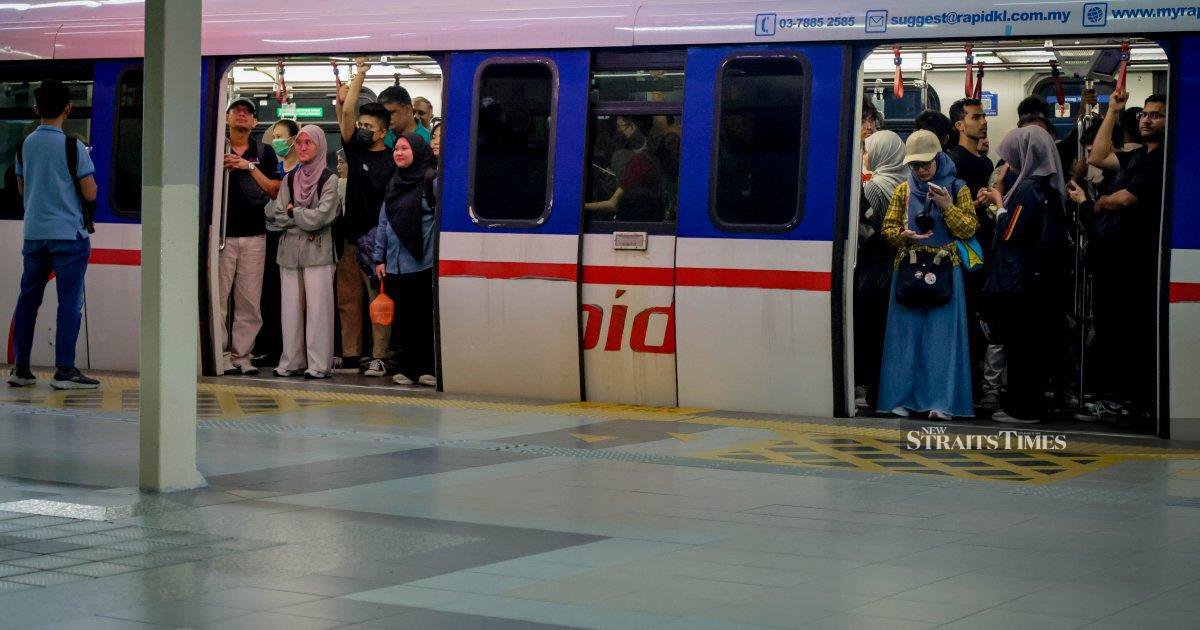

KUALA LUMPUR: Malaysia risks shifting congestion from its roads to railway platforms if the government’s push for greater public transport use is not matched by improvements in rail capacity and reliability, said experts.
Universiti Teknologi Mara’s Malaysian Institute of Transport (Mitrans) postgraduate studies head Dr Abdul Khabir Rahmat said efforts to encourage more Malaysians to use public transport must be supported by adequate capacity to accommodate growing passenger demand.
He said policies such as affordable travel passes, parking restrictions and congestion charges could encourage greater public transport adoption, but warned that capacity expansion must come first.
“We should not wait until passengers experience severe overcrowding before investing in additional capacity.
“Capacity development should precede, rather than follow, major modal shift initiatives.
“Otherwise, we risk transferring congestion from our roads to our railway platforms,” he told the New Straits Times.
Khabir said congestion reflected a growing imbalance between passenger demand and effective operational capacity.
He pointed to Rapid Rail’s reported load factor of 109 per cent in April as an indication of mounting pressure on the system.
However, he said, overcrowding was not caused solely by insufficient trains, but also by fleet availability, service frequency, station capacity and operational reliability.
“When a railway operates close to its capacity, even a relatively minor technical disruption can have a significant cascading effect across the network.”
Meanwhile, Mitrans director Associate Professor Dr Mohd Fathi Abu Yaziz @ Mohamad said the recurring congestion was primarily caused by operational constraints rather than the rail line reaching its maximum design capacity.
He said weekday ridership had climbed to nearly 290,000 passengers, almost double the 2020 figure, placing increasing pressure on the line’s ageing fleet.
“The recurring peak-hour congestion on the Kelana Jaya LRT Line reflects an acute operational availability bottleneck rather than the physical corridor having exhausted its ultimate engineering design limit.”
Fathi said the line operated 74 train sets across three generations, with ageing first-generation units contributing to an approximately 30 per cent increase in technical incidents.
He said about two-thirds of these incidents were linked to emergency braking systems, while critical spare parts could take eight to 12 months to arrive.
When fewer trains were available, service intervals would increase, causing overcrowding at busy stations including Jelatek, KLCC, Masjid Jamek and Pasar Seni.
Fathi warned that recurring disruptions and overcrowding could discourage commuters from continuing to use public transport.
“From a behavioural perspective, modal shift is fragile: commuters who leave their cars behind prioritise predictability and comfort.”
He said the rail network could accommodate additional off-peak passengers but required immediate reliability improvements to sustain higher peak-hour demand.