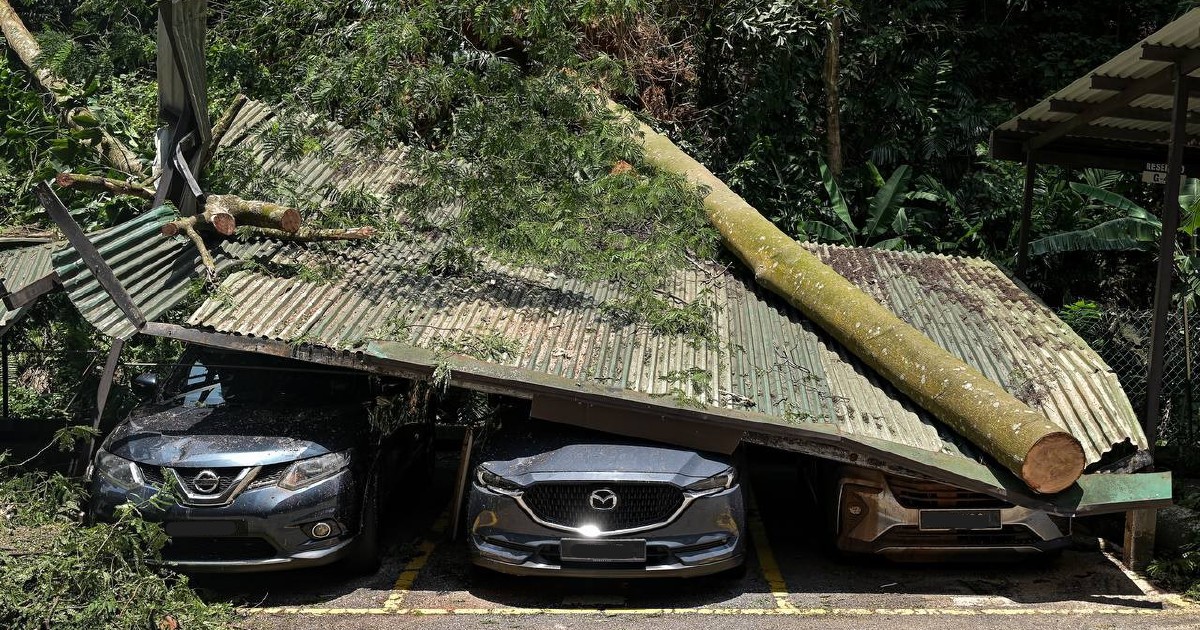

LETTER: The Road Safety Expert Association (RSEA) expresses serious concern over recurring incidents of fallen trees that continue to threaten the safety of road users.
This includes the latest incident along Jalan Templer towards Batu Caves, where a tree reportedly fell onto a lorry, completely blocking all lanes of the road.
The incident rendered the affected route impassable, forcing road users to seek alternative routes.
RSEA believes that such incidents should not be regarded as unusual occurrences or merely as landscaping maintenance issues. Instead, they must be recognised as road infrastructure and environmental safety risk management issues.
Fallen trees can become ‘booby traps’ on our roads because the danger may remain hidden, difficult for members of the public to identify, and can occur without giving road users sufficient time to react.
- THE PRIME MINISTER’S DIRECTIVE MUST BE TRANSLATED INTO ACTION
RSEA wishes to emphasise that the issue of hazardous trees threatening public safety is not new.
Previously, the Prime Minister, Datuk Seri Anwar Ibrahim (PMX), had issued directives concerning the management of hazardous trees, including the removal of trees that could pose a danger to the public.
In this regard, RSEA urges all Local Authorities (PBT), the Public Works Department (JKR), the Ministry of Works (KKR), state governments and relevant agencies to ensure that these directives and safety policies are translated into consistent and effective action.
Local authorities, in particular, must adopt a more proactive approach in identifying, assessing and managing high-risk trees under their respective jurisdictions.
Trees identified as high-risk and no longer safe to retain must be removed based on proper technical assessments and established safety procedures.
Do not wait until a tree falls, a vehicle is crushed or a road user’s life is lost before taking action.
- THE SHORTAGE OF ARBORISTS MUST NOT BECOME AN EXCUSE FOR INACTION
RSEA acknowledges that the number of arborists, or qualified tree assessment specialists, currently available in Malaysia is estimated at approximately 150, based on the information referenced.
This number is clearly insufficient if the government intends to conduct detailed inspections of every potentially hazardous tree nationwide within a short period.
However, the real issue is not simply the shortage of specialists, but also the approach and audit model being adopted.
RSEA believes it would be impractical to expect arborists to individually inspect every tree throughout the country.
Instead, the government should implement a:
- RISK-BASED TREE AUDIT APPROACH
This approach prioritises trees that pose the highest potential risks to human safety, without having to wait until a complete national tree inventory and inspection exercise has been completed.
- WHY CAN FALLEN TREES BE CONSIDERED ‘BOOBY TRAPS’ ON OUR ROADS?
Unlike potholes or road surface defects, which can generally be seen and avoided by road users, the risks associated with potentially dangerous trees may not be identifiable through ordinary visual observation.
A tree may appear healthy externally but could have underlying structural problems, including:
- Rotten, damaged or weakened roots.
-
Hollow tree trunks.
-
Cracks in the trunk or major branches.
-
Dead branches or branches carrying excessive weight.
-
A progressively worsening lean.
-
Structural damage caused by heavy rain, storms or construction activities.
-
Unstable soil conditions or soil erosion.
When such a tree suddenly falls, motorists and motorcyclists may have insufficient space or time to take evasive action.
These risks can result in serious injuries, fatalities, vehicle damage, blocked emergency access routes and major disruptions to traffic movement.
For this reason, RSEA uses the analogy of ‘booby traps’ to describe hidden dangers that can threaten road users without sufficient warning.
- RSEA RECOMMENDS A THREE-STAGE TREE RISK MANAGEMENT APPROACH
To ensure that this approach can be implemented practically, RSEA proposes three key stages:
STAGE 1: INITIAL SCREENING – PRELIMINARY ASSESSMENT
Not every tree needs to be inspected by an arborist.
Local authorities, JKR, road maintenance contractors, landscape officers and field personnel should receive appropriate training to conduct Rapid Visual Screening.
This preliminary screening aims to identify visible warning signs and determine which trees require further technical assessment.
STAGE 2: ARBORISTS AS EXPERT VERIFIERS – SPECIALIST ASSESSMENT
The estimated 150 available arborists should be mobilised as a specialist team to verify and conduct detailed assessments of trees identified as high-risk.
Inspection priorities should include:
- Trees along highways and major roads.
-
Areas near schools and hospitals.
-
Pedestrian zones and public gathering areas.
-
Motorcycle routes and areas with high traffic volumes.
-
Recreational parks and public spaces.
-
Old, large trees and trees with suspicious structural conditions.
-
Locations with a history of fallen-tree incidents.
-
Areas frequently affected by storms and heavy rainfall.
-
Trees leaning towards roads, buildings or public areas.
Trees confirmed to pose high risks must be subjected to immediate mitigation measures, including removal where remedial measures cannot adequately ensure public safety.
STAGE 3: NATIONAL TREE RISK REGISTER
RSEA also proposes the establishment of a National Tree Risk Register, a digital database documenting all trees identified as high-risk.
The records should include:
- Tree location and geographical coordinates.
-
Tree type or species.
-
Estimated age and size.
-
Physical and structural condition.
-
Risk classification.
-
Photographs and inspection records.
-
Date of the latest inspection.
-
Required corrective or mitigation measures.
-
Monitoring status and next inspection date.
This system would enable local authorities, JKR and relevant agencies to continuously monitor tree conditions and determine maintenance priorities and resource allocation.
- SHIFTING FROM A REACTIVE TO A PROACTIVE APPROACH
RSEA emphasises that the government must change its approach to tree risk management, moving away from taking action only after incidents occur towards preventing incidents before they happen.
The short-term objective should be to identify trees that pose the highest risks to human life and take immediate preventive action.
This approach is more consistent with the principles of proactive road safety management.
- RSEA’S RECOMMENDATIONS FOR IMMEDIATE GOVERNMENT AND LOCAL AUTHORITY ACTION
RSEA urges the Federal Government, state governments, local authorities, JKR and relevant agencies to:
- Issue directives for the implementation of a nationwide tree risk audit.
-
Prioritise inspections of high-risk trees along major roads and public areas.
-
Train local authority officers, JKR personnel and maintenance contractors to conduct preliminary screening.
-
Mobilise arborists as specialist verification and technical assessment teams.
-
Immediately remove trees confirmed to be dangerous and unsafe to retain.
-
Establish a National Tree Risk Register for continuous monitoring and integrated management.
-
Allocate dedicated funding for tree maintenance and risk mitigation measures.
-
Ensure immediate emergency action is taken whenever trees show signs of instability, particularly following storms and heavy rainfall.
RSEA wishes to emphasise that the shortage of arborists must never be used as an excuse to delay preventive action.
We do not need to wait for a tree to fall before proving that it is dangerous.
Risks must be identified before structural failure occurs.
The management of hazardous trees is not merely a matter of landscaping, urban beautification or public park maintenance. It is an integral part of road infrastructure safety management and the responsibility to protect the lives of road users.
Road users should never become the individuals who have to test whether a tree is still safe or not.
RSEA believes that a risk-based management approach, supported by arborist expertise, preliminary screening by trained personnel and a national digital database, can help the government address this issue in a more systematic and effective manner.
JAMIL MANAN SUPRI
Founder & Road Safety Advisor
Road Safety Expert Association (RSEA)