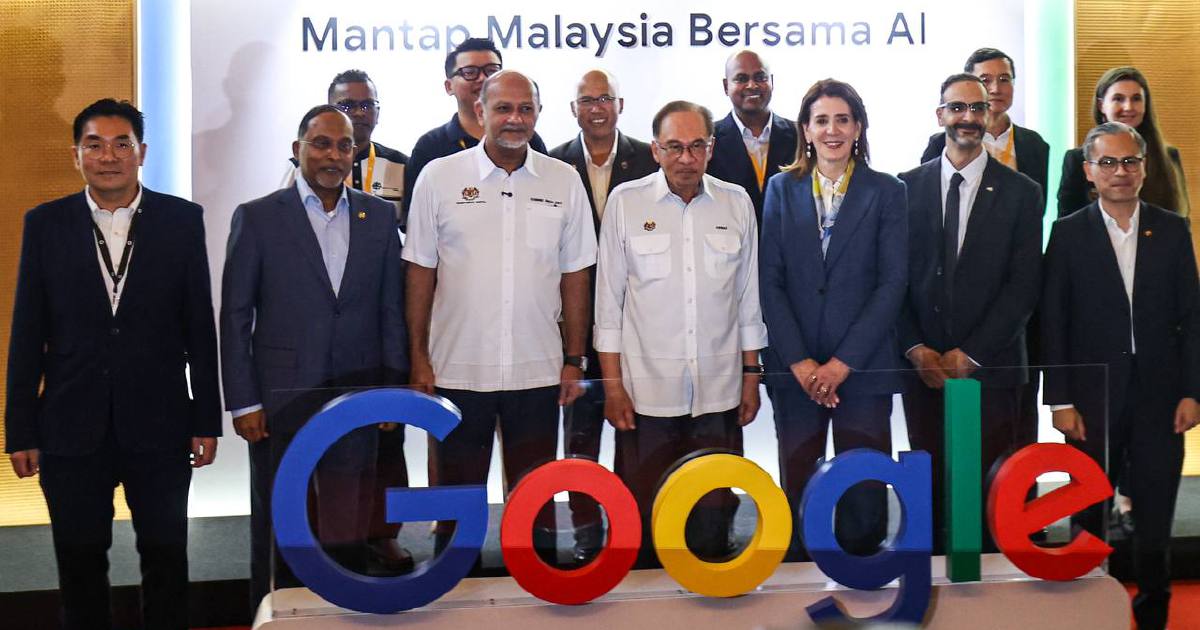

KUALA LUMPUR: Google will invest US$15 billion in Malaysia between 2027 and 2028 to develop digital infrastructure, including data centre campuses in industrial zones, and expand clean energy capacity and strengthen local water security.
The investment, announced in the presence of Prime Minister Datuk Seri Anwar Ibrahim today, forms part of Google’s plan to support Malaysia’s next phase of digital growth through energy-efficient infrastructure and initiatives to upskill about 800,000 Malaysians by 2031.
The company also plans to add more than one gigawatt (GW) of clean energy capacity to the national grid through new collaborations.
The latest investment builds on Google’s more than 15-year presence in Malaysia and expands on its digital infrastructure investment announced in 2024.
Its infrastructure footprint includes its first operational data centre campus at Elmina Business Park and new planned campuses in Selangor and Negri Sembilan.
Google said the in-country infrastructure will provide the computing capacity needed to run homegrown, next-generation digital and artificial intelligence (AI) applications, while powering services such as Search, Maps and Chrome used by millions of people and organisations across Malaysia and the Asia-Pacific region.
The computing capacity in Selangor will also support Google’s upcoming Google Cloud region in Malaysia for enterprise customers.
Google said its cloud capabilities would enable organisations, including AEON360, AirAsia, Bank Muamalat Malaysia Bhd, Gamuda, Hong Leong Bank, Maxis, the Selangor Technical Skills Development Centre, the Digital Ministry and Higher Education Ministry to develop and scale secure, high-performance, low-latency services and advanced customised AI solutions.
Alphabet and Google president and chief investment officer Ruth Porat said Google is committed to growing its presence responsibly, delivering lasting value for Malaysia’s economy and people.
“This investment aligns with Malaysia’s development priorities – providing the foundational computing capacity to deliver the upside of innovation across the country while adding local power and water resources as our operations scale.
“At the community level, Google is proud to partner with local suppliers to expand their expertise and to equip workers, students, and entrepreneurs with in-demand skills, enabling Malaysians to capture the new opportunities unlocked by this computing capacity,” she said in a statement today.
Digital Minister Gobind Singh Deo said Google’s comprehensive blueprint sets a high standard for sustainable, high-impact digital infrastructure development in Malaysia.
He said guided by the Malaysia Madani framework and the Malaysia Digital 2030 Action Plan, the goal was to cultivate an ecosystem that strengthens Malaysia’s technological capabilities, protects public resources, and empowers our people.
“Through its commitment to clean energy and water resilience, alongside deep partnerships with Malaysian institutions and enterprises, Google is helping to anchor a high-value digital economy where local businesses, workers, and communities directly benefit from the transformative potential of AI and digital innovation,” he said.
Economic Contributions And Job Creation
Google is working with more than 80 Malaysian entities across its domestic supply chain to develop and operate its infrastructure in the country.
The collaboration covers construction and civil engineering, network infrastructure, power and cooling system components, as well as logistics, legal, catering and waste management services.
Google said the partnerships would continue throughout the data centres’ multi-decade operational lifecycle, enabling local suppliers to build on their capabilities and move up the value chain, both domestically and globally.
The construction of its new campuses between 2027 and 2028 is expected to contribute an annual average of US$1.1 billion to Malaysia’s gross domestic product (GDP) and support more than 37,000 local jobs a year.
The construction phase is also expected to generate an average annual labour income of US$378 million, with about 6,000 of the jobs estimated to be in construction.
Once operational, the facilities are projected to sustain more than 9,000 local jobs annually, with wages averaging 45 per cent above the national median.
These include specialist on-site positions such as data centre technicians, mechanical and electrical engineers, logistics operations managers and physical security managers, alongside contractor roles with local suppliers and jobs in businesses serving employees and their families.
Google said it had established a full local on-site team for its operations at Elmina Business Park and was recruiting local technical and facilities management talent for its other planned campuses.
Upskilling 800,000 Malaysians
Beyond direct hiring, Google is introducing four programmes to upskill 800,000 Malaysians over five years, from 2027 to 2031, focusing on educators and youth, microentrepreneurs, civil servants and vocational jobseekers.
The programmes will initially target communities in states hosting its campuses.
The Experience AI Malaysia programme, developed with the Education Ministry, Penang Science Cluster and Raspberry Pi Foundation, aims to advance AI literacy in classrooms nationwide by certifying educators to teach students aged 11 to 14.
The curriculum will focus on hands-on learning, equipping students with critical thinking skills to direct AI in problem-solving and evaluate its outputs.
Meanwhile, Jelajah AI MSME, in collaboration with Pepper Labs, will help grassroots businesses develop digital assets such as searchable online business profiles and digital storefronts to reach customers beyond their neighbourhoods.
The programme will begin with a pilot cohort of microentrepreneurs in Selangor and Negri Sembilan before expanding nationwide.
Another initiative, Anjakan Kemahiran AI Demi Rakyat (AKAD Rakyat), will be carried out with Arus Academy to equip council officers and constituency members with AI literacy skills and productivity tools.
It will target 19 local government councils in Selangor and Negri Sembilan, while appointing dedicated AI champions to modernise workflows and help frontline staff automate routine paperwork.
Google also plans to establish Data Centre Institutes in selected polytechnics in Selangor and Negri Sembilan from 2027.
The initiative will train and place local Technical and Vocational Education and Training (TVET) jobseekers in data centre deployment and operations roles through a 10-week curriculum led by industry experts.
The training will include practical sessions using a physical data centre simulator provided by Google to prepare candidates for on-site roles at hyperscale facilities.
The new programmes complement Google’s existing community initiatives, including Future Skills 4 All with UNICEF Malaysia, CelcomDigi, the Malaysia Digital Economy Corporation and Arus Academy, as well as Pathway to Prosperity with the United Nations Institute for Training and Research and the Selangor Human Resource Development Centre.
Earlier this week, Google announced education and training initiatives with SOLS Foundation to establish Solar and Energy Labs in local public schools and equip youth from lower-income backgrounds and Indigenous communities for skilled trades in clean energy.
Water Security And Responsible stewardship
On water security, Google said it uses a data-driven water risk framework at each data centre location to assess watershed health and only considers water cooling when local resources are healthy and resilient.
Its assessments in Selangor and Negri Sembilan, conducted with environmental scientists, hydrologists and water sustainability experts, found that local watershed supplies were not at high risk of scarcity or depletion, informing its decision to use water cooling at the campuses.
The company has been working with the Global Environment Centre (GEC) and Petaling Jaya City Council on nature-based solutions at Taman Aman Lake.
This includes floating constructed wetland cells to help reduce algae blooms, improve water quality and enhance biodiversity.
In addition to this project and the development of an off-river storage reservoir and water treatment plant in Negri Sembilan, Google announced two new water replenishment projects.
The first involves expanding its collaboration with GEC to introduce nature-based solutions and community-led initiatives in the Sungai Buloh and Sungai Selangor river basins.
These include constructed wetlands, riverbank bioengineering and pollution monitoring to improve raw water quality, enhance river ecosystems and reduce filtration and treatment burdens on downstream water treatment plants.
The second project involves establishing school-based water resilience centres in collaboration with CLEAN International, Water Watch Penang and Gravity Water.
The initiative will install 20,000-litre storage tanks, rainwater harvesting systems and self-closing faucets at four schools in Selangor.
Google said the facilities would reduce schools’ operating costs by replacing municipal water with harvested rainwater for non-potable needs and curbing unintended water loss.
During unscheduled municipal water supply disruptions, each school would be able to provide at least two weeks of emergency water capacity for up to 2,000 community members.
The water replenished through the projects will be quantified using the Volumetric Water Benefit Accounting methodology and audited by independent third-party hydrologists.
Google said water cooling could reduce a data centre’s energy consumption by about 10 per cent compared with air cooling.
More Than 1GW Of Clean Energy Capacity
On energy, Google plans to bring more than 1GW of new clean energy capacity to Malaysia’s national grid to increase power supply and accelerate the country’s clean energy transition alongside the growth of the digital economy.
The initiative builds on its existing partnerships with consortiums led by Shizen Energy-Solarvest and TotalEnergies to support grid resilience and decarbonisation.
Through its collaboration with Tenaga Nasional Bhd, Google plans to enable the development of new clean energy generation facilities under Malaysia’s Corporate Renewable Energy Supply Scheme.
The collaboration will also explore round-the-clock clean energy projects to address the intermittency of renewable energy sources such as solar.
Google will pay for 100 per cent of the electricity consumed by its data centre campuses, as well as the direct infrastructure costs required to connect them to the grid, while complying with applicable local regulations.
In 2027, the company plans to invest in community-based initiatives to strengthen grid resilience and safeguard energy affordability, including programmes to reduce electricity bills for households in states hosting its infrastructure.
This builds on its household electrification work with SOLS Foundation, which has installed solar systems for off-grid Orang Asli homes in Kampung Sungai Relang and Kampung Air Kuning, with plans to expand to Kampung Sejantung next year.
Google said it also designs its facilities to minimise electricity requirements through custom-designed networking equipment, coolant distribution units, power distribution systems and chips for general-purpose computing and AI workloads.
This enables its data centres to achieve a Power Usage Effectiveness (PUE) of between 1.12 and 1.14 in warmer tropical climates such as Malaysia, compared with the industry average of 1.54.
The company said it would disclose quarterly PUE figures for each site once fully operational