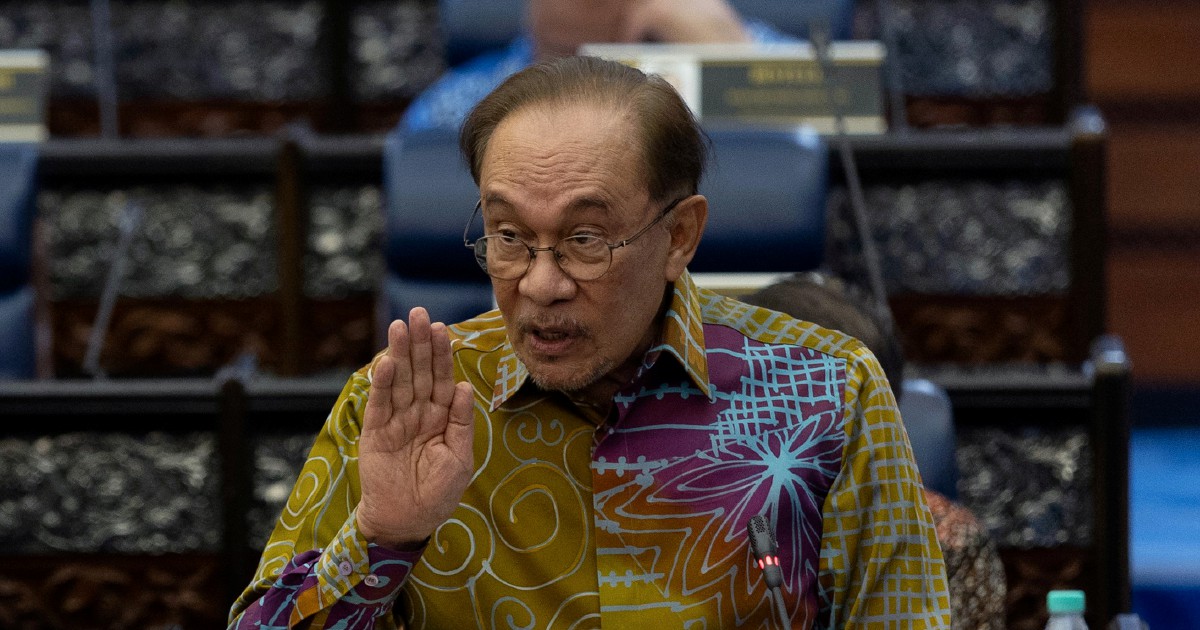

KUALA LUMPUR: The government’s refusal to reintroduce the Goods and Services Tax (GST) is driven by macroeconomic considerations rather than political reasons, Prime Minister Datuk Seri Anwar Ibrahim said.
Anwar, who is also finance minister, said the government remained concerned that reintroducing the broad-based consumption tax would place an additional burden on Malaysians whose incomes were still relatively low.
“This is not about politics. What is political about it if it benefits the country’s economy and the people?
“For me, this is an important macroeconomic consideration that is debated in many countries, not just here,” he told the Dewan Rakyat.
Anwar was responding to Datuk Seri Dr Ronald Kiandee (PN-Beluran), who questioned whether the government’s insistence on retaining the Sales and Service Tax (SST) was driven by political considerations rather than the merits of the taxation systems.
Kiandee argued that GST could address the cascading effect of SST, where taxes imposed at different stages of production and distribution could increase costs for businesses and consumers.
He also questioned whether the government would consider incorporating GST features into a hybrid taxation system.
Anwar said the tax could be reconsidered when Malaysians’ incomes had increased substantially, citing RM4,000 to RM5,000 as an illustrative level.
“The people’s incomes are still relatively low. We are only trying to raise the minimum wage to RM2,000, and even that is difficult because many businesses are opposed to it.
“That is why I reject the proposal to introduce GST at this time,” he said.
Anwar also challenged claims that GST would necessarily generate significantly higher government revenue.
He said SST currently contributed 2.2 per cent of gross domestic product (GDP), matching the contribution recorded under GST in 2017.
“SST now generates 2.2 per cent of GDP. That is the same figure as GST in 2017.
“So there is no basis to claim that introducing GST would increase revenue,” he said.
He added that about 700,000 businesses were affected by GST in 2018, compared with 130,000 under SST this year.
Anwar acknowledged that GST had advantages in terms of efficiency and transparency, but said those benefits had to be weighed against its potential impact on lower-income households.
He also said major business groups and chambers of commerce had repeatedly called for GST to be reintroduced during Budget consultations.
However, he maintained that the government’s priority was to ensure the taxation system did not worsen the cost-of-living pressures faced by ordinary Malaysians.
Anwar said he remained open to examining proposals supporting GST and welcomed further debate on the merits of both taxation systems.