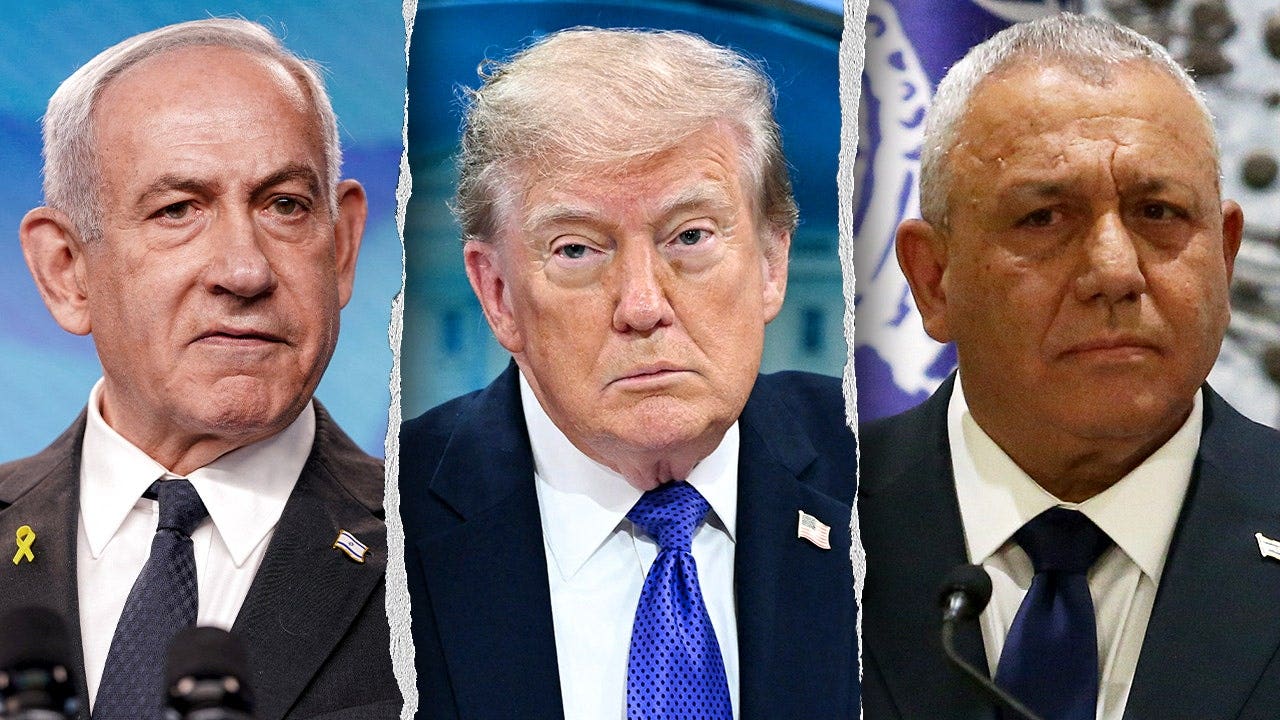

The politician tasked by Israel’s president to form a new government, Gadi Eisenkot, said Monday that Iran poses no immediate threat requiring military action before a new government is formed, drawing a sharp response from Prime Minister Benjamin Netanyahu as President Donald Trump considers renewed strikes against Tehran.
The dispute comes amid a political power struggle following last month’s Israeli election. Netanyahu remains caretaker prime minister, but Eisenkot’s allies now control the leadership of the Knesset and key parliamentary committees as negotiations over a new government continue.
“Today I see no direct and immediate threat to Israel that requires action before a government is formed,” Eisenkot, who previously served as the IDF chief of staff, told his party’s Knesset faction, according to an English translation of his Hebrew remarks provided to Digital.
ISRAEL’S POLITICAL SHAKE-UP ENTERS NEW PHASE AS FORMER PM PLAYS KINGMAKER — AND DEADLINE LOOMS
He stressed that Iran remains Israel’s gravest security threat, particularly its nuclear program.
“In my view, the gravest threat from Iran is its stockpile of 440 kilograms of uranium enriched to 60%,” Eisenkot said. “It has yet to be destroyed or removed.”
He called for the material at a minimum to be placed under strict monitoring.
Netanyahu pushed back hours later, accusing political rivals of downplaying the Iranian threat for political reasons.
NETANYAHU’S BLOC FALLS SHORT AS LONGTIME ALLIES REPORTEDLY WEIGH MOVE THAT COULD END HIS RULE
“The Iranian threats are real,” he said before a Likud faction meeting, according to TPS-IL. He renewed his call for a national unity government, signaling room for compromise on ultra-Orthodox military conscription while rejecting a coalition dependent on Arab-led parties.
The status of Iran’s uranium remains uncertain. The International Atomic Energy Agency last verified approximately 440.9 kilograms enriched to 60% before attacks on Iranian nuclear facilities in June 2025, but inspectors have since lost continuity of knowledge about the material. The U.S., Britain, France and Germany highlighted that verification gap in a Nov. 19 statement.
Adding another perspective Monday, former Mossad director David Barnea urged military action against Iran “as soon as all conditions allow.”
Speaking at The European Leadership Network Jerusalem conference, Barnea warned that “a diplomatic agreement with the Ayatollah regime will never succeed,” according to The Times of Israel, although he also acknowledged the option of giving sanctions more time.
TRUMP WARNS OF NEW STRIKES AGAINST IRAN AFTER NEW YEAR, CALLS NEGOTIATORS ‘PROFESSIONAL TAP DANCERS’
The competing assessments followed Trump’s comments Sunday to chief foreign correspondent Trey Yingst that he was inclined to resume strikes against Iran after the new year if talks failed.
Trump called Iranian negotiators “professional tap dancers” and warned that ships challenging the U.S. naval blockade could be sunk.
In a response to Digital, a U.S. official said the administration believes its economic pressure campaign has been effective enough that major military operations are not currently necessary, while emphasizing that Trump retains all options. “As President Trump and Secretary Rubio have stated, our economic pressure campaign is devastating Iran to such an extent that the President does not have any need to conduct major combat operations,” the official said on background.
“However, President Trump has all options at his disposal to ensure that Iran can never have a nuclear weapon. President Trump holds all the cards and will do whatever is best for the United States.”
An Israeli source familiar with discussions within the opposition told Digital that there are assessments that anti-government demonstrations in Iran could intensify as the blockade adds to economic pressure.
According to the source, those assessments are contributing to an argument for waiting before launching another major military operation. The forecast has not been independently verified.
IRAN VOWS ‘ASTONISHING’ STRIKES AND LIFTS MISSILE-RANGE LIMIT AS US TARGETS LAND ROUTES
The blockade has already significantly curtailed Iranian oil exports. Reuters reported Monday that visible Iranian crude exports had dropped to near zero in recent months.
Iranian Foreign Ministry spokesman Esmaeil Baghaei said Tehran would use all available means to oppose the restrictions, calling them military aggression, according to Reuters.
The disagreement over Iran is unfolding as Eisenkot attempts to turn an electoral advantage into a governing coalition.
Israel’s Oct. 27 election left no bloc with a governing majority. Eisenkot’s four-party alliance won 48 seats in the 120-member Knesset, while Netanyahu’s traditional right-wing and religious allies secured 53, including 13 held by the ultra-Orthodox parties. But those alliances have since shifted. United Torah Judaism, which holds seven seats, declined to endorse Netanyahu and has entered coalition negotiations with Eisenkot, leaving the prime minister with just 46 lawmakers formally backing his bid to remain in office.
Eisenkot, meanwhile, received the support of 67 lawmakers, including 19 from Arab-led parties, although significant disagreements remain over the composition of a future government.
Unlike Congress, Israel has a single-chamber parliament. Although Netanyahu remains in charge of the caretaker government, the new parliamentary majority can advance legislation and exercise oversight without first forming a government.
Eisenkot ally Matan Kahana is now Knesset speaker. Former Defense Minister Avigdor Liberman heads the Foreign Affairs and Defense Committee, Liran Avisar Ben Horin chairs the provisional Finance Committee, and Yashar lawmaker Roy Folkman leads the Arrangements Committee, which helps organize parliamentary business.
IRAN NUCLEAR DEAL HINGES ON IAEA ACCESS TO LONG-BLOCKED ATOMIC WEAPON SITES, EXPERTS SAY
Those appointments have practical consequences.
At a Nov. 17 Finance Committee meeting, officials said approximately 1.5 billion shekels in coalition funds remained unallocated. Avisar Ben Horin instructed the Finance Ministry to submit requests involving those funds separately so lawmakers could scrutinize them, according to an official Knesset announcement.
The new majority is also advancing legislation to reverse changes to judicial appointments and other measures adopted under Netanyahu, though the bills have not become law.
The Israeli source said opposition leaders view control of the committees as an opportunity to restore parliamentary oversight after years in which Netanyahu’s coalition dominated the legislative agenda.
The source said they also hope to put Eisenkot in a stronger position should Israel return to the polls.
Eisenkot said any coalition must respect his core principles, including establishing a state commission of inquiry into the Oct. 7 attacks and expanding mandatory military service.
“There will be no compromise on establishing a state commission of inquiry,” he said. “There will be no compromise on mandatory service for all.”
The debate over when to act against Iran now unfolds alongside another unresolved question in Jerusalem: who will lead Israel when that decision is made.
Reuters contributed to this report.