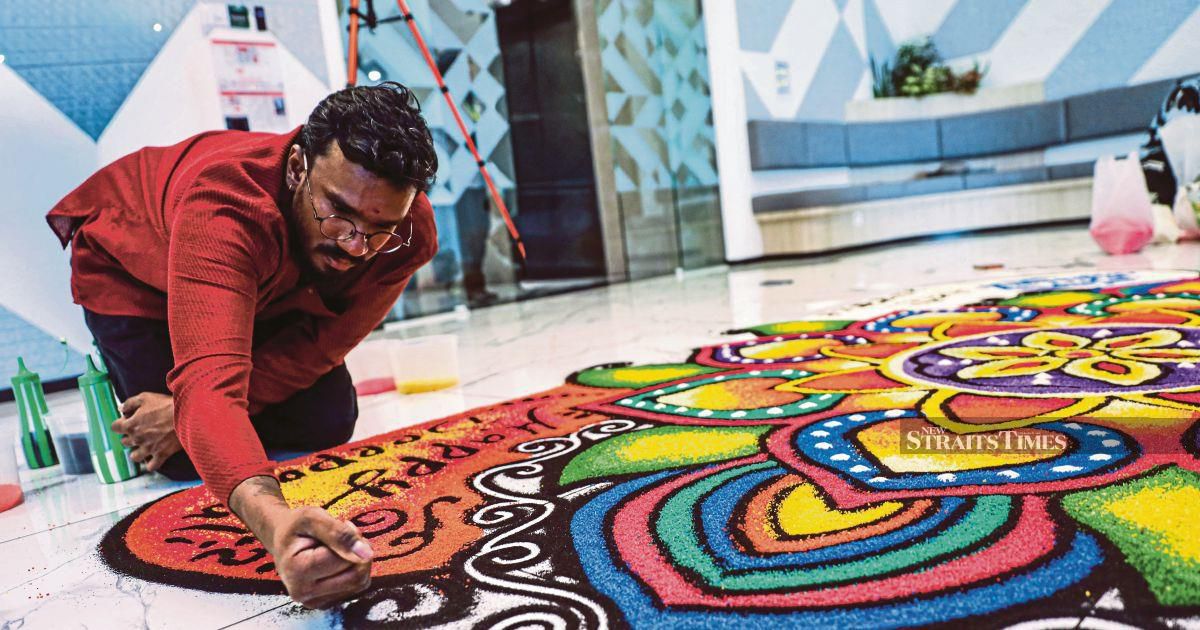

KUALA LUMPUR: Grain by grain, Sivabalan Arumugam transforms ordinary rice grains into intricate works of art.
With nimble hands, he moves across the floor, bringing vibrant kolam designs to life.
For the 36-year-old founder of Life Creation and Design Rangoli Kolam, the temporary nature of his creations has never dampened his passion for the traditional art form.
His fascination with colour has fuelled a lifelong commitment to preserving the craft while finding new ways to bring it into modern spaces.
Sivabalan has spent nearly 21 years working professionally in the field, having started at the age of 15. His creations have adorned shopping malls and office spaces.
His dedication earned him a place in the Malaysia Book of Records in October 2024 for creating the “Most Colours in a Single Rangoli Kolam”.
The record-setting creation measured 20 x 25 feet and featured 100 distinct shades, with Sivabalan coming up with the entire design himself.
His interest in kolam began at the age of 7, when he started creating designs at home during festive occasions such as Deepavali and Pongal.
“My father could draw very well as a mechanical engineer, and I learnt from him. I really love colours. Whenever I draw a kolam, I feel happy,” he said.
Trained in graphic design, Sivabalan handles both the design and execution of his creations, relying largely on freehand techniques rather than ready-made patterns.
He draws inspiration from books, online videos and textiles, as well as frequent trips to India, where he observes locals creating kolam outside their homes and in temples.
“Every day, the people, including women and children, design kolam in front of their houses and temples.
“The kolam they draw uses only white kolam powder, which is different from the kolam we make in Malaysia,” he said.
His eye for colour combinations has led him to experiment with different shades, giving each design its own character.
But bringing each design to life requires months of painstaking preparation.
Rather than relying entirely on commercially available coloured rice, Sivabalan prepares his own using broken rice and food colouring, including jelly and cake colouring.
ART THAT DOESN’T LAST
For all the hours spent preparing and arranging the rice grains, a kolam remains a temporary creation.
A large installation can take three to four months to prepare and several days to complete, only to be cleared soon after the celebrations end.
“It is sad seeing the kolam swept away after hours of hard work. But that’s just how the process goes when making a kolam.
“We can only look forward to next year’s celebration and come up with newer designs to make our kolam even better,” Sivabalan said.
PASSING IT ON TO THE NEXT GENERATION
For Sivabalan, the fleeting nature of kolam is a reminder to value not just the finished creation, but also the skill, patience and preparation behind it.
He believes the tradition can survive only if it is passed on to those willing to learn and practise the craft, particularly younger generations.
“I definitely want to teach the younger generation so they can appreciate the culture and it won’t be forgotten,” he said.