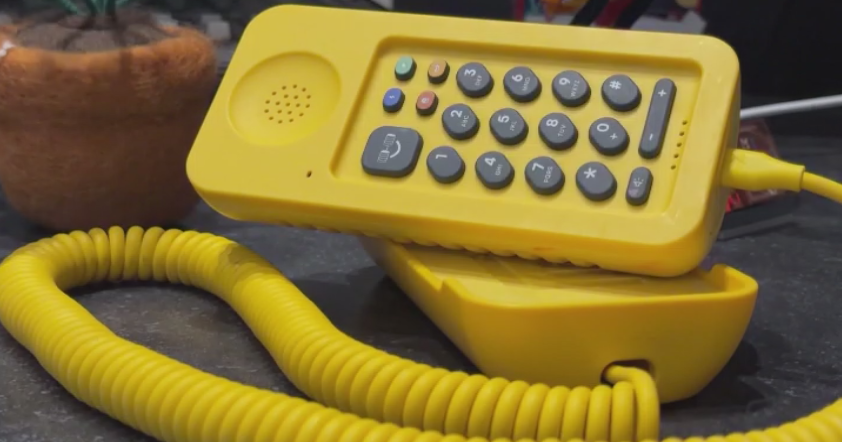

As more parents question what age is appropriate to give their children smartphones, a new generation of internet-connected landline phones is offering families an alternative.
The Tin Can Phone, a corded telephone that connects through a home’s internet service, is gaining popularity among families looking to give children a way to communicate with friends without the distractions and features of a smartphone.
Nearly half of all children in the United States have a smartphone by age 10, according to nonprofit Common Sense Media. A recent study by Lurie Children’s Hospital of Chicago found that more than one-third of parents believe their child received their first smartphone too early. Some said they felt pressured to give their children a phone.
St. James Episcopal School decided to gift every student a Tin Can Phone as an alternative for families who want to delay smartphone use.
Jules Leyser, the school’s director of advancement and communications, said the idea was rooted in the school’s philosophy.
“Our whole mission here at St. James is to preserve the wonder of childhood,” Leyser said.
Julia Emescu, the mother of 7-year-old Remy, wanted to give her daughter a way to talk to friends without introducing her to a smartphone.
Emescu got her a Tin Can Phone, which brought back memories of her own childhood.
“Honestly, at first, just the nostalgia factor for me, just me remembering when I was eight years old, talking on the phone with my friends and then seeing her do it, it was amazing,” Emescu said.
Chet Kittleson, co-founder and CEO of Tin Can Phone, says that he wanted to bring back the phone that raised so many.
The device resembles a traditional landline telephone, complete with a cord and handset, but connects through a home’s internet connection rather than a traditional copper telephone line.
It has no screen, and parents must approve the contacts their children can call. Calls between Tin Can phones are free, while communicating with traditional phones, including cellphones, requires a monthly subscription.
For 10-year-olds Leah and Sidney, both fifth graders at St. James Episcopal School in Los Angeles’ Koreatown neighborhood, the phones have become a regular way to stay in touch. Leah and Sidney said they talk nearly every day.
“I just think it’s really good for children smaller than me, and also me too, that I’m able to communicate with my friends and my peers without having to go ask my mom,” one student said.
Both girls know classmates and other children who already have cellphones, but neither has one.
When asked whether having the Tin Can Phone makes them want a cellphone less, Leah said it does.
“I feel like it kind of eliminates some purposes of a cellphone,” she said.
Leyser said parents can face considerable pressure when they decide to hold off on giving their children smartphones. Offering an alternative to the entire school community can make that decision easier.
“I think it’s very hard these days as a parent to hold the line alone if that’s a choice that you want to make,” Leyser said. “If we can actually hold that line together, then the kids won’t feel isolated, the parents won’t have the strain of being constantly asked for a cellphone.”
The school has also heard from parents who say the phones are helping children develop communication skills, including introducing themselves, starting conversations and knowing how to end them.
Tin Can launched about a year ago and the company said it has sold hundreds of thousands of phones across the U.S. and is now accepting preorders in the United Kingdom, Australia and New Zealand.
Tin Can isn’t the only company offering parents a way to delay their children’s smartphone use. Competitors like Ring Ring Club and Waffle also sell internet-connected home phones with parent-approved contact lists.
For parents who want their children to stay connected without giving them a smartphone, the growing interest in these devices suggests that sometimes an old-fashioned phone call is still enough.