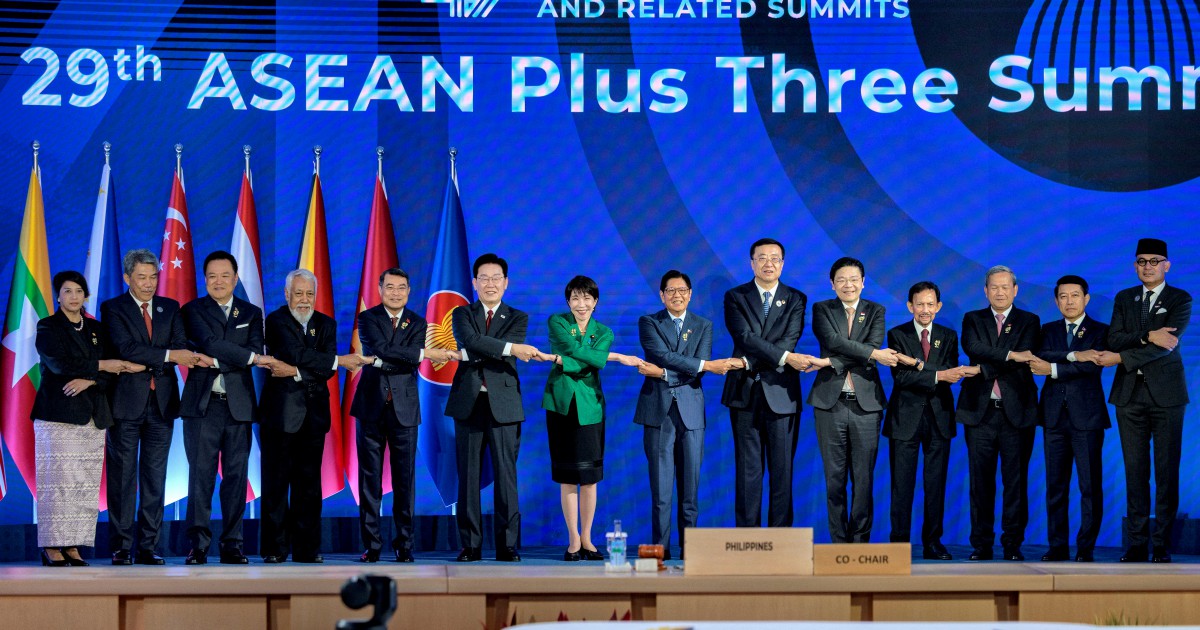

MANILA: President Ferdinand R. Marcos Jr. on Tuesday urged Southeast Asian and East Asian leaders to translate regional cooperation into concrete safeguards for food and energy supplies, stressing that global disruptions must not leave households facing higher costs and businesses struggling to operate, The Philippine News Agency (PNA) reported.
In opening the 29th Asean Plus Three (APT) Summit, Marcos said the impact of conflicts, supply disruptions and other shocks thousands of miles away can quickly reach East and Southeast Asia through rising rice prices, energy costs and lost income.
“A disruption thousands of miles away can reach households across East and Southeast Asia through the price of rice, the cost of energy, or the loss of a day’s income,” he said.
The Asean Plus Three framework brings together the 11 Asean member states and China, Japan and South Korea.
Japanese Prime Minister Takaichi Sanae, South Korean President Lee Jae Myung and Chinese Minister on Agriculture and Rural Affairs Zhang Zhu joined the talks along with other Asean leaders.
Marcos said the region must ensure that cooperation produces tangible results, particularly in keeping maritime trade and logistics moving and securing essential supplies.
“Our task today is to put our collective strength to work. In ships reaching their destinations, in reliable supplies of food and energy, in businesses continuing to operate, and in families facing the future with greater confidence,” he said.
He cited the Chiang Mai Initiative Multilateralisation (CMIM) and the Asean Plus Three Emergency Rice Reserve (APTERR) as existing mechanisms that provide a foundation for regional economic stability and cooperation during emergencies.
The CMIM is a multilateral currency swap arrangement designed to safeguard the APT region against short-term liquidity and balance-of-payments difficulties while the APTERR is a permanent regional cooperation mechanism established in 2011 to strengthen food security, poverty alleviation, and malnourishment eradication, and to stabilise rice price volatility caused by climate change or natural disasters without distorting trade.
Marcos said these arrangements would be increasingly important as conflict, supply disruptions, financial uncertainty and natural disasters put additional pressure on regional economies.
Marcos said the partnership remains an important platform for stability, resilience and shared prosperity amid growing global fragmentation.
As the cooperation framework approaches its 30th anniversary, he urged leaders to make the benefits of their agreements more directly felt by their people.
“Let us renew our ambition for this partnership and shorten the distance between the commitments we make around this table and the benefits our peoples feel in their daily lives,” he said.
The regional leaders meet as the ongoing conflict involving the United States, Israel, and Iran in the Middle East triggered severe global fuel and energy crisis, driven by disruptions and security pressures around key transit corridors like the Strait of Hormuz, the world’s most vital energy chokepoint.
The strait carries roughly 20 per cent to 25 per cent of global petroleum and oil supplies and about 20 per cent of global liquefied natural gas exports.