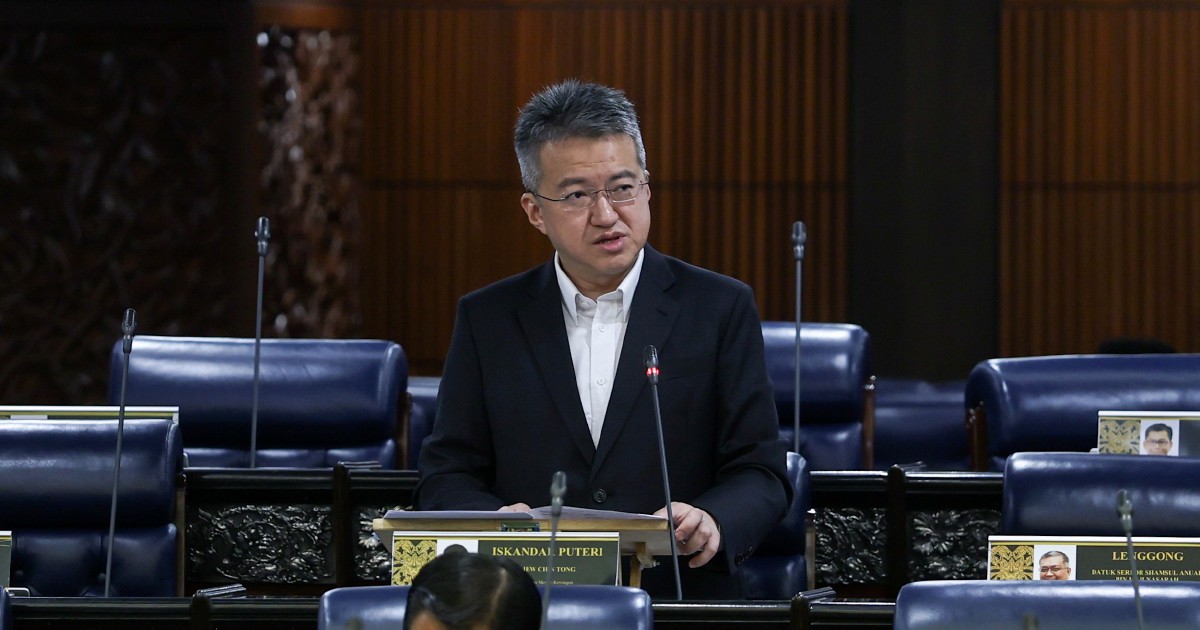

KUALA LUMPUR: MediAsas will remain a voluntary medical insurance and takaful scheme rather than a national health insurance programme providing automatic coverage to all Malaysians.
Deputy Finance Minister Liew Chin Tong said the initiative was designed to make private healthcare more affordable by controlling medical costs and insurance premiums, while the public healthcare system would continue serving the population.
“MediAsas, at this stage, is not a national health insurance scheme. It is a voluntary insurance scheme.
“This means those who pay the premiums will have access to hospitals under the scheme,” he told the Dewan Rakyat.
Liew was responding to a supplementary question from Suhaizan Kaiat (PH-Pulai), who asked whether unemployed Malaysians could receive government-funded health insurance coverage under MediAsas.
Suhaizan cited Thailand’s healthcare system, where the government provides coverage for people who are not employed, and asked whether Malaysia could adopt a similar approach.
Liew said Malaysia’s healthcare system differed from Thailand’s as it comprised both government and private hospitals.
He said MediAsas was intended to address the sharp increase in private hospital charges over the past five to 10 years.
“In recent years, particularly over the past five to 10 years, private hospital costs have become excessively high in some cases.
“MediAsas seeks to intervene and find ways to control hospital costs so that more Malaysians can access healthcare, whether through government hospitals or private hospitals under MediAsas, with premiums kept under control,” he said.
He said the government was seeking an approach suited to Malaysia’s healthcare system rather than adopting another country’s model wholesale.
The MediAsas initiative forms part of the government’s broader strategy to improve access to affordable and sustainable medical and health insurance and takaful protection.
The scheme is scheduled for nationwide implementation by the end of January 2027, following a pilot programme launched in the Klang Valley in late July.
Liew said the pilot involved various groups, including government agencies, government-linked companies, government-linked investment companies, youths, small and medium enterprises (SMEs) and gig workers.
He said public feedback had been encouraging, with further engagement being conducted to refine the scheme before its nationwide rollout.
Under the 2027 Budget, eligible SME employees will receive premium subsidies to encourage wider insurance coverage, particularly among workers with limited or no existing medical and health insurance protection.