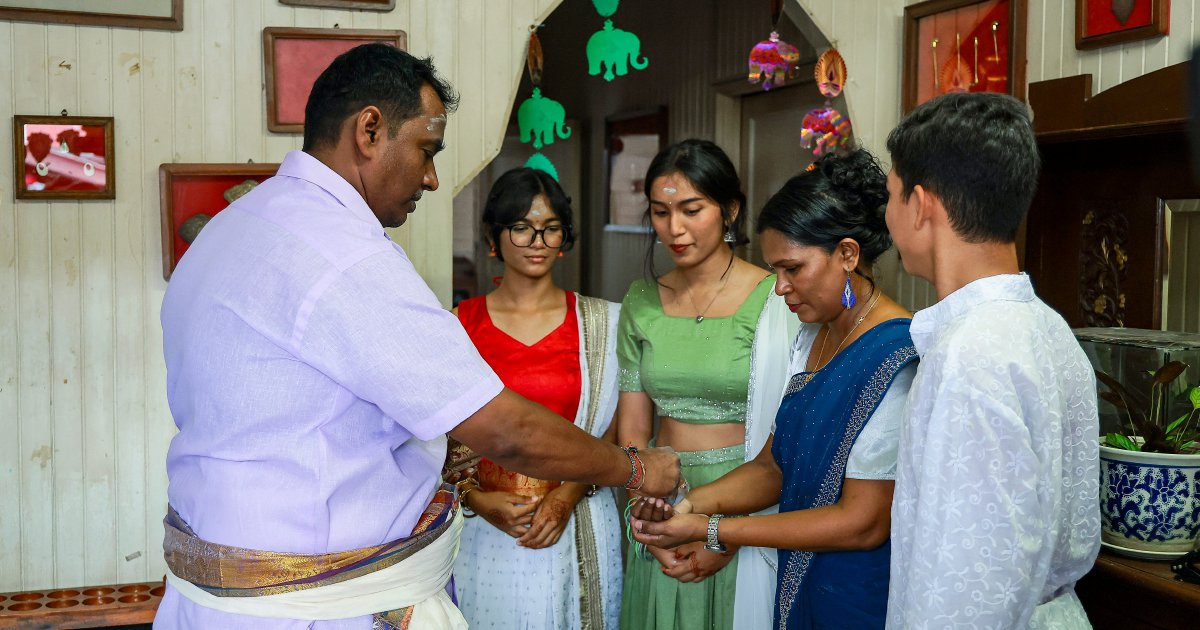

MELAKA: Deepavali celebrations by the Melaka Chetti community at Kampung Chetti had a distinctively festive atmosphere, with the Festival of Lights marked by a spirit of goodwill, harmony and family togetherness.
Although only about 30 families are believed to remain in the heritage village, the lively celebrations, marked by unique traditions, demonstarted the minority community’s efforts to safeguard its identity, which dates back to the era of the Melaka Sultanate.
One tradition that sets the community apart from other Hindu communities is the practice of temple priests delivering prasadam and visiting homes to bless families.
However, public understanding and knowledge of the unique culture and history of the Melaka Chetti community remain limited, particularly among those outside the community, leading to misconceptions about its true identity.
Among those working to preserve its heritage is Wenila Nadarajan, 46, who is determined to ensure the community’s continued presence in Malaysia, particularly in Melaka.
Wenila, who runs a Chetti food business in Jalan Tengkera, described herself as often playing the role of a storyteller to answer questions from the public about the origins of the Indian Peranakan community, which practises Hinduism but speaks a form of Malay creole.
“At my shop, I am like a storyteller. Whenever people come, I have to explain who the Chetti people are because they do not know. Many people, especially those from outside Melaka, are unfamiliar with the community.
“Many assume that the Chetti community is Muslim because they speak Malay, or because they do not know how to speak Tamil, although that is not the case for everyone.
“In the past, the Chetti community spoke Baba Malay, but nowadays many also marry Indians and Chinese, so the language has become a mixture,” she told Bernama at her home here.
Wenila also hopes that efforts to promote and raise awareness of the Chetti Melaka community, including through school history textbooks, can be expanded so that younger generations become more familiar with its existence.
However, beneath the pride in the community’s distinctive identity and traditions lies deep concern over the future of the heritage village, which is increasingly threatened by rapid development.
A native of the village, Shanmugam Raja, 57, said the historic settlement must be protected from physical development that could wipe out the community’s culture.
“This place should be preserved. If the village is not gazetted and uncontrolled development is allowed, it will affect the settlement. If the village disappears, the Chetti community, along with our culture and heritage, will quickly become extinct and be lost.
“One thing I have observed is that when members of a community do not live together in one area, practising their culture and traditions is not difficult, but there is a lack of encouragement.
“Here, all the neighbours practise them together, making it easier and more enjoyable,” he said.
The information technology professional also expressed concern about younger generations who move away and later return to the village with the mindset of being ‘guests’ rather than ‘hosts’, consequently reducing their sense of responsibility towards carrying on their customs and traditions.
“I have noticed that many among the younger generation, when they return, do not see themselves as hosts but as guests. When this happens, they do not take part in the activities here.
“That is the problem, and over time, these cultural practices will disappear,” he said.