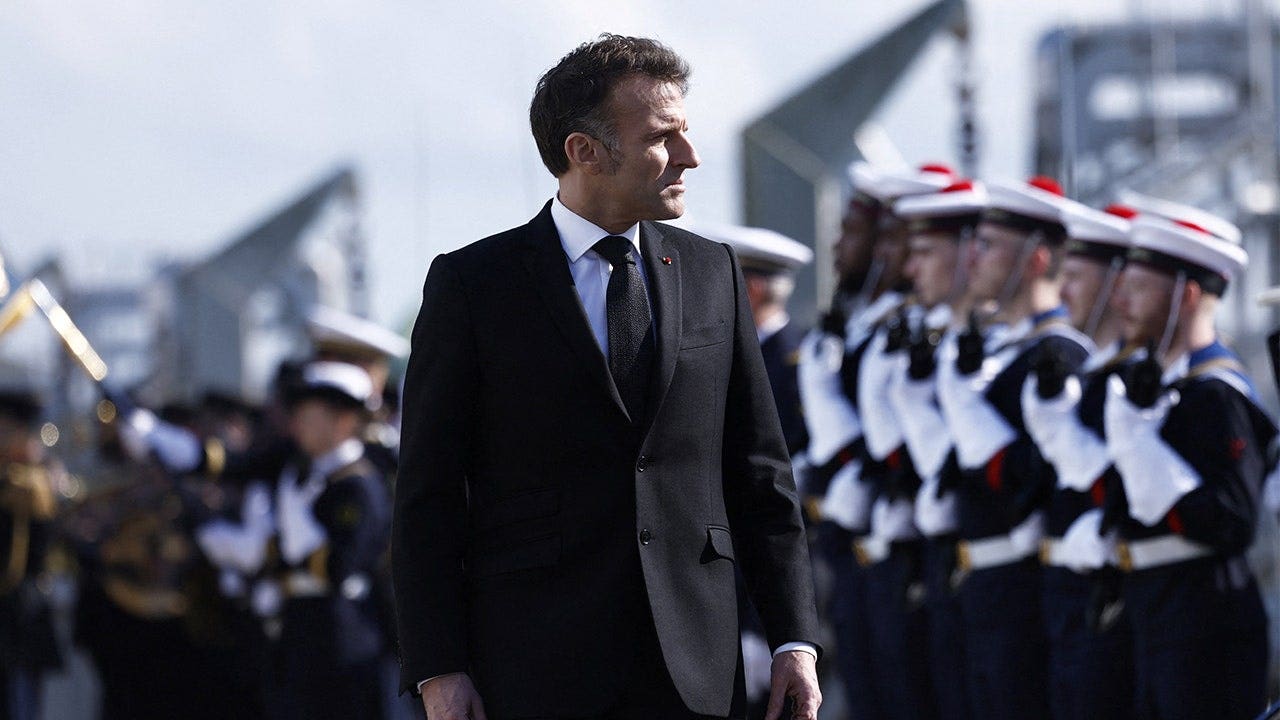

French President Emmanuel Macron is pushing ahead with plans for a new European military presence in Lebanon while struggling with mounting political and economic turmoil at home, even as the initiative encounters resistance from a key European partner and Washington considers an alternative that may not require troops.
Secretary of State Marco Rubio confirmed that he had discussed the future of the United Nations Interim Force in Lebanon (UNIFIL) with Macron, suggesting that a replacement monitoring mechanism could be civilian rather than military.
“It doesn’t have to be a military mission. It could be a civilian mission,” Rubio said in remarks published Tuesday.
Rubio explained that the administration is seeking a credible mechanism to verify arrangements under which Israeli forces withdraw from designated areas, the Lebanese Armed Forces (LAF) assume control and the Iran-backed terrorist group Hezbollah is prevented from returning.
RUBIO ANNOUNCES FRAMEWORK DEAL BETWEEN ISRAEL AND LEBANON AS EXPERTS WARN IRAN WILL FIGHT TO SABOTAGE IT
He suggested France could play a constructive role but emphasized that any arrangement would require agreement from both Lebanon and Israel.
U.S. Ambassador to the United Nations Mike Waltz also made clear that Washington has no intention of preserving the existing peacekeeping mission.
“UNIFIL in its current form will not continue, and it must not continue — we are working with our intentional partners to draw down the mission and ensure that the Lebanese people can choose their own future and to ensure that the Lebanese Armed Forces can secure the nation’s future,” Waltz told Digital.
MACRON UNDER FIRE OVER IRAN, HEZBOLLAH POLICY AS TRUMP ADMIN HOSTS ISRAEL-LEBANON TALKS
The French initiative, meanwhile, envisions a multinational force potentially involving thousands of European troops to support the Lebanese army as UNIFIL prepares to end its nearly five-decade mission. The proposed force’s final size, mandate and participating countries remain unconfirmed.
However, Italy, which previously joined France in calling for an international coalition following UNIFIL’s withdrawal, does not support deploying its troops under the proposal currently advanced by Paris, three sources with knowledge of the discussions told Digital.
The initiative comes as Macron faces growing domestic pressure, with France experiencing widespread demonstrations over rising living costs, wages and deteriorating public services.
The unrest has further complicated the government’s efforts to pass its 2027 budget, as mounting debt and political divisions limit its room to maneuver, Reuters reported Nov. 5.
Against that backdrop, France’s proposed deployment raises questions about the financial and military resources Paris could commit to another overseas mission, particularly without firm support from its European partners.
Simone Rodan-Benzaquen, senior envoy for Europe at the Foundation for Defense of Democracies, said France could still play an important diplomatic role, regardless of whether the eventual monitoring mission is civilian or military.
FRANCE IS DEVOURING ITSELF AS SCHOOL RIOTS REVEAL A CRISIS FAR BIGGER THAN BROKEN CLASSROOMS
“Rubio’s remarks suggest there is room for French involvement that Washington could support. Paris can help bring Beirut and Jerusalem to agreement on a monitoring mission both would trust,” Rodan-Benzaquen told Digital.
“Whether the monitors are civilian or military, they need access to suspected weapons sites and the ability to return to verify that Hezbollah has stayed out.”
The question of who would conduct such inspections has already proved contentious.
The United States and Israel had previously opposed France serving as a third-party verifier of Hezbollah’s disarmament, according to an Aug. 7 Reuters report citing Lebanese officials and foreign diplomats. A Lebanese official also told Reuters that Beirut had rejected an earlier proposal involving private security companies.
The challenges extend beyond diplomatic disagreements.
According to a Congressional Research Service assessment updated November 9, Hezbollah continues to refuse disarmament while Israeli forces maintain positions in southern Lebanon.
IS THE IRAN-BACKED TERRORIST MOVEMENT HEZBOLLAH ON THE ROPES IN LEBANON?
A U.S.-brokered framework agreement reached in June linked a phased Israeli withdrawal to the verified disarmament of armed groups and the deployment of Lebanese forces. But implementation has stalled beyond the initial pilot areas, and negotiations in October ended without agreement.
Rodan-Benzaquen argued that France should use its influence with Beirut to encourage the Lebanese government to enforce its decisions against Hezbollah’s military activities.
“Israel needs credible evidence that Hezbollah cannot resume operations in an area its forces are leaving. Beirut needs confidence that once its army has secured that area, the agreed Israeli withdrawal will follow. That is where French and American diplomacy can make a difference.”
The debate follows the August 2025 Security Council resolution extending UNIFIL’s mandate for a final time, until December 31, 2026, with an orderly withdrawal authorized over the following year.
Washington backed terminating the mission amid longstanding concerns about its inability to prevent Hezbollah from maintaining a military presence in southern Lebanon. France, by contrast, has warned against leaving a security vacuum.
PENTAGON HOSTS FIRST-EVER ISRAELI–LEBANESE MILITARY TALKS AIMED AT CURBING HEZBOLLAH
In a previous Security Council statement, the French Mission to the U.N. said: “France will support UNIFIL until the expiration of its mandate. It will contribute to defining the future international engagement in Lebanon, in support of its sovereignty and the implementation of resolution 1701.”
U.N. spokesperson Stéphane Dujarric told Digital that Secretary-General António Guterres presented three options for a future U.N. presence in June, but the Security Council has not formally selected one.
He added that the U.N. is aware of discussions about a possible non-U.N. military presence in southern Lebanon but is not directly involved in those negotiations.
With UNIFIL’s mandate approaching expiration, France faces the challenge of securing agreement not only on which countries would contribute personnel, but also on what those forces would be authorized to do in a country where Hezbollah remains armed and Israeli troops have yet to fully withdraw.
The Italian government has not responded to Digital’s request for comment. Requests for comment were also sent to the State Department, Spanish and Lebanese authorities.