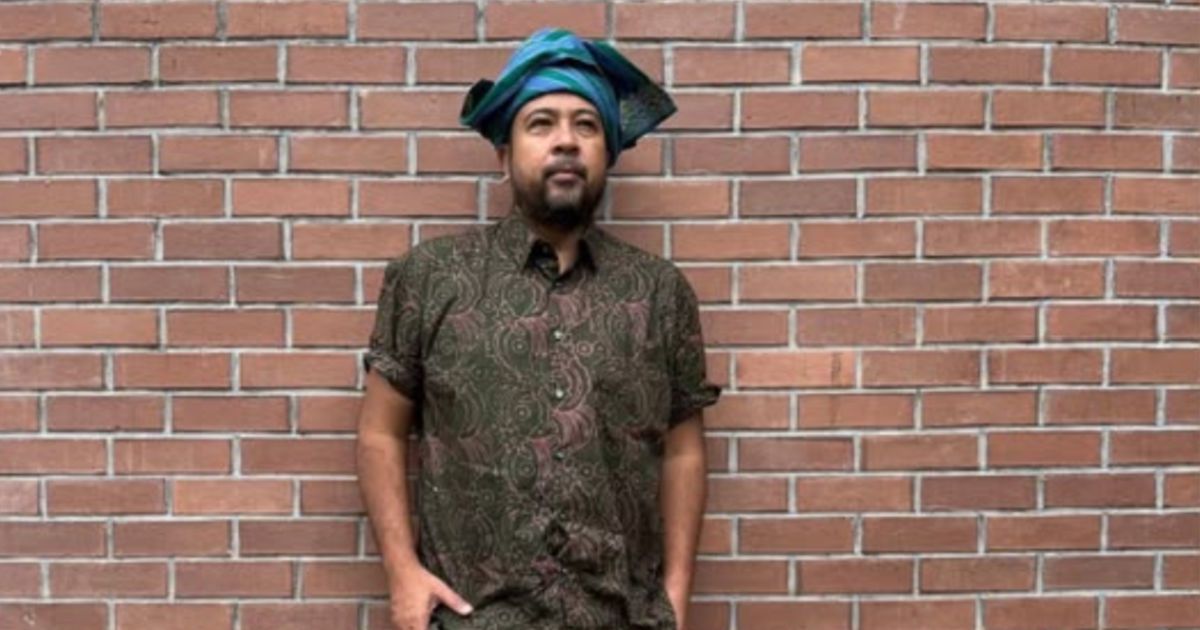

KUALA LUMPUR: The passing of National Laureate Datuk Seri A Samad Said is more than the loss of a towering literary figure; it has left a deep mark on musician Loque, who views the celebrated writer as a vital source of inspiration for his music.
Loque, whose real name is Khairil Ridzwan Annuar, said the late author’s works have long been a key reference point—especially for enriching his command of Malay—even though the two never had the chance to work together.
“To me, he is like a father of literature. His generation produced many intellectuals who used the Malay language.
“The late writer was like a symbol of our national language. With globalisation and the absence of intellectuals like him, there is a slight sense of worry. Today is a dark day for Malaysia,” he told BH Online.
Speaking after attending the funeral prayers this morning to pay his final respects, Loque admitted he had once hoped to collaborate with his idol, though he accepts that the opportunity never came to pass.
Instead, he hopes younger generations will look to A Samad Said’s mastery of the Malay language as a benchmark.
“I really wanted to, I really wanted to collaborate with him. I didn’t know him personally, but I know his son because we studied together at Berklee College. I really wanted to meet the late writer, but I didn’t get the chance.
“When he was already advanced in age, we wanted to interview, meet and discuss, but his son informed us that he was less welcoming of invitations because he was unwell.
“We respect that decision. When he was frail, we respected his privacy and perhaps he was also uncomfortable. He might not have been able to give his full attention to creating works. That’s fine. At least we can draw inspiration from how he used language. We need to revisit his works because he left behind such a vast legacy,” he said.
For Loque, A Samad Said was not merely an author, but a pivotal figure who elevated the beauty of Malay and championed its dignity.
That dedication, he noted, was clear even in small, everyday choices.
“Revisit his writing, for example, in terms of enrichment and language use. At the very least, on his Facebook page, he didn’t use the word ‘admin’, instead writing ‘pentadbir’.
“Even from that, we can draw inspiration. When I went to the mosque earlier, I met Altimet, and he also said we need to revisit the late writer’s works. His passing seems to give us the awareness to dig back into his writings,” Loque said.
Loque added that he has spent years exploring classic Malay literature from the 1960s and 1970s alongside A Samad Said’s catalogue.
That research continues to shape his songwriting, including his latest track, Villa Marhaen, which draws directly from the laureate’s poem Marhaenville.
“His works always inspire. Our newest song, Villa Marhaen, was inspired by the poem Marhaenville. I searched for the poem on the internet, but couldn’t find it. Eventually, I came across it in a book. I changed its title into Malay, but took the essence and core from that work, especially its name, which was translated directly.
“Since way back, I have read a lot of his writing, including short poems that became key references such as Sungai Mengalir Lesu, Langit Petang and Benih Harapan, if I’m not mistaken. However, I may have delved less into his novels,” he said.
Earlier this morning, funeral prayers for the late A Samad Said were held at Masjid Saidina Abu Bakar As-Siddiq in Bangsar before his burial at the Bukit Kiara Muslim Cemetery here.
Named a National Laureate in 1985, he produced novels, short stories, poetry, plays and essays examining life and social realities, with renowned works including his 1961 novel Salina, as well as Sungai Mengalir Lesu, Langit Petang and Hujan Pagi.