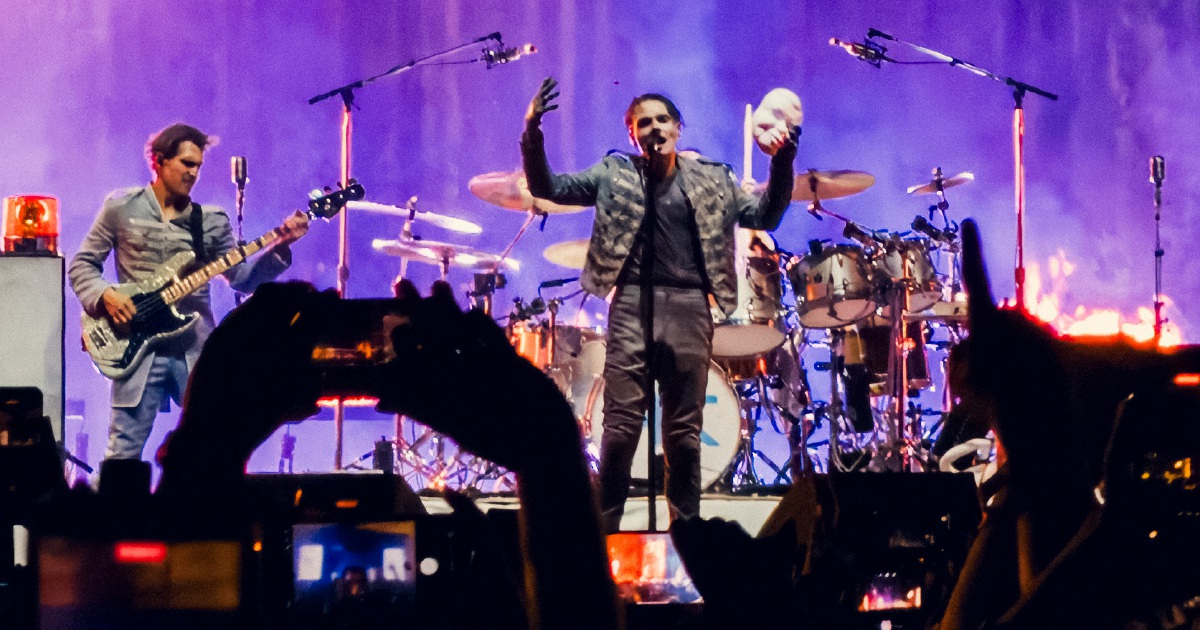

ONE note from the keyboards was enough to set thousands of people off.
Before Gerard Way had properly begun ‘Welcome to the Black Parade’, the audience at Bukit Jalil’s National Stadium was already there with him.
I was discovering the song’s power in real time; around me, people seemed to be revisiting a part of themselves.
“When I was a young boy” begins a childhood recollection that grows into something enormous.
A father takes his son to see a marching band. That memory becomes bound up with death, the people we lose and what remains after they are gone.
Then the guitars arrive, the rhythm gathers force and recollection turns into resistance. “We’ll carry on” becomes a promise delivered by thousands of voices.
You could know little about My Chemical Romance and still feel the force of it. I certainly did. I attended the second and final Kuala Lumpur show on Nov 20, arriving unfamiliar with much of MCR’s music and leaving a fan.
The conversion owed something to the spectacle, but considerably more to discovering the feeling beneath it.
Promoter Hello Universe reported nearly 130,000 fans across the Nov 19 and 20 concerts, describing them as the band’s biggest Southeast Asian tour shows.
The second night alone drew a reported 63,000. Almost 19 years had passed since their Malaysian appearance at Stadium Merdeka in December 2007. The years between those visits had changed the audience, but had done little to weaken its attachment.
Fans had dressed for the reunion in black, dramatic eye make-up and outfits inspired by the band’s marching uniforms. The emo get-ups carried both affection and effort. The audience was contributing to the theatre before the performance began.
[[nid:1587342]]
A BAND BORN FROM UPHEAVAL
MCR’s fascination with mortality has a backstory. Witnessing the Sept 11 attacks in 2001 helped push Way towards forming the band, questioning what he was doing with his life.
‘Skylines and Turnstiles’ emerged from that experience. Their breakthrough studio release, ‘I Brought You My Bullets, You Brought Me Your Love’, followed with ‘Three Cheers for Sweet Revenge’ in 2004, then the epic concept album, ‘The Black Parade’ in 2006.
A split in 2013 and reunion in 2019 made the prospect of seeing them together again something fans could hardly take for granted.
Way’s imagination also produced ‘The Umbrella Academy’ comics, illustrated by Gabriel Bá and later adapted by Netflix. His parallel career helps explain the concert’s commitment to characters, atmosphere and a world extending beyond individual songs.
The first set performed ‘The Black Parade’ in full. Its central figure, the Patient, confronts death through a journey of memory, regret and fear. The parade of the title draws on that childhood experience with his father.
The tour places another story around it: Draag, a fictional authoritarian state, and MOAT, a reconditioning facility where the band’s Black Parade alter egos are captive. Surveillance and control make this a distinctly uncomfortable place to spend an evening.
I found myself fascinated by how much storytelling had gone into the production. The band’s ‘Black Parade’ alter egos were being held in a fictional reconditioning facility, with characters who made the promise of treatment seem distinctly threatening.
Among them was Nurse Sylvia, an unsettling figure whose uniform suggested care while her manner hinted at control. Even without understanding every reference, I wanted to know what would happen next.
Mama drew that strange world further into sinister cabaret, incorporating its Dagger passage. The song’s theatrical pedigree goes back to the original recording, which featured Liza Minnelli, partly because she was Way’s grandmother’s favourite performer.
Watching the drama unfold, that connection to musical theatre made perfect sense.
THE FEELING BENEATH THE SPECTACLE
‘The End’ and ‘Dead!’ established the macabre mood, followed by ‘This Is How I Disappear’ and ‘The Sharpest Lives’.
‘House of Wolves’ brought swagger, but the gentler passages revealed another strength.
‘I Don’t Love You’ made heartbreak painfully direct. Cancer reduced the scale from dystopian spectacle to one person facing illness and separation.
Against the vastness of the stadium, its vulnerability landed with particular force. ‘Sleep’ deepened the unease before ‘Teenagers’ released it into a raucous singalong.
Disenchanted expanded through its ‘Falling Sk’y outro, while ‘Famous Last Words’ built towards a ‘Welcome to the Black Parade’ reprise. ‘Blood’ added grotesque humour to complete the album sequence.
Across more than two hours and around 25 songs, guitarists Ray Toro and Frank Iero and bassist Mikey Way gave Gerard’s dramatic delivery a muscular foundation.
The second set loosened the atmosphere with ‘Planetary (GO!)’, ‘Thank You for the Venom’, ‘I’m Not Okay (I Promise)’, ‘The World Is Ugly’ and ‘Vampire Money’ among its pleasures.
Helena carried another personal history: it was inspired by the Way brothers’ late grandmother, who had encouraged Gerard’s singing and drawing.
Beneath the elaborate imagery were recognisable experiences of love, absence and regret. That connection made the evening work for someone arriving without the soundtrack of an adolescence invested in this band.
The characters could be bewildering; the feelings rarely were.
I had come wondering what inspired such devotion. By the end, I understood the attraction of returning to songs that give grief a melody, anger an outlet and endurance a chorus.
elena@