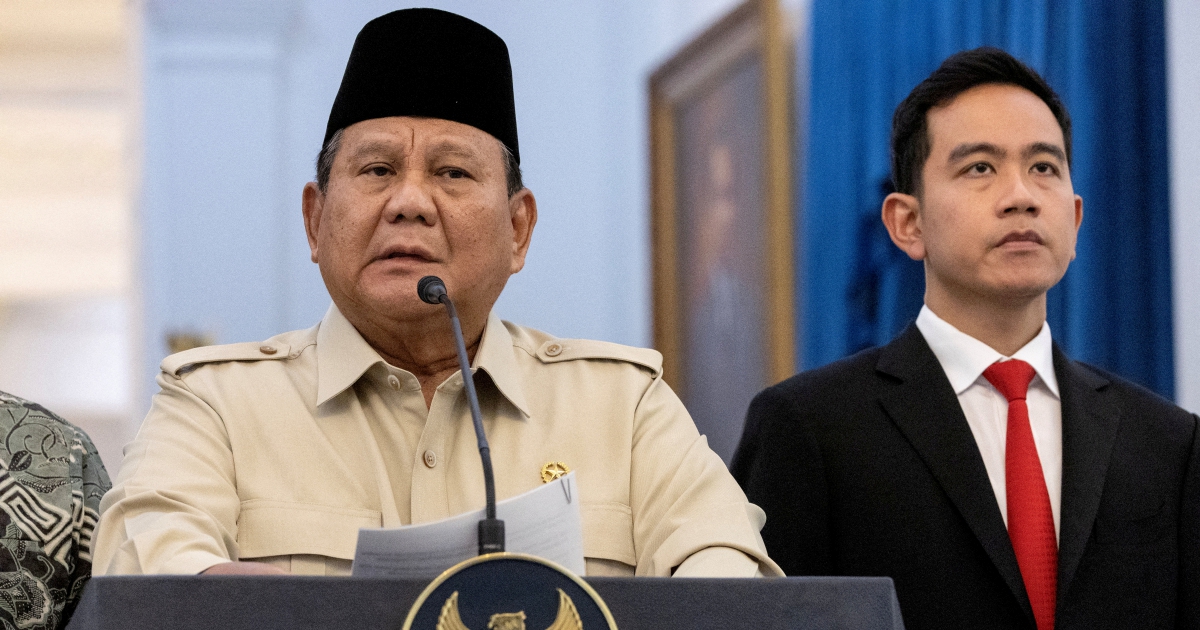

THE world must be watching developments in Indonesia with growing concern, particularly those living in this region. Indonesia is, after all, Southeast Asia’s most populous country and largest economy, a G20 member and a founding member of Asean.
The world is already grappling with numerous challenges, and every country must deal with them as best it can.
Unfortunately, President Prabowo Subianto’s government is also facing a series of domestic challenges emerging almost simultaneously.
The challenges are considerable.
The rupiah has weakened to a record low against the US dollar, falling beyond the levels reached during the Asian financial crisis of 1997-98.
Students have taken to the streets to protest against rising living costs, among other grievances.
Foreign investors have also been withdrawing funds from the Indonesia Stock Exchange at a record pace.
Amid these challenges, forest fires have continued to affect parts of Kalimantan and Sumatra, fuelling public discontent as residents contend with health problems and disrupted livelihoods caused by the haze.
A stronger-than-expected El Niño also worsened fire conditions this year.
Prabowo can hardly be blamed for these misfortunes emerging before he is even halfway through his presidential term.
He must now also contend with the inevitable political fallout.
Prabowo was elected on a wave of popular support after forging a political alliance with his predecessor, Joko Widodo, and choosing Joko’s son, Gibran Rakabuming Raka, as his running mate.
This week, Vice-President Gibran Rakabuming Raka resigned amid controversy over whether his academic qualifications met the requirements for the post.
His resignation comes amid growing speculation about a widening rift between Prabowo and Joko, who left office after 10 years with considerable public goodwill.
This seems like an unfortunate replay of elite politics playing out in the Philippines where President Ferdinand Marcos Junior forged a ticket with Sara Duterte, the daughter of his predecessor, Rodrigo Duterte, and won by a landslide.
Vice-President Duterte is again facing impeachment proceedings.
If convicted by the Senate, she would be barred from holding public office, potentially derailing her presidential ambitions.
Could a similar political rupture occur between Prabowo and Joko’s family?
Political tensions in Jakarta have yet to reach such a level.
Those of us who wish Indonesia well must hope that such a rupture can be avoided.
As we watch anxiously the happenings in Indonesia, we must hope for an orderly and measured political resolution.
Whatever conspiracy theorists may think and say, Indonesia’s near neighbours have much more to gain from its rising prosperity and political stability than if it were to wade into another round of political and economic uncertainty.
The great diversity and physical sprawl of Indonesia make it a challenge to govern at the best of times. Nothing in neighbouring countries comes close by comparison.
The writer views developments in the nation, region and the wider world from his vantage point in Kuching