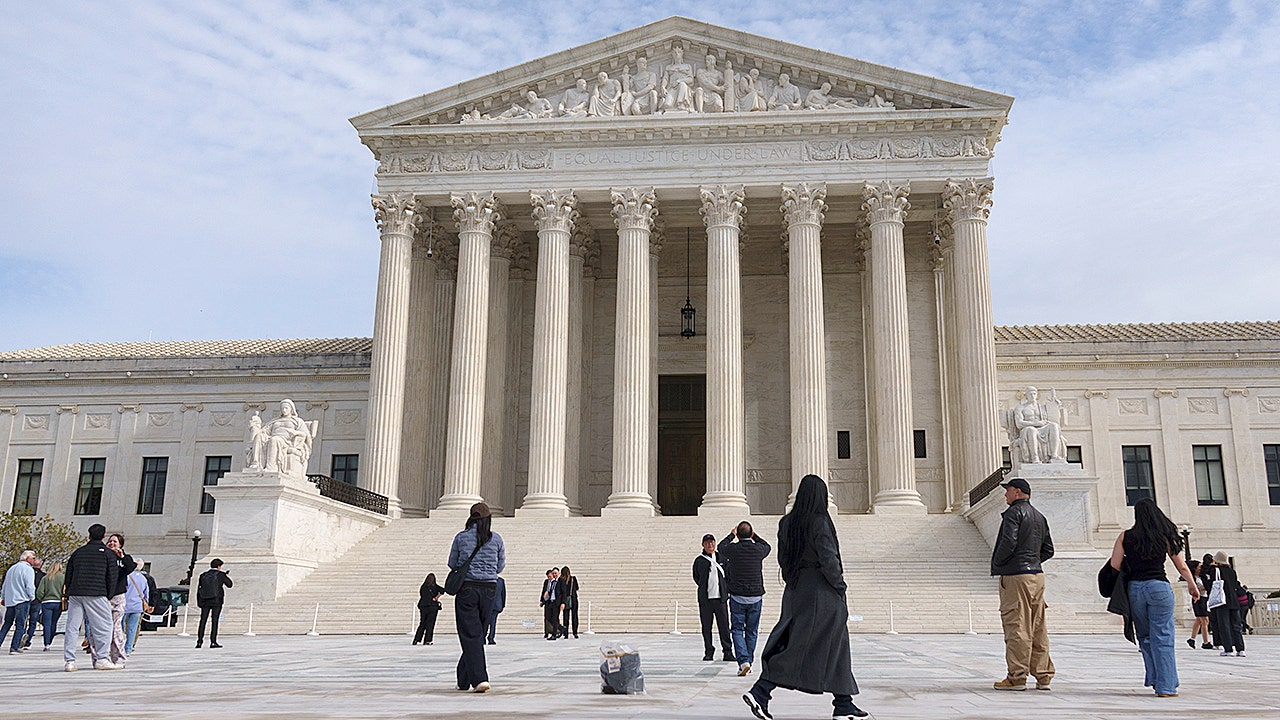

A Trump administration official who served four months in federal prison for defying a congressional subpoena is asking the Supreme Court to overturn his convictions in a case that could raise the bar for criminally prosecuting others who refuse to comply with Congress’s demands.
Peter Navarro, who was a senior trade advisor to President Donald Trump during his first administration, filed a petition with the Supreme Court last month. Navarro currently serves in the Trump administration as senior counselor for trade and manufacturing. He was convicted in 2023 on two counts of contempt of Congress stemming from his refusal to provide testimony and documents to the Democratic-led House Jan. 6 committee on the grounds that he believed he was barred by executive privilege.
If the justices take the case, they could make it harder to convict someone for defying a congressional subpoena by requiring proof that the person knew they were breaking the law.
JUDGE TOSSES CASE AGAINST EX-FBI OFFICIALS ACCUSED OF LYING TO CONGRESS ABOUT HUNTER BIDEN INVESTIGATION
Before Navarro’s trial, U. S. District Judge Amit Mehta ruled in August 2023 that he had failed to establish that Trump invoked executive privilege for the subpoena, barring him from relying on that claim as a defense. After serving his sentence, Navarro appealed his conviction to the U. S. Court of Appeals for the D. C. Circuit, which ruled that a person violates federal law by refusing to comply with a subpoena “even if he subjectively and mistakenly believed his default was lawful. ”
The three-judge panel ruled that only the president can invoke executive privilege under Article II, and Trump never granted Navarro protection.
“Dr. Navarro claimed executive privilege before even seeing the subpoena and refused to turn over documents, appear for his deposition, or engage with the Select Committee’s efforts to accommodate his privilege claim,” the court wrote.
“A court, in other words, cannot simply take a defendant at his word that the President invoked privilege because doing so would impermissibly tangle separation-of-powers lines.”
But Abhishek Kambli, counsel for Navarro, argued the D.C. Circuit misinterpreted the statute, pointing to United States v. Murdock, a 1933 Supreme Court ruling that a taxpayer’s sincere but mistaken belief that the Constitution protected his refusal to answer investigators’ questions mattered in determining whether he acted “willfully.”
“We absolutely believe that we are correct on the law on this, because Congress chose to use the word willful when it put this statute together, and there’s no reason to believe that willful applies any differently in this context than it has in just about every other one, but it would have the added effect of toning down lawfare and weaponization if we were to succeed,” Kambli told Digital.
The House voted to hold Navarro in contempt for failing to comply with a subpoena, but Kambli argued the Jan. 6 committee bypassed the negotiations traditionally used to resolve disputes involving executive branch officials.
WHITE HOUSE LAWYER’S HARDBALL WARNING TO DEMS HAS LEGAL EXPERTS ON BOTH SIDES QUESTIONING ONE KEY THREAT
“When it comes to executive branch officials, there was an accommodation process where they would negotiate terms of the appearance of the witness that’s an executive branch official, and then determined whether executive privilege applies or not,” Kambli told Digital. “What happened with the J-6 committee is that they short-circuited a lot of that and sent people straight to getting prosecuted and indicted.”
Kambli said a Supreme Court ruling in Navarro’s favor could help “tone down the weaponization that could potentially occur” once Democrats take control of both chambers of Congress.
“What would happen is that if we were to win and the correct mental state is required to prove someone violated this law and get convicted and sent to jail, you would have fewer prosecutions for contempt of Congress because they’re going to be much harder to prove,” Kambli told Digital. “And what will happen is that there’s less of an opportunity to wield a congressional subpoena in a weaponized manner rather than just through a legitimate legislative purpose, which Congress is limited to traditionally.”
Navarro’s lawyers filed the petition a week before Sen. Elissa Slotkin, D-Mich., called for investigating alleged Trump administration corruption, saying cases targeting those who “enabled” the president could send a “deterrence message” to young people considering administration jobs.
Following Democrats’ wins in the 2026 midterm elections, lawmakers took to social media to vow investigations into Trump officials, with House Oversight Committee ranking member Rep. Robert Garcia, D-Calif., posting on X, “LAWYER UP.” However, Republicans still control both chambers of Congress until Democrats take control in January 2027.
“We can’t keep this up where people are utilizing law fare and other weaponization tactics to harm their political opponents, so we think that this petition would protect everyone in the long term and allow our politics to be better because we’re not constantly trying to utilize congressional subpoenas as a way to indict people,” Kambli told Digital.
Mike Davis, a conservative lawyer and founder and president of the Article III Project, which filed an amicus brief supporting the petition, said the Supreme Court must take this case up to end “lawfare.”
“Democrats weaponized Congress to throw Peter Navarro in prison for standing up for President Trump’s Executive privilege in good faith,” Davis said. “The D.C. Circuit then ruled that good faith is no defense to contempt of Congress, and that turns every congressional subpoena into a criminal trap. It tears up more than two centuries of negotiation between the co-equal branches.”
The petition from Navarro comes after the Supreme Court vacated the ruling against Steve Bannon. The former Trump White House strategist served four months in federal prison in 2024 after being convicted of two counts of contempt of Congress for defying a subpoena from the House Jan. 6 committee. In April 2026, the Supreme Court vacated the D.C. Circuit’s decision in his case and sent it back for further proceedings following the Justice Department’s motion to dismiss his indictment.