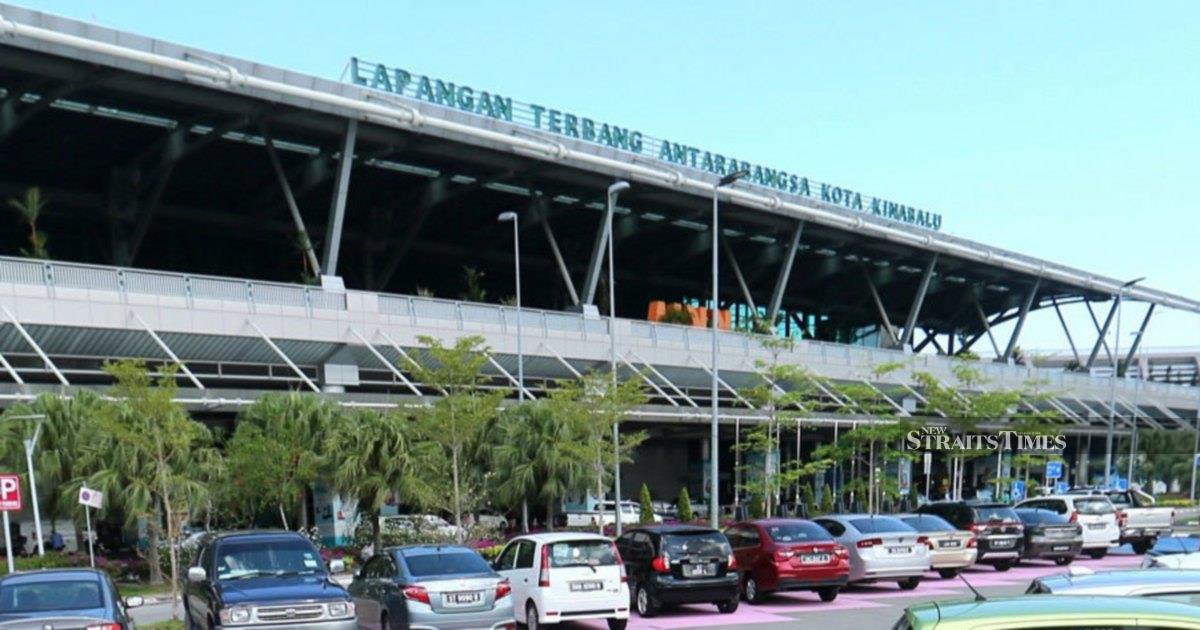

THERE has been much debate lately as to whether Kota Kinabalu should have a new airport.
This comes as the current Kota Kinabalu International Airport (KKIA) — already the second busiest airport in the country — appears to be bursting at the seams despite regular upgrades, including a planned RM442.3 million expansion.
There was even a forum recently on “The Future of Kota Kinabalu International Airport: Retain, Expand or Relocate?”
Any visitor to the Sabah capital will surely say retain and expand the existing KKIA based solely on sheer convenience.
The airport juts out to sea at one end and it takes less than 15 minutes to get there from the city centre.
But, of course, proximity to the city is a boon and also a bane for KKIA. There is only limited space available for expansion, including a second runway.
Is it feasible to expand seawards, and at what cost? In the final analysis, perhaps the inevitable verdict will be to have a new international airport further out from the city while retaining the existing KKIA as a city airport, much like Subang Airport is for Kuala Lumpur.
Chartered Institute of Logistics and Transport Malaysia Sabah Section deputy chairman Mohd Faizal Malik has called for the state to look beyond the planned expansion of KKIA and assess its long-term capacity needs in support of future aviation growth.
He said increasing its passenger handling capacity from nine million to 12 million annually would not necessarily address the airport’s wider operational limitations.
Former Civil Aviation Authority of Malaysia chief executive officer Datuk Captain Chester Voo added his voice to the call for an assessment of a potential new airport site, citing the risk of relying on a single runway for an increasingly busy airport.
And undeniably, at the back of anyone’s mind must be the potential high costs involved in building a new airport.
It will likely take billions to plan and build a new KKIA.
The good news is that much of that spending will probably be well into the future, although seed investments may need to be made immediately in the interest of forward planning.
It will certainly be a more feasible idea than Sarawak’s plan to build a new international airport in Kuching, reportedly costing RM100 billion (although that is likely just a projection and includes a new deep-sea port, among other things, at Tanjung Embang, outside Kuching).
Kuching’s air traffic movement currently pales in comparison to KKIA’s.
Moreover, KKIA is already a busy and viable airport hub and there is still room for expansion where it is, while Kuching needs a lot more work and investment if its airport is to become another hub, along the lines of Doha’s airport in Qatar, as Premier Tan Sri Abang Johari Openg has let it be known.
Hence the setting up of AirBorneo, Sarawak’s answer to Qatar Airways, the oil-rich emirate’s expensive twin investment which took 10 years to turn a profit but made Doha a new airport hub.
- The writer views developments in the nation, region and the wider world from his vantage point in Kuching