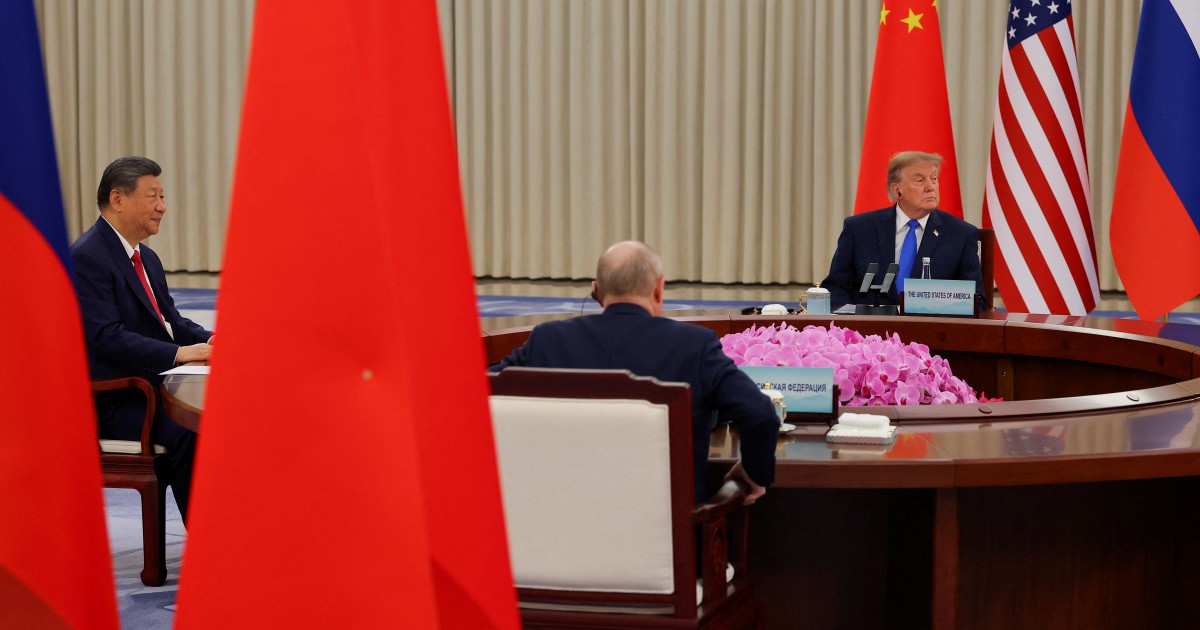

US President Donald Trump has long revelled in the pomp and ceremony of international summitry but has often come away with little to show for his signature brand of personalised diplomacy.
His meeting on Thursday with Chinese President Xi Jinping and Russian President Vladimir Putin has starkly exposed the limits of that approach, analysts said.
Trump went into the unprecedented three-way summit in the southern Chinese city of Shenzhen seeking to reassert himself internationally after being politically weakened at home with his Republican Party’s loss of control of Congress in this month’s midterm elections.
He is also still locked in a tense stalemate with Iran in a war that polls show is very unpopular and which has driven down his approval ratings.
But while the three leaders agreed on a symbolic “peace declaration” reaffirming that nuclear war should never be fought, they announced no plans for arms control talks long sought by Trump.
They also showed no signs of advances on issues such as Iran, Ukraine and Taiwan, or on narrowing gaps over trade and artificial intelligence.
Some analysts said the outcome of the Shenzhen summit may actually diminish Trump’s stature on the world stage as he enters the lame-duck phase of his presidency, while bolstering two of Washington’s main adversaries.
“Trump has always loved the pageantry and the sense that he’s sitting down with the most important people in the world, and he got that moment,” said Christopher Preble, a senior fellow at the Stimson Center think tank in Washington.
“But as in other summits, it’s hard to see any substantive progress made on any major issue.”
For Trump, it fit the pattern of many of his leader-to-leader encounters since returning to office last year, including earlier meetings with Xi and Putin that did not yield breakthroughs, and his inconclusive first-term summits with North Korean leader Kim Jong Un.
Trump, a former reality TV star who relishes political showmanship, has signalled that his definition of diplomatic success places as much emphasis on the spectacle surrounding him as on any agreements reached at the negotiating table.
Trump suggested in a Fox News interview that he had already secured a victory simply in the way he was received in China on Wednesday, when, in an unprecedented gesture, Xi greeted him directly at the airport with an elaborate military welcome.
[[nid:1583814]]
The three-way meeting had drawn comparisons, particularly in Russia, with the 1945 Yalta Conference between the United States, Britain and the Soviet Union that formalised spheres of influence, set the stage for the post-World War Two order and became shorthand for great-power deals imposed on smaller countries.
Such a comparison was particularly worrisome for Ukraine, which is engaged in a four-year-old war with invading Russian forces.
But Thursday’s less-than-90-minute summit was not another Yalta, which lasted for more than a week and involved detailed discussions and far-reaching decisions.
Reflecting the challenges Trump could face in Washington when the balance of congressional power shifts in January, US Senator Charles Schumer of New York, who leads Democrats in the Senate, said:
“Trump keeps acting like he struck the diplomatic deal of the century, but he didn’t secure any meaningful commitments from China or Russia that will last even a millisecond,” Schumer said.
Still, some analysts said the Shenzhen summit – by bringing adversaries together – could be a plus for international stability.
Daryl Kimball, executive director of the US-based Arms Control Association, said it was “positive” that the countries with the three largest nuclear arsenals issued a statement that “reaffirmed that a nuclear war cannot be won and must never be fought.”
They also agreed to hold a nuclear risk reduction dialogue, though gave no time frame.
But, Kimball added, “we need much more than rhetoric.”
With two years left in office and still in command of broad foreign policy powers of the US presidency, analysts say Trump may continue this brand of personal diplomacy, in part because he values unpredictability in his foreign affairs.
“Ultimately the proof of all of this is what is the resolution in Iran, what is resolution in Ukraine, if any,” said Josh Lipsky, vice president of international economics at the Atlantic Council think tank.
“That’s how this will be judged over history.”
- The writer is from Reuters