
NIBONG TEBAL: A nature-based drainage system developed at Universiti Sains Malaysia (USM) two decades ago is gaining attention as an alternative to conventional drainage methods, with the potential to reduce flood risks and water pollution.
The Bio-Ecological Drainage System (BIOECODS), developed at USM’s Tuanku Syed Sirajuddin Engineering Campus, uses natural filtration rather than conventional concrete drains to slow water flow, filter runoff and reduce the risk of flooding before water is discharged into rivers.
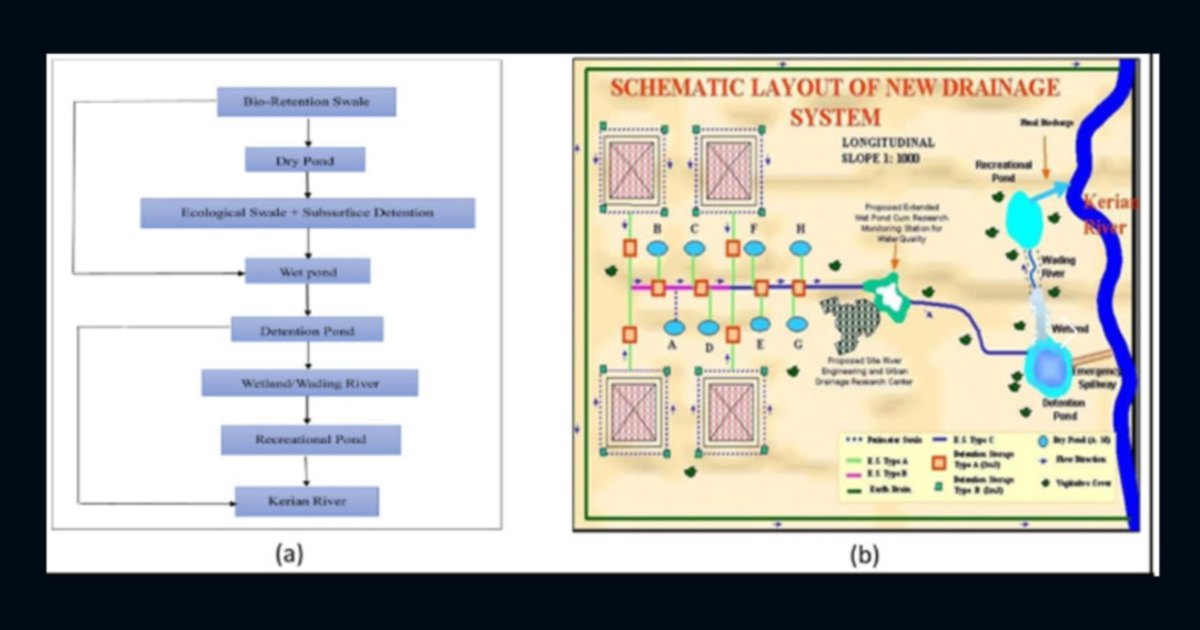
The 129.4ha campus system features grass-lined channels, permeable mesh and river sand layers.
USM River Engineering and Urban Drainage Research Centre (REDAC) director Dr Chang Chun Kiat said BIOECODS comprised three main elements: grassed swales to slow water flow, fields that temporarily serve as dry detention basins during heavy rain, and artificial ponds to filter water.
He said the project began in 2001, following the introduction of the Urban Stormwater Management Manual for Malaysia (MSMA) by the Department of Irrigation and Drainage (DID) in 2000.
DID and USM later formed a strategic partnership to establish the campus as a pilot site for demonstrating environmentally friendly drainage management.
“The project was completed in 2002 at a cost of RM6 million, of which RM1.2 million was contributed by DID for pond construction.
“Water flows from the perimeter swales into detention areas, followed by wet ponds and retention ponds, where it undergoes natural purification through constructed wetlands before entering an artificial meandering stream,” he said.
Chang said the stream featured floodplains and embankments, with the floodplain areas kept free of development because they were prone to inundation.
The water then flows into a recreational pond before being discharged into the nearby Sungai Kerian.
He said REDAC was now applying the same approach through projects known as Bio-FD (Bio-Filter Drain) at SK Francis Light in George Town and the official residence of the Penang Yang di-Pertua Negeri, in collaboration with the Public Works Department (PWD).
At SK Francis Light, water channelled into a storage pond can be reused for landscape maintenance.
Outside Penang, the system is being implemented at the 930.7ha Kwasa Damansara development in Sungai Buloh, Selangor. Design planning began in 2013 and the project has since entered the construction phase.
Chang said two other pilot projects, undertaken with PWD, were also being carried out at the Southern Region Civil Defence Training Centre (Pulapas) in Kluang, Johor, and the Pasir Mas police headquarters in Kelantan.
The projects involve studies on water quality control and costs.
“Based on a 2020 study, the system can reduce overall drainage infrastructure costs by at least 10 to 20 per cent,” he said.
Chang said BIOECODS also offered aesthetic and landscaping benefits while supporting greener urban environments, beyond its role in reducing flood risks and pollution.
He said USM had promoted the system for years, but public interest had grown recently as more urban areas experienced flooding and people began looking for alternative solutions.
On Nov 3, Deputy Prime Minister and Energy Transition and Water Transformation Minister Datuk Seri Fadillah Yusof announced that BIOECODS was among three Unesco ecohydrology demonstration sites in Malaysia, alongside Putrajaya Wetlands and Universiti Tun Hussein Onn Malaysia.