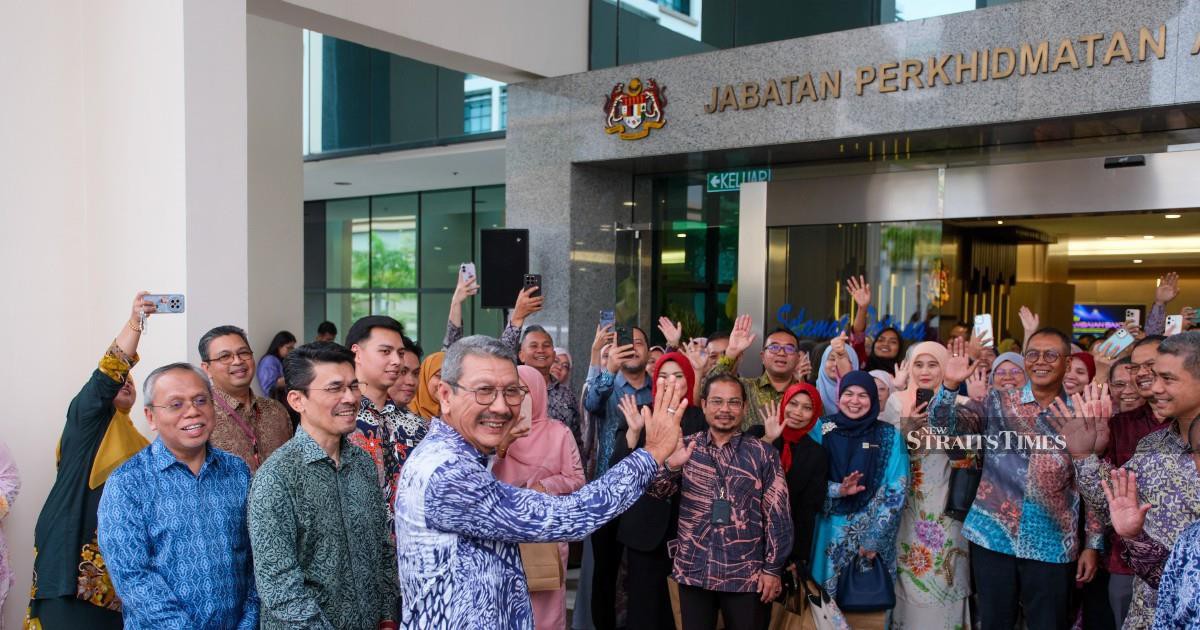

PUTRAJAYA: Tan Sri Dr Wan Ahmad Dahlan Abdul Aziz today retired as the 27th director-general of the Public Service Department (PSD), ending a 31-year career spanning several key government institutions.
“I have just a few hours left before concluding my service, marking more than 31 years in the public service.
“I am grateful that in every posting, I had a great team, whether at the National Palace, Home Affairs Ministry, Implementation Coordination Unit (ICU) or PSD,” he said.
Wan Ahmad Dahlan, who turns 60 tomorrow, joined the public service on Jan 25, 1995. He was appointed PSD director-general on Jan 8, 2024.
Speaking to reporters after his farewell ceremony today, he described the introduction of the Public Service Remuneration System (SSPA) as one of his major achievements.
He said its implementation required balancing civil servants’ needs with the government’s financial capacity.
He said cooperation between the department, stakeholders and the Congress of Unions of Employees in the Public and Civil Services (Cuepacs) had been instrumental in making the system a success.
“What stands out most to me is the success my team at PSD and I achieved in completing the new remuneration system, namely the SSPA.
“It was not easy, as it required balancing the needs of civil servants with the government’s financial capacity.
“Nevertheless, through the cooperation of all parties, including Cuepacs, which represents public service associations and trade unions, we were able to bring it to fruition.
“Civil servants are now enjoying the benefits outlined under the SSPA,” he said.
The SSPA was introduced by Prime Minister Datuk Seri Anwar Ibrahim in August 2024 to replace the Malaysian Remuneration System. It took effect on Dec 1 that year.
He also cited the Government Service Efficiency Commitment Act 2025 (ILTIZAM Act), which came into force on Dec 1 last year, as another significant achievement.
The Act requires ministries and departments to review existing legislation, standard operating procedures and administrative processes to reduce red tape, eliminate overlapping regulations and ease regulatory burdens.
Wan Ahmad Dahlan said the initiative aimed to transform the government’s role from regulator to enabler while ensuring public services kept pace with changing needs.
“Another source of satisfaction for me is our success in introducing the ILTIZAM Act, under which all ministries and departments are required to review existing Acts, SOPs and procedures and replace those no longer suited to current circumstances,” he said.
He said the reviews must be presented to Parliament every three years to demonstrate improvements in public service delivery.
Wan Ahmad Dahlan said he hoped Malaysia’s public service would achieve standards comparable with those of developed nations, including the United States, Singapore and European countries.
He said the country was moving in the right direction, with civil servants’ commitment and determination being key to achieving that goal.
“My hope is to see Malaysia’s public service stand on par with that of developed nations such as the United States, European countries and, closest to home, Singapore.
“I believe that with commitment and a strong drive among civil servants, we will succeed in standing shoulder to shoulder with these developed nations,” he said.
He said public service delivery must remain people-centric, with government policies translating into tangible improvements in people’s lives.
“Whatever we implement, the policies we execute must be people-centric.
“Let what we implement not merely remain policies on paper within ministries and departments, but be felt by the people. That is what matters most,” he said.
In an accompanying statement, PSD said it had strengthened performance management through MyPerformance, with the Public Service Engagement Index rising from 78.5 per cent in 2023 to 84.37 per cent in 2024.
The department had also studied the impact of artificial intelligence (AI) and audited staffing positions to modernise work processes and reduce overlapping duties.
Public feedback gathered through its e-Participation platform and Customer Satisfaction Surveys was also used to improve service delivery.
In his farewell message, Wan Ahmad Dahlan called on PSD personnel to uphold the H.E.M.A.T. values by simplifying processes for stakeholders, aligning work practices with government priorities and expediting assigned tasks.
He also called for stronger collaboration with academia and greater engagement on the ground.
He urged the department’s leadership to provide constructive guidance and discharge their responsibilities fairly and compassionately.
He thanked Anwar for entrusting him with leading the country’s public service, which has about 1.5 million personnel.
“It is no easy feat to cater to the needs of every scheme within the public service.
“However, with the formidable teams we have at PSD, we were able to handle it in the best possible way,” he said.
PSD expressed appreciation for his service, saying staff valued the trust he had placed in them to contribute ideas, shoulder responsibilities and drive reforms together.
It said the collaborative spirit he had fostered would guide the department in challenging conventional practices and making public services more accessible.
Deputy Public Service director-general (Development) Datuk Dr Mohd Bakhari Ismail and deputy Public Service director-general (Operations) Datuk Mohd Shaiful Ibrahim attended the farewell ceremony, Majlis Lambaian Bakti, alongside the department’s senior management and staff.
Wan Ahmad Dahlan will continue as chairman of Malaysia Rapid Transit Corporation Sdn Bhd (MRT Corp), a position he was appointed to on Aug 13 this year.
He will also continue as chairman of the Sustainable Energy Development Authority (SEDA Malaysia), to which he was appointed on May 15 last year.
Meanwhile, his successor has yet to be announced.
The post is among the most critical in the federal administration, overseeing public sector human resource management and driving civil service reforms.
It is traditionally filled by senior civil servants with extensive government administration experience, particularly those who have served as secretary-general in major ministries.