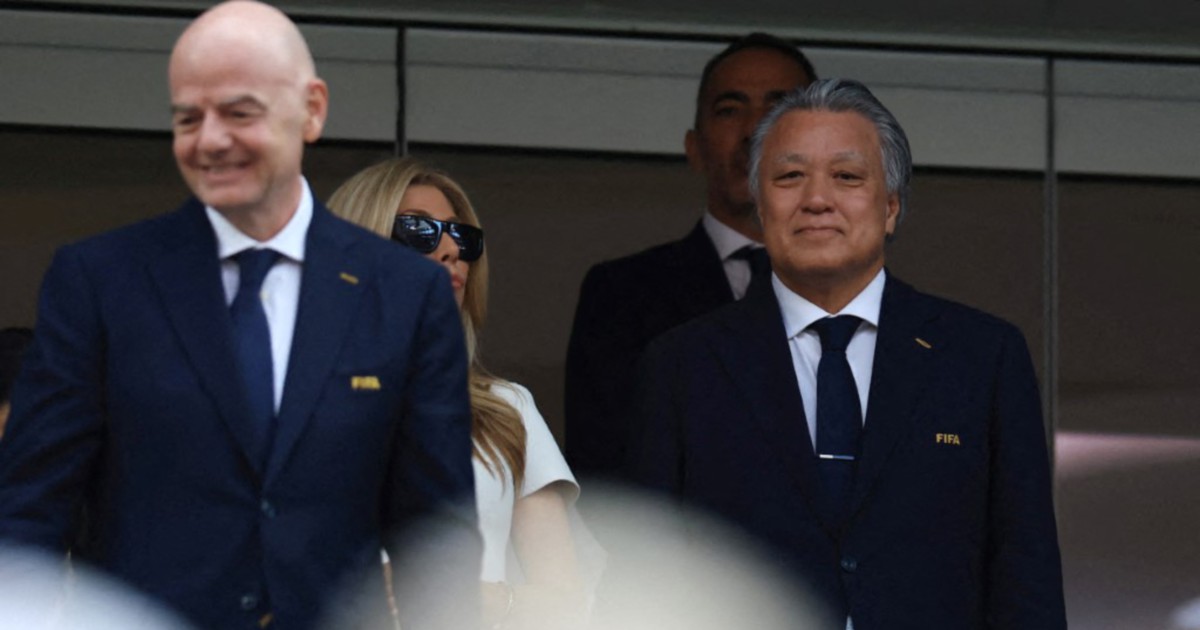

KOZO Tashima’s declaration last week that he would stand against Gianni Infantino in next March’s FIFA presidential election came as a surprise, but is the latest sign of dissatisfaction within Japanese football at the state of the sport’s governance.
The move comes in the wake of Takeshi Okada’s resignation from his role as a Japan Football Association vice-president last month.
Okada, who coached Japan at the 1998 and 2010 World Cup finals, quit citing concerns over developments surrounding FIFA and the World Cup, and his announcement was made in the aftermath of the Asian Football Confederation declaring its support for Infantino’s reelection.
Tashima, currently the JFA’s honorary president after eight years as president, has vowed to self-fund his challenge and his move underscores the mood within a country that has established itself as Asia’s on-field leader of the sport.
The 68-year-old has played a central role in that rise and had already voiced his opposition to Infantino’s FIFA Forward Enterprise several months before confirming his intention to stand against the incumbent.
In August, Tashima told Nikkei Shimbun he viewed the plan to sell a stake in the sport to private investors as “unacceptable both in terms of its decision-making process and its substance”, declaring the proposal “flawed.”
Infantino has accepted that he made mistakes in the way he communicated the FFE plan and indicated he would be open to an independent review of FIFA’s governance system.
Tashima accepts that his chances of unseating Infantino are at best around 30% and that he has yet to secure the necessary backing of five national federations.
“It is not about winning or losing, but about making clear to the world what honesty, soundness and integrity Japanese football has built,” he said when announcing his candidacy.
“I believe this is exactly what FIFA needs now.”
Infantino’s now abandoned efforts to sell off commercial rights of FIFA properties did not sit comfortably with how Tashima, a former player, coach and administrator, views the game.
SEVEN CAPS FOR JAPAN
Tashima has been involved in the sport since his youth, captaining Saitama Municipal Urawa Minami High School to the prestigious All Japan High School Championship in 1976 before going on to study at the University of Tsukuba.
While at college he gained the first of seven caps for Japan playing as a forward and, after graduating, joined the Furukawa Electric club in the Japan Soccer League, the amateur predecessor to the J.League.
Tashima retired from playing in 1982 aged 25 and went on to study coaching in Cologne before returning to Japan to work extensively in the sport, first on the technical side and then in a series of administrative and political roles.
He coached Japan’s team at the FIFA Under 17 World Cup in 2001, while in 2002, following the country’s co-hosting of the World Cup, he was named the JFA’s technical director.
Tashima took over as the national body’s general secretary in 2006, became the JFA’s vice-president in 2010 and, in 2015, was elected to the FIFA Council.
His rise continued when, a year later, he won the first of a record four consecutive two-year terms as JFA president, gaining a reputation as a trusted and decisive leader capable of making important decisions.
Tashima was called upon to do that when he fired Vahid Halilhodzic as Japan coach two months before the 2018 World Cup in Russia, replacing the Bosnian with Akira Nishino.
Nishino went on to lead Japan to the last 16.
Now Tashima is seeking a change at the helm of FIFA, with Infantino in his sights.
“Selflessness is my motto. That’s what it means to be the head of FIFA,” he told Sports Nippon in an interview at the weekend. —