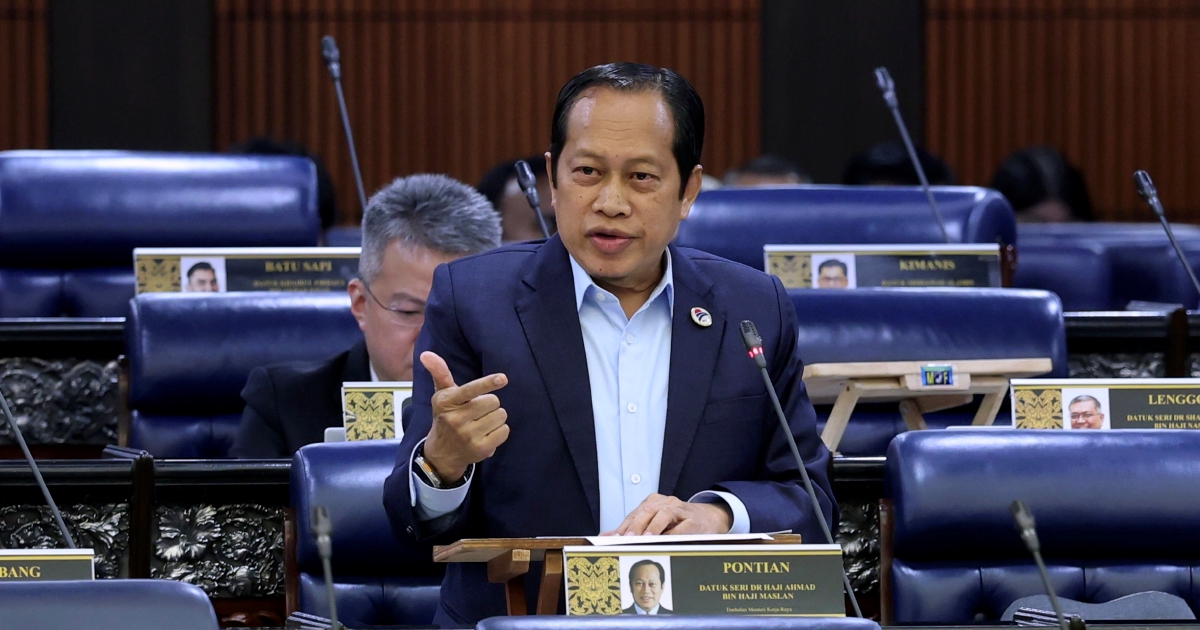

KUALA LUMPUR: The Works Ministry received only about half of the RM5 billion to RM6 billion it sought for road maintenance, Deputy Works Minister Datuk Seri Dr Ahmad Maslan told the Dewan Rakyat.
He said the ministry received RM2.68 billion in 2026, while RM2.59 billion was approved for 2027.
Ahmad said the shortfall was among the reasons road maintenance and resurfacing works nationwide could not be carried out to the extent required.
“When honourable members raise the issue of roads that have not been fully paved or need resurfacing, one of the causes is budget constraints.
“It is not that the ministry did not apply. We applied for between RM5 billion and RM6 billion, but received only about RM2.5 billion, which is half of what is needed,” he said.
He was winding up for the Works Ministry during the committee-stage debate on its 2027 Budget allocation.
Ahmad said the Finance Ministry and the Economy Ministry should take note of the shortfall to ensure actual maintenance needs were considered when allocations were drawn up.
“I do not intend to blame any party, but it is important for the Finance and Economy ministries to look at the overall budget needs that are very important to the people, especially road maintenance,” he said.
He said although the Works Ministry received the highest development allocation among the 28 ministries, the amount was still insufficient to meet all its needs, particularly road maintenance.
Ahmad said the ministry’s road maintenance allocation was RM1.6 billion in 2021, RM1.17 billion in 2022, RM1.71 billion in 2023, RM2.39 billion in 2024, RM2.99 billion in 2025 and RM2.68 billion in 2026.
On alternative approaches to road paving, he said the ministry, through the Public Works Department’s Centre of Excellence for Engineering and Technology (CREaTE), was researching more durable paving materials.
These included mixtures using crumb rubber, rubber from gloves and discarded plastic.
However, he said the cost of using such materials remained higher than conventional paving because they were not yet widely used.
“Still, when we want to implement it, the cost of the materials is rather higher than ordinary paving. That is another constraint.
“However, if the allocation is sufficient, all these matters can be resolved,” he said.