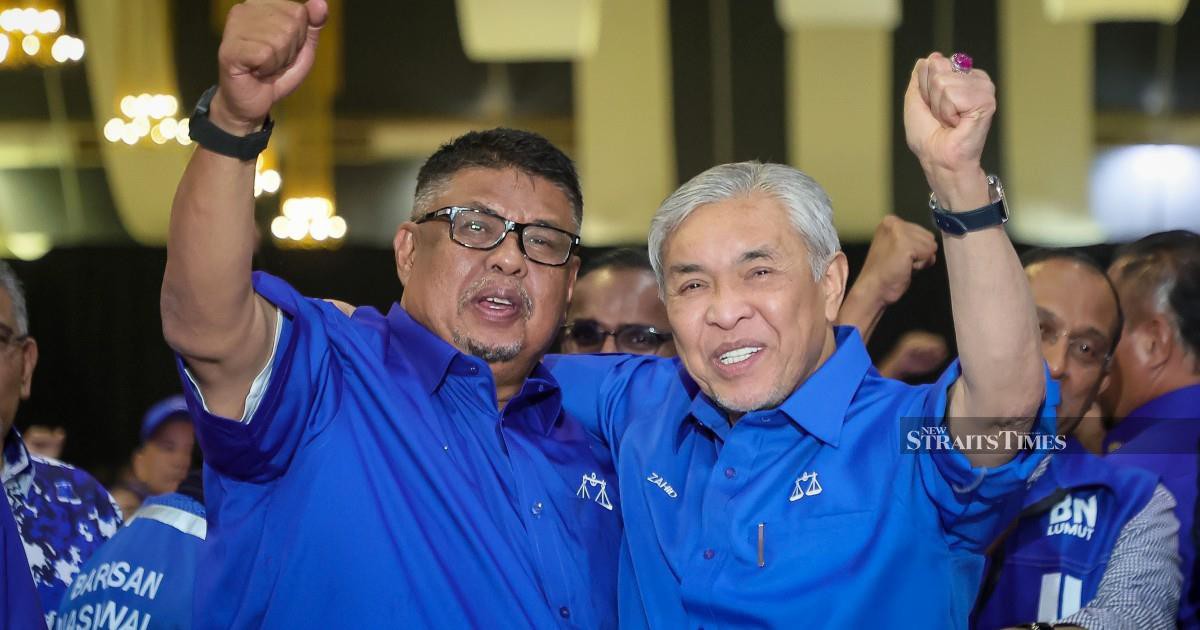

THE Nov 14 Melaka state election delivered a verdict, but its deeper political meaning deserves careful examination.
Official Election Commission results gave Barisan Nasional (BN) 21 seats, Perikatan Nasional (PN) three and Pakatan Harapan (PH) four in the 28-member assembly.
The electorate has determined who holds legislative power; the harder question is how that power will serve the public.
BN alone exceeded the simple-majority threshold. Together, BN and PN command 24 seats, surpassing the two-thirds benchmark.
This provides legislative strength, not an unlimited mandate. Power without responsibility resembles a grand house without supporting pillars: impressive from outside, vulnerable within.
For Umno, the outcome highlights the continuing relevance of grassroots organisation, administrative experience and community relationships.
Its electoral performance may inform discussions ahead of the 16th General Election (GE16), but Melaka cannot serve as a mechanical national forecast.
Candidates, local concerns, demographic patterns and political circumstances differ across constituencies and states.
PH, including DAP, must examine why its representation stands at four seats despite its continued support in several constituencies.
Bersatu and Bersama likewise face questions about their electoral reach, organisational effectiveness and capacity to address public priorities.
Such scrutiny should examine actual results rather than presume that every voter shares a single motive. Electoral defeat invites reflection, not convenient explanations that dismiss the electorate.
Debates surrounding Muslim political unity also require proportion. Appeals to solidarity may help explain cooperation, yet political differences cannot automatically be characterised as hostility towards the ummah.
Divisive rhetoric carries risks for every party. As the familiar proverb warns, those who sow the wind may reap the whirlwind.
Citizens are entitled to assess practical solutions, social cohesion and fulfilled commitments rather than the volume of partisan accusations.
On election night, BN and PN announced their intention to continue political cooperation in forming Melaka’s government.
They also agreed to nominate Datuk Seri Dr Ab Rauf Yusoh for another term as chief minister, with the nomination to be conveyed to the Yang di-Pertua Negeri.
This marked a proposed transition from electoral Tafahum Siyasi to an arrangement for governing together.
The constitutional distinction matters. A campaign understanding does not replace the procedures governing executive appointment or the requirement for legislative confidence.
The Yang di-Pertua Negeri’s constitutional role must be respected. Ab Rauf was sworn in on Nov 15, completing the formal appointment process. The administration must now translate coalition agreement into accountable delivery.
[[nid:1578808]]
The implications for GE16 extend beyond Melaka. Umno organisations in Selangor, including Bangi, have reason to strengthen factual public communication and listen to residents in villages and urban neighbourhoods.
Young people, farmers, small traders and workers face concrete concerns: living costs, employment, housing and essential infrastructure.
Their experiences cannot be reduced to campaign slogans or assumptions about party loyalty.
Public policy should therefore take precedence over triumphalism. Transparent procurement, dependable services, balanced investment and responsive constituency representation offer measurable tests of political performance.
A commanding majority can facilitate implementation, but it also increases the responsibility to preserve legislative scrutiny and institutional checks.
Stability is valuable only when accompanied by fairness and results.
Malaysia’s constitutional settlement requires protection of Islam’s position, the rights of Malays and Bumiputera, and the lawful rights of every community.
Upholding these provisions does not require ethnic antagonism. Responsible leadership can defend constitutional commitments while maintaining mutual respect and equal access to lawful public services.
Political developments in Sabah, Johor, Negeri Sembilan and Melaka may shape broader discussions, but momentum is not a guarantee of future victory.
Elections occur under distinct conditions. Treating one state’s outcome as an inevitable national trend risks confusing political enthusiasm with evidence.
The real examination begins after the celebrations fade. The public will judge whether leaders maintain clean administration, distribute development fairly and address everyday hardship.
A coalition adept at counting seats must also count the burdens borne by households. Otherwise, today’s success can become tomorrow’s uncomfortable lesson.
Datuk Seri Dr Ahmad Zahid Hamidi’s reported reminder against arrogance captures an essential responsibility. Victory should encourage gratitude, humility and renewed service, not complacency or entitlement.
Melaka’s voters have conferred authority through the ballot box. Respecting that authority means honouring constitutional institutions, accepting scrutiny and delivering on promises.
The measure of this political outcome will be governance, not applause.
- The writer is a political and economic analyst