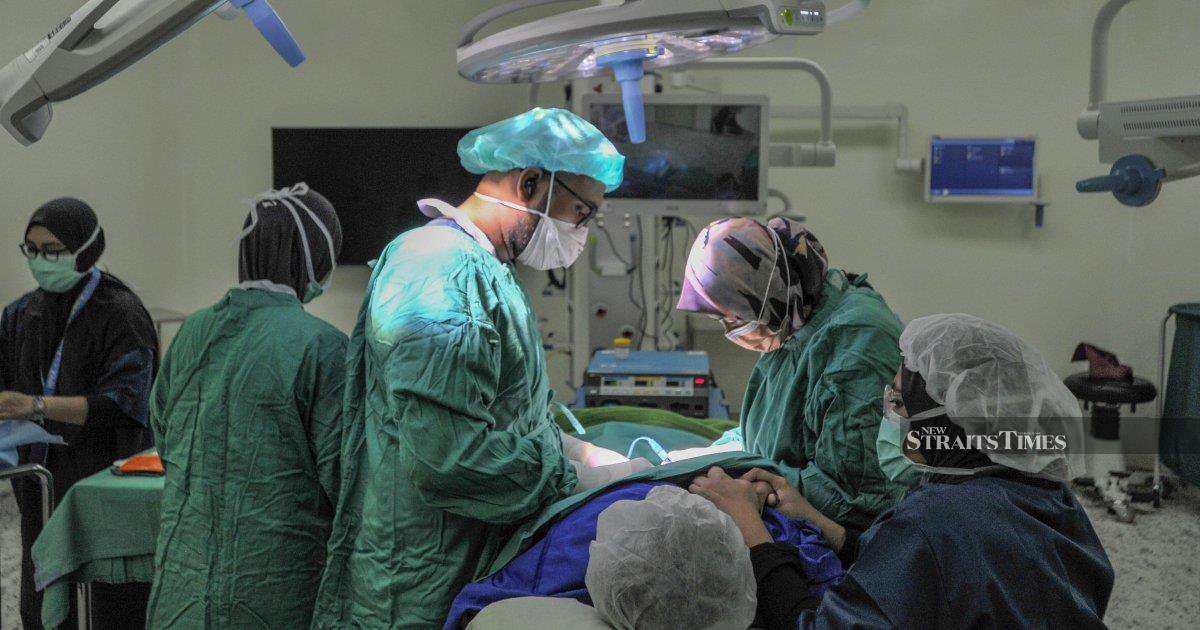

KUALA LUMPUR: Only 19 cardiothoracic surgeons are currently serving at six of the seven Health Ministry hospitals offering heart surgery.
Health Minister Datuk Seri Dr Dzulkefly Ahmad said 37 medical officers were undergoing specialist training, comprising four under Universiti Teknologi Mara’s Master of Surgery programme and 33 through the parallel pathway.
He was responding to Dr Ahmad Yunus Hairi (PN-Kuala Langat), who proposed easing entry requirements for cardiothoracic specialist training to address the nationwide shortage.
Yunus cited the resignation of the ministry’s head of cardiothoracic surgery services, Dr Basheer Ahamed Abdul Kareem, on Oct 23.
He also referred to the ministry’s target of producing 800 medical specialists and 700 dental specialists annually, supported by an allocation of RM165 million, as well as RM239 million for specialist training scholarships for medical and dental officers.
“How many cardiothoracic specialists do we plan to train, and how many scholarships can be provided for this expertise?
“The government should ease the admission of medical officers for cardiothoracic specialisation training,” he said while debating the ministry’s allocation at the committee stage.
Winding up the committee-stage debate on the Health Ministry’s allocation under the Supply Bill 2027 in the Dewan Rakyat today, Dzulkefly said cardiothoracic surgery was a highly specialised service requiring support from anaesthetists, cardiologists, perfusionists and trained personnel, including operating theatre nurses.
He said the service was provided regionally, with specialists travelling to hospitals without resident cardiothoracic surgeons to perform operations.
The ministry’s current strategy was to strengthen its seven existing cardiothoracic centres, prioritising hospitals with no resident specialist or only one, including Hospital Raja Perempuan Zainab II and Hospital Queen Elizabeth II.
In the short term, the ministry was using its Hospital Services Outsourcing Programme for cardiology and cardiothoracic services to meet demand for heart surgery.
Dzulkefly said amendments to the Medical Act 1971 had also resolved registration issues faced by specialists returning from overseas training, including those under parallel pathway programmes.
The Medical (Amendment) Act 2024, gazetted in October 2024, allows specialists trained under the ministry’s parallel pathway programme to apply for inclusion in the National Specialist Register through the Malaysian Medical Council.