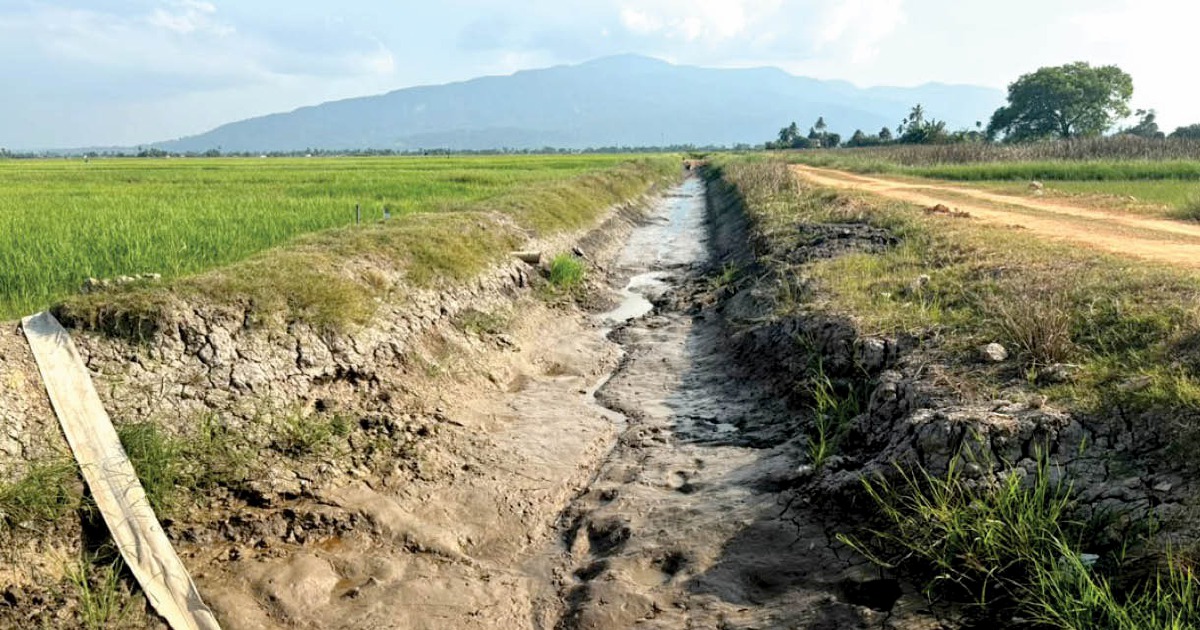

KUALA LUMPUR: Recurring water shortages in Malaysia’s main rice-growing region expose longstanding weaknesses in its irrigation system, with experts warning that El Niño alone cannot explain the crisis.
They said rising irrigation demand, inefficient water management and repeated reservoir depletion had left the system increasingly vulnerable, threatening padi production.
Universiti Utara Malaysia (UUM) water resources expert Chong Kai Lin said water storage at Pedu Dam had fallen sharply before El Niño was expected to develop this year.
Pedu Dam’s storage stood at 39.89 per cent in March, despite La Niña conditions in February, which are generally associated with increased rainfall.
El Niño, which brings drier conditions, was expected to develop between June and August.
“Although El Niño may have intensified the decline, it cannot fully explain why reservoir storage had already reached a constrained level before the event developed,” she said.
Chong said previous shortages showed the problem was longstanding. Pedu Dam’s storage fell to 33.84 per cent in October 2016 and 33.21 per cent in August 2024.
She said low rainfall was only one factor, as reservoir levels were also affected by water releases, irrigation demand, evaporation and other losses.
Between June 18 and Sept 17, storage fell by about 67 million cubic metres to 36.99 per cent. Chong cautioned that the decline alone did not establish whether leakage or wastage was to blame.
She called for a comprehensive water audit to track inflows, releases and losses.
She also cautioned against relying on cloud seeding, as there was no guarantee that rainfall would reach the targeted dam catchments.
“Super El Niño is a warning and an aggravating factor, but it should not become a convenient single explanation for a recurring structural problem,” she said.
Universiti Utara Malaysia (UUM) food security expert Dr Bakri Mat said decades of rising irrigation demand, particularly after the expansion of double cropping, had placed mounting pressure on the system.
Double cropping is the practice of growing two successive rice crops on the same land within a year.
Citing a 1989 study by Japanese researcher Dr Yoshinobu Kitamura, Bakri said the Muda and Pedu reservoirs had repeatedly reached full capacity before 1975. This pattern ended after double cropping expanded to more than 90 per cent of the Muda irrigation area.
The study found that depleted reservoirs prevented irrigation for the 1978 off-season crop, while only half the area could be irrigated in 1983 and 1984.
Bakri said double cropping had increased water demand, leaving the system more vulnerable to prolonged dry spells and erratic rainfall.
“Even in normal conditions, the margin of water security becomes smaller. When there is a long dry spell, erratic rainfall or a phenomenon like El Niño, this pressure becomes clearer,” he said.
He said the authorities must assess the entire irrigation network, from rivers and canals to farm drainage and field-level water management, rather than focus solely on reservoir storage.
“We need to look at the whole water chain, from the dam, rivers, main canals, secondary canals, farm drains and field water control, down to the water-use practices of the farmers,” he said.
Bakri proposed recycling surplus water between padi fields, improving canal management and using digital monitoring to reduce reliance on reservoir supplies.
“Surplus water from one area of padi fields can be reused in another if the drainage, pumps and water gates are managed well,” he said.
He warned that repeated planting disruptions could force smallholders to reduce cultivation or leave fields idle, undermining rice production.
“If this issue is not tackled structurally, Malaysia will face not just water problems for farmers, but also long-term risks to rice self-sufficiency, food price stability and national food security,” he said.