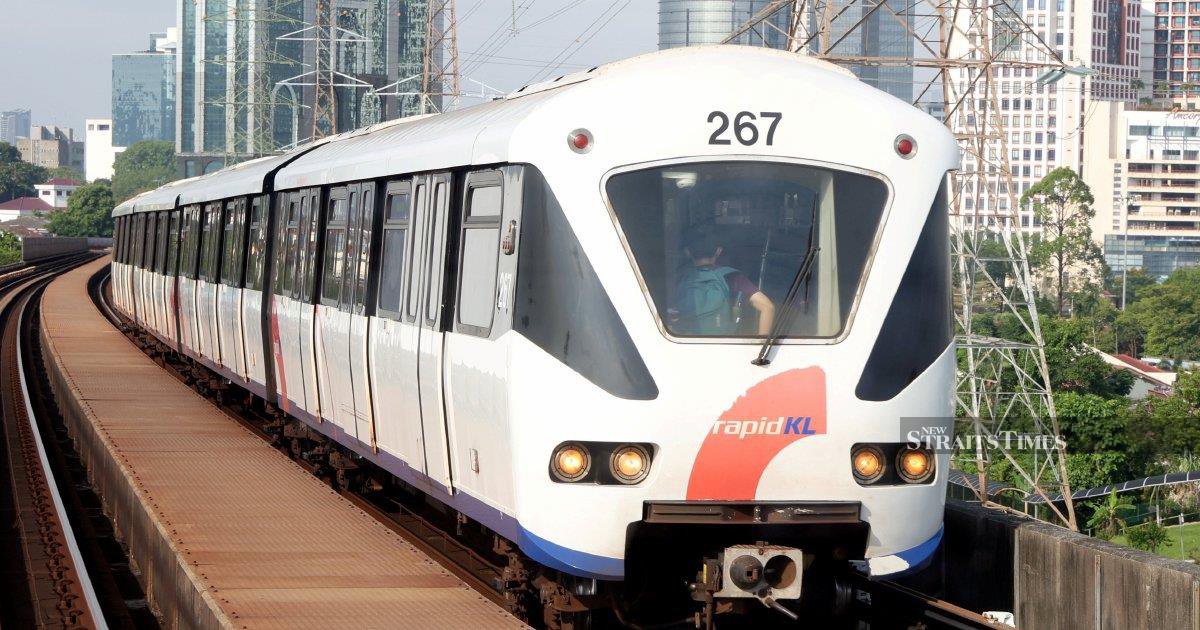

KUALA LUMPUR: Commuters on the Kelana Jaya LRT Line have railed over increasingly frequent service disruptions.
A passenger, Hijanah, said the service had become less reliable than it was last year.
She said service disruptions often resulted in overcrowded trains and longer journeys home.
“Sometimes, after finishing work at 6pm, I only get home at 8pm because the trains are too crowded,” she said.
Checks by the New Straits Times at major stations along the line, including Pasar Seni, KLCC and Masjid Jamek, found heavy passenger congestion between 7am and 9am.
Despite the congestion, trains arrived at intervals of about five minutes during peak hours.
The journey from Ampang Park to Pasar Seni typically takes about 11 to 15 minutes, although delays can extend travel time.
Cecilia Jayakumari said train breakdowns often forced her to seek alternative transport, including buses to connect her to other rail services.
Another passenger, Ahmad Aziman Abdul Aziz, who has used the line since 2022, said disruptions had become more frequent after a relatively stable period between 2022 and 2024.
Aziman travels from Seksyen 7, Shah Alam, to his workplace near KLCC, a commute that takes about an hour and 20 minutes in total.
He rides the Shah Alam Line (LRT3) before transferring to the Kelana Jaya Line at Glenmarie.
He said he experienced delays on one or two days during a typical five-day working week, with disruptions sometimes occurring throughout the week.
He also recalled seeing passengers lose their balance when trains came to sudden stops.
“If there were another line that could take me to KLCC without having to travel too far, I would not mind using it.
“But I have no choice because this is the most practical route for me,” he said.
Siti Syafiqah Nabilah Abdul Hadi, a commuter travelling from Subang Jaya to KLCC, said poor communication during train disruptions and frequent boarding issues were commonplace.
“Sudden emergency braking also feels like a new norm, with passengers losing their balance or even falling. It feels like nobody cares, and this is now something we expect when taking the train,” she said.
Having recently returned to work after maternity leave, Syafiqah said she spent over RM600 monthly on Grab rides home, with fares reaching RM70 during peak hours.
“I feel really stressed because I have a baby to pick up from the babysitter after work. If I am late, I have to pay extra, and I also feel bad about being away from my baby for so long,” she said.
Passengers have also taken to social media to highlight the problems, sharing videos of rush-hour congestion and complaining about sudden braking.
Prasarana Malaysia Bhd acting president and group chief executive officer Dr Prodyut Dutt has acknowledged that the Kelana Jaya Line faced greater reliability challenges this year.
He said the company was stepping up efforts to improve services through round-the-clock maintenance, closer cooperation with suppliers and the introduction of new train sets.
“From January to August 2026, the Kelana Jaya Line recorded one incident for every 749km travelled, compared with one incident for every 1,066km during the corresponding period last year.
“That represents a deterioration of about 30 per cent,” he said in a Bernama report last month.
Prasarana is investing more than RM3.4 billion in a comprehensive overhaul of its rail services, an initiative announced by Prime Minister Datuk Seri Anwar Ibrahim when tabling the 2027 Budget on Oct 9.